



Regardless of whether it’s democracy or communism, people should not be overly obsessed with worshipping their leaders. Blind support, which often leads to absurd loyalty, would produce dictatorships, which in turn have a habit of slipping into a comedy show. In 1937, after Joseph Stalin delivered a speech at a Communist Party conference, the hall erupted in applause.
Party officials jumped to their feet and began clapping enthusiastically. But after a few minutes, an awkward problem emerged – who would dare stop clapping first? No one wanted to be the first to sit down and risk appearing disloyal. And so, the applause continued – for 11 full minutes. Some Swedish researchers later found out something called “infection” of applause.
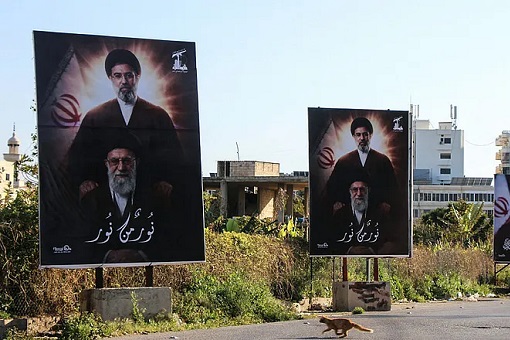
As the Iran War continues to escalate, people who have an ounce of intelligence are asking a simple, yet relevant question – where is Iranian new Supreme Leader Mojtaba Khamenei? The son of Ayatollah Ali Khamenei (who was killed in US-Israeli strikes) was announced as the new supreme leader on March 9. Yet, till today, the new Ayatollah has not made any public appearance.
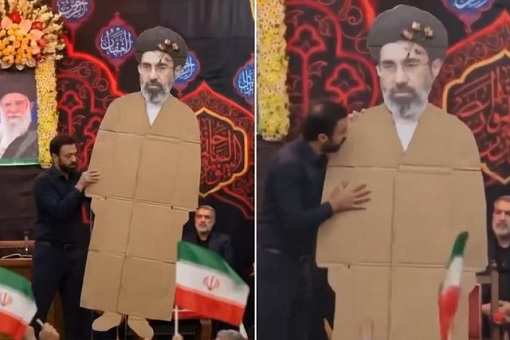
Rather, Tehran had its own comedic moment when a life-size cutout of Mojtaba Khamenei, held together with tape, was carried onstage to roaring crowds at the Tehran allegiance rally in Revolution Square. State media broadcast regime loyalists hailing and swearing allegiance to a cardboard Khamenei. The IRGC too pledges allegiance to the cardboard cutout.
According to Iranian state media, Khamenei sustained leg injuries in the initial U.S.–Israeli strikes on Iran. The injuries must be quite serious if a cardboard ayatollah cuts a more commanding figure than a wheelchair-bound Khamenei. The joke on the street is that Mojtaba is already dead, but the next guy on line says he will only take the job if he’s not mentioned anywhere.
It’s absolutely strange and puzzling that a new supreme leader did not appear at his own allegiance ceremony, especially after his dubious first official address in the form of a statement read out on state TV. Mojtaba vowed to keep the Strait of Hormuz closed and to avenge martyrs. Even if he was terrified of his own security, he could always make a pre-recorded video from a secured location to prove he is functioning, can he not?
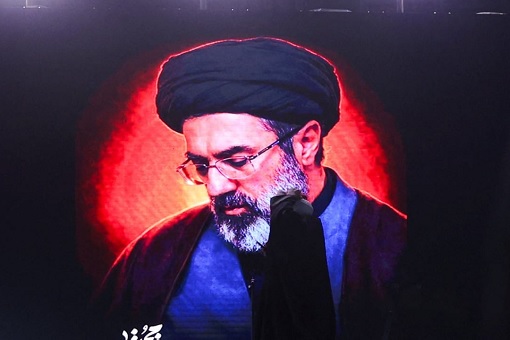
Leaked audio obtained by The Telegraph reveals that Mojtaba Khamenei was targeted in the same attack that killed his father and other members of the Islamic Republic’s leadership. But he had gone outside “to do something” moments before Israeli Blue Sparrow ballistic missiles hit his residence at 9.32am local time on Feb 28. As a result, he suffered an injury to his leg in the strikes.
Tehran claims Mojtaba sustained only “a minor injury to his leg”. If that’s true, he should be perfectly fine to make a film of himself to assure fanatic followers about his well-being. Even with the latest photographs, it is better than nothing. US Defence Secretary Pete Hegseth said that Khamenei had been “wounded and likely disfigured“, which makes more sense as to why the new supreme leader has yet to be seen in-person.
When even Osama bin Laden had made some video and audio messages while hiding in the mountainous regions of Afghanistan and the Afghanistan-Pakistan border, exactly what is so hard for Ayatollah Mojtaba Khamenei to do the same while hiding in a high-security underground bunker in Iran? Even if he has fled to Russia, he still can work from home and pretend as if he is still in Iran.
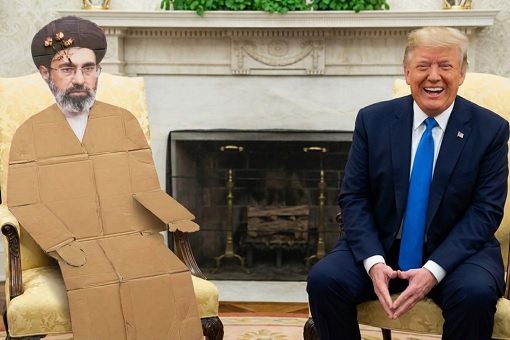
Hilariously, none of Ali Khamenei’s other children has appeared publicly since the Israeli strikes, and none has issued congratulatory messages or pledges of allegiance when Mojtaba was selected as supreme leader – leading to suggestion that Mojtaba is in coma at best, and at worst, more badly injured than Iran will admit. Trump says he thinks Iran’s new supreme leader is alive but “damaged”.
U.S. intelligence assessments suggest Ali Khamenei had reservations about his son succeeding him. He considered Mojtaba to be “not very bright” and “unqualified to be leader”. There were also rumours of problems in his private life, having sought treatment for impotence during multiple visits to private hospitals in the United Kingdom. The New York Post claimed that U.S. intelligence had told Mr Trump that Ali Khamenei was probably gay.
The theory is that Mojtaba is definitely incapacitated, but is being used as a “poster boy” to hoodwink the Iranians and scam the Americans whilst the powerful Islamic Revolutionary Guard Corps (IRGC) security forces exerting greater control under another leader. Mojtaba Khamenei probably does not even know that he had been crowned as the Supreme Leader.
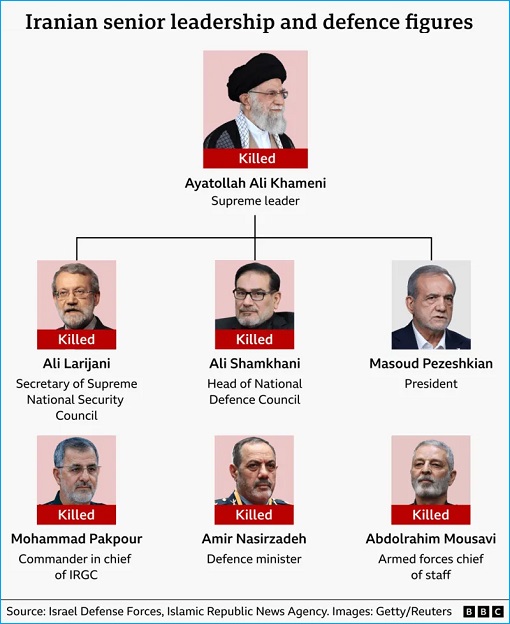
But it doesn’t matter what actually happened to the supreme leader. Israel, determined to wipe out every Iranian regime members – one by one – had launched air strikes that killed Iran’s top security official, Ali Larijani, and the head of the paramilitary Basij force, Gholamreza Soleiman on Tuesday (March 17). Iranian authorities have confirmed the deaths of both men, as well as Larijani’s son and bodyguards.
Larijani is the most senior Iranian official to have been assassinated since the Supreme Leader, Ayatollah Ali Khamenei, was killed on the first day of Israeli and U.S. strikes on 28 February. Following the elimination of Khamenei, Larijani consolidated his status as the de-facto leader of the Iranian regime and led the combat efforts against Israel and Gulf countries across the region.
Unlike Mojtaba Khamenei, Larijani was filmed – strolling confidently in dark sunglasses and a black coat – with supporters of the Islamic Republic at the Quds Day demonstration in Tehran last Friday. Four days later, he was dead. Early Tuesday morning, Israel’s intelligence services found Larijani gathered with other officials at a hideout on the outskirts of Tehran and killed him with a missile strike.
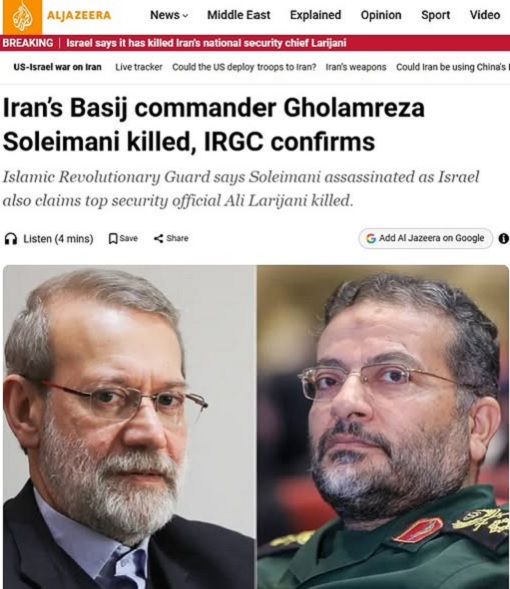
That same night, Israel got a tip from ordinary Iranians that the leader of the feared Basij militia, Gholamreza Soleimani, was holing up with his deputies in a tent in a wooded area in Tehran. Israel’s tactic works like a charm – blowing up Basij headquarters and command posts for more than two weeks, forcing its members to gather out in the open. Like a sitting duck, Soleimani was struck and killed.
The killings on early Tuesday – followed by the Israeli announcement a day later that Iranian Intelligence Minister Esmail Khatib had also been killed – were milestones in that campaign made possible by the fast-accumulating damage from airstrikes and a growing harvest of intelligence about possible targets. With thousands of regime members killed – from top leaders to street-level grunts – Iranians are reporting a sense of disorder.
Security forces of the Iranian regime – long targeting and oppressing ordinary Iranians – are under stress and on the run as they threaten protesters to stay off the streets. Since the war began on March 28, Israel has been chasing security forces from their headquarters to muster points then all the way to hideouts under bridges in an effort to disrupt their activity and show Iranians that the enforcers are being taken out.
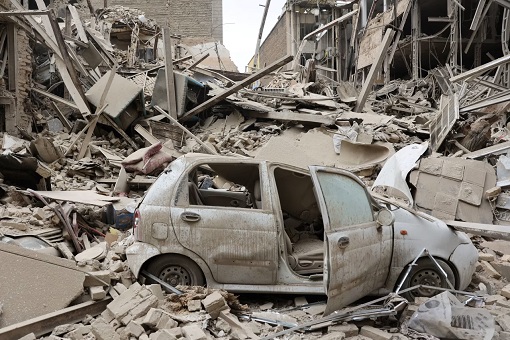
So far, Israel says it has dropped 10,000 munitions on thousands of different targets, including more than 2,200 related to the Islamic Revolutionary Guard Corps, Basij and other internal security forces. It believes thousands have been killed or wounded. The advanced technology deployed by Israel and the penetration of Iranian society by its agents have created the greatest threat to the regime.
Working hand-in-glove with the U.S., they first killed Supreme Leader Ali Khamenei, then quickly destroyed most of Iran’s missile launchers and wiped out its air defences, not to mention the Islamic Republic of Iran Navy. Then they divided responsibilities. The U.S. focused on Iran’s military and industrial power, and Israel went after the structures of internal control in earnest.
By the second day, Israeli warplanes were already systematically hitting headquarters and command centers related to the Revolutionary Guard’s domestic security arms, the Basij militia and special police forces. The Israeli forces targeted everything, from the Tharallah -the Revolutionary Guard unit responsible for protecting the capital – down to neighborhood police stations in Tehran.
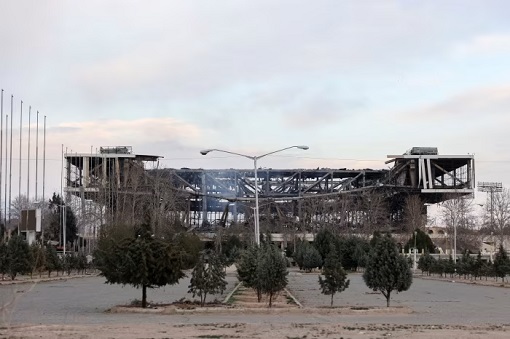
Israeli intelligence also learned that Iran had a cunning fallback plan for its internal security forces in the event their facilities were destroyed – mustering at local sports complexes. When a missile strike destroyed the 12,000-seat indoor arena at Tehran’s Azadi sports complex on March 5, Israel watched with popcorn as it killed hundreds of members of the security services and military.
The stunning strike shocked Iranian security personnel, who pushed into Gandhi hospital in Tehran and forced patients to make room for their wounded. As expected, Tehran condemned the strikes on civilian targets, with Iranian state media happily published pictures of the aftermath but conveniently didn’t mention the presence of security forces.
The air attacks were so effective and devastating that they hurt rank-and-file morale and drove some security forces to begin sleeping in their vehicles, mosques or other sports facilities. Using psychology tactics, Israeli intelligence officials also began placing calls to individual commanders, threatening them and their families by name if they didn’t stand aside in the event of an uprising.
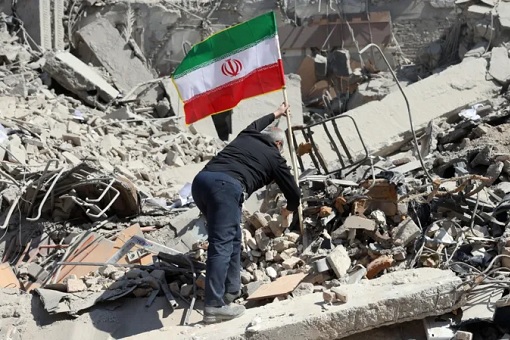
On the ground, Israel went after police warehouses, destroying computer equipment, vehicles, and police gear. Another target was motorcycle units, which have been central to efforts to suppress protests. Israel’s air force also began operating fleets of loitering drones above Tehran and other areas of Iran, shifting its focus from command centers to individual Basij checkpoints and roadblocks.
Israel has successfully created a climate of fear with its air war – sparking disruption in command and control and harming morale in the security forces. Heck, Iranians said they have seen security forces scramble for safe workspaces while hunted by Israeli jets and drones, taking over schools and sports facilities and civilian buildings.
Other residents said many security officers are hiding in residential buildings. When they move in, the neighbors evacuate, fearing a strike. As Iran’s security forces still have control of the street, many Iranians said it would be suicide to rise up now. However, Israel believes Iran’s crumbling economy and popular anger have put the regime on an irreversible path to collapse.
Other Articles That May Interest You …
- Strategic Error – How Iran’s Retaliatory Strikes At Gulf States Backfires
- Live By The Sword, Die By The Sword – How Ayatollah Khamenei Was Killed
- Iran Panicking – Armada Is Ready And Trump Could Strike Anytime
- Revolution – How One Man Rallies Iranians To The Street
- From Robot Wolves To Satellite Killer – How China’s Military Parade Sends A Message That Annoys Trump
- Gone In 25 Minutes – How Trump Tricked Tehran Twice Before Obliterated Iran’s 3 Nuclear Sites With MOPs
- Iran’s “Axis Of Resistance” Missing In Action – Why Tehran Became Isolated & Alone In WAR Against Israel
- Iran On Fire – Khamenei Should Flee To Russia While He Can Before US-Israel Upcoming Surprise
- Paying The Price For Hamas Attacks – How Trump Misled Iran Before Israel Sends 200 Jets To Attack
- Psychological Warfare – How Mossad Cracked Hezbollah Secret Network With Low-Tech Pager & Walkie-Talkie “Walking Bombs”
- China Has Spoken – If US-South Korea Strikes North Korea, We Will Defend Kim

|
|
March 19th, 2026 by financetwitter
|


|

|

|

|

|

|




















Comments
Add your comment now.
Leave a Reply