



For most of the day on Saturday, despite the stunning military strike unleashed by the U.S. and Israel on Iran, tourists and residents relaxed on Dubai’s Palm Jumeirah, tanning on the man-made beaches and throwing birthday parties for their children. Even incoming Iranian missiles being intercepted over the Persian Gulf did not create any panic. It was business as usual.
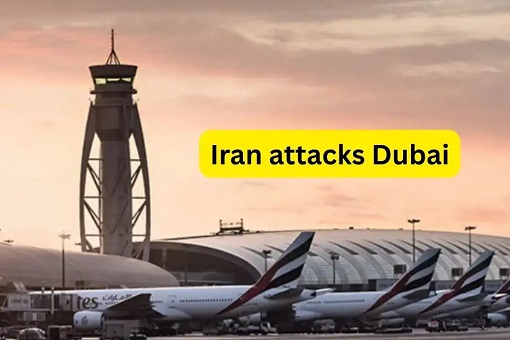
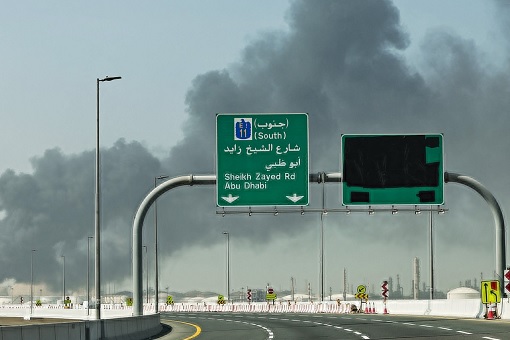
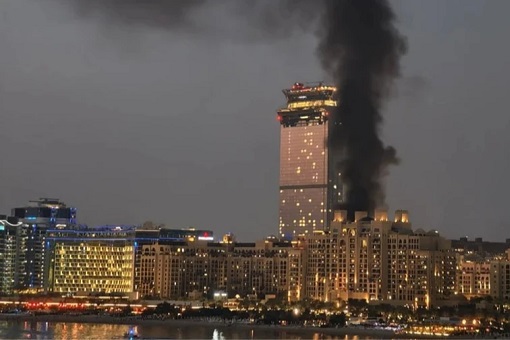
But just after dusk, everything began to change. A luxury hotel in Dubai was hit as Iran blindly launched retaliatory strikes across the Middle East. Thick black smoke rises into the sky as a fire raging at Fairmont The Palm Hotel in the United Arab Emirates’ largest city. The next day, in the early hours of Sunday, four people were wounded in an “incident” at Dubai International Airport – a major transport hub.
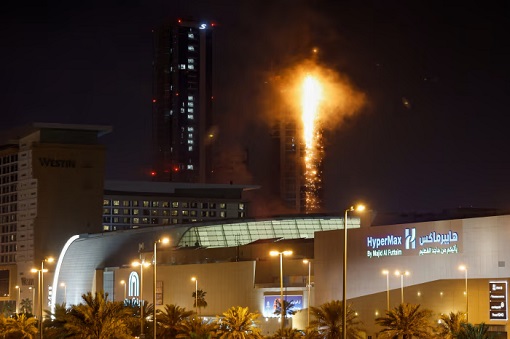
Video from Bahrain’s capital, Manama, shows the moment a drone hits a tower block, exploding into a brilliant yellow fireball. Bahrain’s Ministry of Interiors said that three buildings in Manama and Muharraq were hit by “drone attacks and falling debris from an intercepted missile.” In Kuwait, a drone targeting the international airport caused “minor injuries to several employees” with “limited” damage to a terminal.
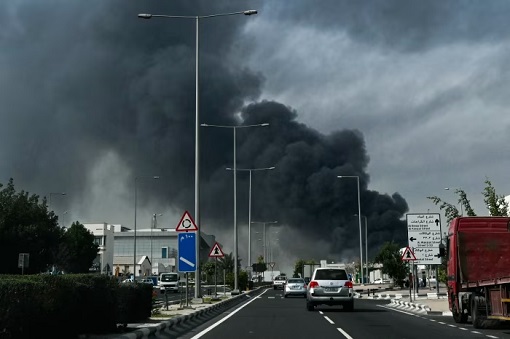
In Doha, Qatar, footage showed dozens of people fleeing from a falling missile in a residential area. Qatar’s Ministry of Foreign Affairs said it condemned the “targeting of Qatari territory with Iranian ballistic missiles”, which it said was “a flagrant violation of its national sovereignty” and an “unacceptable escalation”.
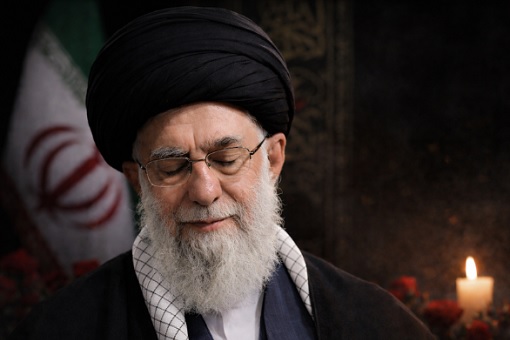
The Iranian regime, decapitated in the first hours of the U.S.-Israeli campaign that saw Supreme Leader Ali Khamenei killed on Saturday, has responded by striking at least nine countries across the Middle East. The apparent calculation was that, by targeting rich Persian Gulf monarchies that hold sway with the Trump administration, Tehran could force Washington and Israel into a rapid de-escalation.
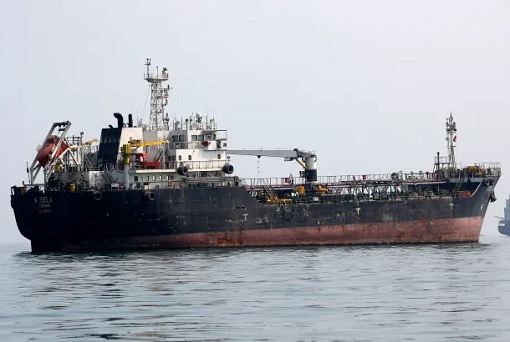
Iran’s expectation was that, by squeezing oil shipping through the Strait of Hormuz and disrupting air traffic, it would cause unbearable pain to the Gulf nations that depend so much on expatriate workers, tourism and overseas trade. The regime thought by violently dragging its rich neighbours into the conflict, U.S. President Trump could be pressured to end the military campaign.
However, this calculus seems to have backfired. Gulf states, rattled by volleys of Iranian drones and missiles targeting their hotels, ports and airports, are concluding the Iranian peril must be confronted. Rather than seeking an offramp, the prevailing mood in the Gulf – at least for now – is that the Iranian regime can’t be allowed to get away with this unprecedented onslaught on its neighbors.
“Iran is coming to the countries and people of the Gulf and saying: ‘You know what, I am actually your number-one threat.’ This has long-term implications, regardless of whoever is actually in power in Iran,” – Anwar Gargash, diplomatic adviser to the United Arab Emirates president, said in an interview. “Targeting Gulf states is completely irrational, and very shortsighted.”
Iran has struck all six of the oil-rich Gulf Arab states, including Oman, which had mediated nuclear talks between Tehran and the Trump administration. It also hit Jordan, Iraq and Israel. At first, all the Gulf states publicly opposed the U.S.-Israeli assault on the Iranian regime, which has already resulted in the death of Ali Khamenei and the killing of many Iranian military and intelligence commanders.
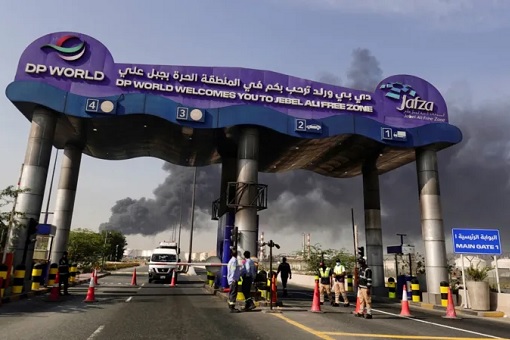
The mood changed quickly once the brunt of the Iranian response targeted cities such as Dubai and Abu Dhabi in the U.A.E., Doha in Qatar, and Manama in Bahrain, inflicting widespread damage to infrastructure and civilian casualties. In the U.A.E. alone, Iran killed three people and injured 58 after firing 165 ballistic missiles and 541 drones, most of which have been intercepted, according to the Defense Ministry.
“Many people in the Gulf woke up Saturday pissed off at the United States and Israel, and went to sleep pissed off at Iran,” – said William Wechsler, director of Middle East programs at the Atlantic Council in Washington. Saudi Arabia and the U.A.E., which were engaged in an acrimonious diplomatic quarrel until the weekend, put their disagreements aside for now as they showed a united front against Iran.
Iranian Foreign Minister Abbas Araghchi argued on Sunday that the escalating conflict wasn’t Iran’s fault and that if the Gulf states and other Middle East neighbours were angry, “they should be angry at the United States and Israel.” He tried to spin and twist Tehran’s idiotic strategy – “They shouldn’t pressure us to stop this war. They should pressure the other side.”
This approach worked in last year’s 12-day war, when limited Iranian strikes on Qatar led to the end of hostilities. “The Iranian strategy has been – if you can’t reach your main enemy, hit his allies, so that they pressure him,” – said Nikolay Kozhanov, a specialist on Iran at Qatar University. “Iran was sure that this psychological pressure works, that by scaring the Arab monarchs it can succeed. But, it looks like, this time around, the situation may be different.”
Indeed, the opposite is happening. The leading Gulf states have rapidly steered their foreign policy from one of rapprochement with Iran to something verging on accepting that regime change in Tehran could be welcome. “Whether that regime will or will not survive is something that’s up to the Iranian people, they have to decide, they have to live with the outcome,” – said Gargash of the U.A.E. “I don’t think it’s for us to decide.”
In Europe too, even though ties with the U.S. have frayed since President Donald Trump’s re-election, the initial apprehension over the attack on Iran has turned to tacit approval – especially after some Iranian missiles on Sunday were intercepted on their way to Cyprus, a member-state of the European Union.
Kaja Kallas, who leads the European Commission’s foreign and security policy, described the killing of Khamenei as “a defining moment in Iran’s history.” She said – “What comes next is uncertain. But there is now an open path to a different Iran, one that its people may have greater freedom to shape,” There is little appetite among European leaders to confront Trump over Iran, despite the fraying of the trans-Atlantic alliance over his claims on Greenland.
To them, Europe’s priority is to ensure, with American cooperation, the survival of Ukraine and the deterrence of Russia. “In Europe, we read the world through the lens of the Ukraine war, and for a good reason, as this is the most important issue for Europeans,” – said Nathalie Tocci, director of the Institute of International Affairs in Rome.
Germany, France and the U.K., which didn’t participate in the initial strikes on Iran, said on Sunday they “will take steps to defend our interests and those of our allies in the region, potentially through enabling necessary and proportionate defensive action to destroy Iran’s capability to fire missiles and drones at their source.”
With the U.S.-Israeli campaign against Iran focused almost exclusively on air power, it is unclear how the Iranian regime, which drowned recent protests in blood, could actually be dislodged without an uprising. Washington has to continue weakening the regime to assure ordinary Iranians that it is safe to start challenging the authorities.
“The best we can hope for is the Venezuela scenario,” – said Saudi political analyst Ali Shihabi, referring to the cooperation that the remainder of Venezuela’s regime established with the U.S. after the seizure of that country’s ruler, Nicolás Maduro, in January. “Frankly, it is a good scenario because that means the country stays together, you don’t have chaos, you don’t have civil war, you have a regime that has been neutered and modified,” Shihabi said.
Meanwhile, he added, Iranian attacks on Gulf states have removed any embarrassment that these monarchies had in cooperating with the U.S. military campaign. It is unlikely that Saudi Arabia, the U.A.E. and other Gulf states will just keep absorbing Iranian blows for long. One possibility is to start targeting missile and drone launch sites inside Iran.
“Rather than being passively defensive, we can be more actively defensive,” – said Gargash, the U.A.E. diplomatic adviser. “We have to look at what sort of conflict is shaping up. We also have our own capabilities, and the idea is that you want your response to be proportionate.” On Sunday, the U.A.E. closed its embassy in Tehran and withdrew its diplomats from Iran.
With industries such as tourism, air travel, real estate and finance beginning to supplement oil revenue, Gulf economies can ill afford the likelihood of the war ending with the Iranian regime still in place, and able to threaten them again with drone and missile attacks, many officials say. “Iran has crossed a line,” – said retired British Air Marshal Martin Sampson, executive director of the International Institute for Strategic Studies – Middle East in Bahrain.
Other Articles That May Interest You …
- Live By The Sword, Die By The Sword – How Ayatollah Khamenei Was Killed
- The War Begins – US & Israel Strike Iran To Topple Regime
- Iran Panicking – Armada Is Ready And Trump Could Strike Anytime
- Revolution – How One Man Rallies Iranians To The Street
- “Operation Narnia” Revealed – The Bold Attack On Iran That Israel Feared Could Not Succeed
- Gone In 25 Minutes – How Trump Tricked Tehran Twice Before Obliterated Iran’s 3 Nuclear Sites With MOPs
- Iran’s “Axis Of Resistance” Missing In Action – Why Tehran Became Isolated & Alone In WAR Against Israel
- Iran On Fire – Khamenei Should Flee To Russia While He Can Before US-Israel Upcoming Surprise
- Paying The Price For Hamas Attacks – How Trump Misled Iran Before Israel Sends 200 Jets To Attack
- Ran Out Of Luck And Place To Hide – Here’s How Israel Trainee Squad Accidentally Killed Hamas Mastermind Sinwar
- Psychological Warfare – How Mossad Cracked Hezbollah Secret Network With Low-Tech Pager & Walkie-Talkie “Walking Bombs”

|
|
March 2nd, 2026 by financetwitter
|


|

|

|

|

|

|



















Comments
Add your comment now.
Leave a Reply