



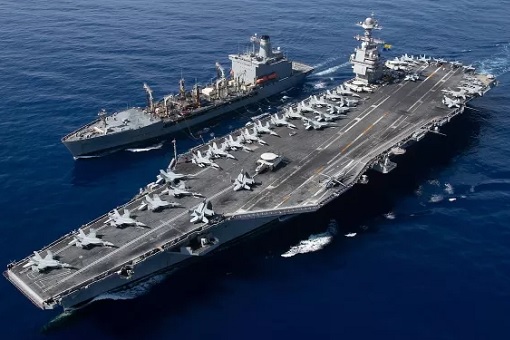
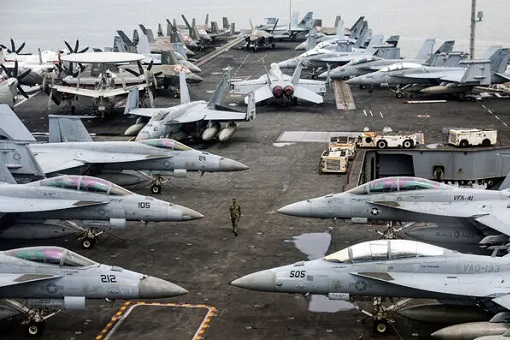
Fresh from taking out Venezuelan strongman Nicolas Maduro, the United States is now shifting attention to Iran. While Donald Trump may not give the order to abduct Ayatollah Ali Khamenei like how Maduro and his wife were kidnapped and brought to American soil to face charges, the sign before a military strike is the same – an armada of aircraft carrier along with other warships, bombers and fighter jets.
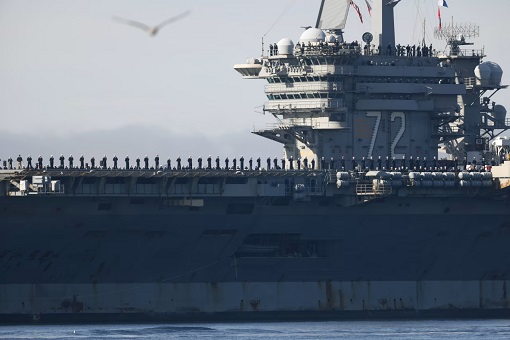
The U.S. military has assembled a formidable force in the Middle East within striking range of Iran. As warships and planes reach the region in growing numbers to join aircraft carrier Abraham Lincoln, the ball is in President Trump’s court to decide how and when to use it. Trump has warned Tehran that it is running out of time to negotiate a deal on nuclear weapons.
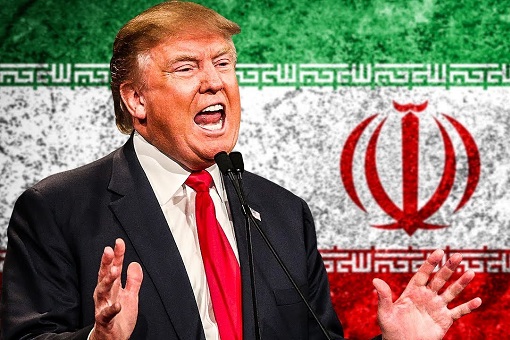
If Tehran does not agree to a set of demands the Trump administration had made of the country’s leaders, the Commander-in-Chief could soon mount an attack “with speed and violence.” Mr. Trump’s threat of a second direct attack on Iran by U.S. forces in eight months cannot be taken lightly. The last time a president who laughed at the U.S. forces assembled in the Caribbean Sea is now in the U.S. prison.
The specifics of the deal are unknown, but they are believed to consist of three key demands – a permanent end to all enrichment of uranium and disposal of its current stockpiles, limits on the range and number of their ballistic missiles, and an end to all support for proxy groups in the Middle East, including Hamas, Hezbollah and the Houthis operating in Yemen.
The White House could easily use the death toll from the recent street demonstrations in Iran to justify a military strike. Iran says the death toll was 3,117, but human rights groups say that the actual figures range from 3,400 to 6,200 – even higher in the tens of thousands. The only reason Trump has not given the green light to attack is because the administration officials are still debating.
They are debating whether the main aim is to go after Iran’s nuclear program, hit its ballistic missile arsenal, bring about the collapse of the government – or some combination of the three. What is clear is Trump does not want to risk a long-term war in the Middle East. The ideal option would be one that hits the regime hard enough that it has no choice but to accede to U.S. nuclear demands and lay off dissident.
The regime already chickened out when it scrapped a plan to execute some 800 protesters after Trump threatened a military action if the execution went ahead. There have been discussions about a punishing bombing campaign that could topple Iran’s government. Trump and his team have also weighed leveraging the threat of military force to extract diplomatic concessions from Iran.
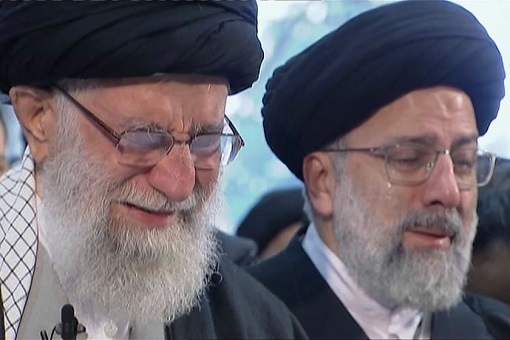
Khamenei was obviously trying to put up a brave face when he warned U.S. of “regional war” if Iran is attacked. In truth, Iran today isn’t the same Iran some eight months ago. The regime is much weaker now after the June 2025’s 12-day war with the U.S. and Israel – the first-ever direct U.S. attacks on Iranian soil. The U.S. air attack had “obliterated” three major Iranian nuclear sites, namely Natanz, Fordo and Isfahan.
Speaking about American warships converging on the Middle East, Trump told reporters in the Oval Office that “they have to float someplace. They might as well float near Iran.” Trump in his second term has already ordered attacks in Yemen, Iran, Venezuela, Syria, Somalia and Nigeria, often without an Oval Office speech explaining his actions or seeking congressional authorization.
Pentagon has developed some possible attack options. Among them is the so-called big plan, which would see the U.S. strike facilities of the regime and Islamic Revolutionary Guard Corps (IRGC) in a large-scale bombing campaign. More limited options include strikes on symbolic regime targets, allowing space for more attacks if Iran doesn’t agree to a deal to Trump’s liking.
Make no mistake – the U.S. could terminate Khamenei if Trump gives the order. However, the problem is even if Khamenei is ousted, no one can say for sure whether the government that follows would be any more friendly. A senior IRGC member would likely assume control, which could preserve – or even deepen – the regime’s hard-line approach.
The White House is wary about getting drawn into unproductive negotiations. “He likes the application of military violence when it is quick, cheap and decisive,” – said Justin Logan, director of defense and foreign policy studies at the Cato Institute in Washington, in referring to Trump. “The problem is you can’t do things quickly and cheaply and get decisive results.”
But there is a powerful force that is quietly pushing Trump to go all the way out to finish the business – once and for all – for a full-blown regime change. Did anyone notice how Israel’s leaders have remained unusually silent. Aside from some remarks in support of Iran’s anti-government protests this month, Israel’s prime minister has had little to say publicly about his superpower ally taking on his biggest enemy.
Yes, it appears Benjamin Netanyahu is counting on the U.S. military build-up in the Middle East to topple Khamenei – the key threat facing Israel, and the biggest source of instability in the Middle East. Silence is Israel’s strategy to allow the Americans to lead the way this time. Behind the silence, Israel’s military intelligence chief, Shlomi Binder, has met US intelligence agencies in Washington to discuss about possible targets in Iran.
Danny Citrinowicz, who served for 25 years in Israel’s Defence Intelligence, and is now senior Iran researcher at Israel’s Institute for National Security Studies, believes Netanyahu is privately pushing the US towards maximalist strikes aimed at regime change in Iran. When Netanyahu reportedly urged Trump to hold back earlier this month, it was because he viewed the planned U.S. attack as “too small”.
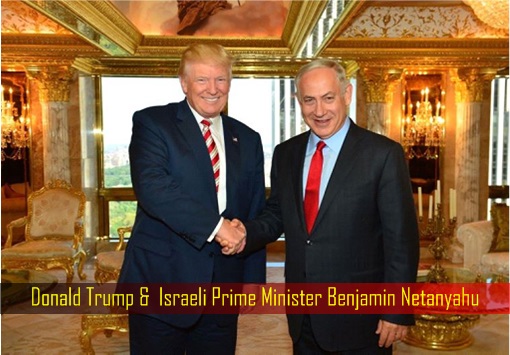
It was not empty rhetoric when – just hours after Israeli fighter jets started striking Iranian nuclear facilities and air defence systems in June 2025 – Israel’s Prime Minister Benjamin Netanyahu appealed to the Iranian people directly to unite and fight against the Iranian regime for their freedom. “The Islamic regime, which has oppressed you for almost 50 years, threatens to destroy our country, the State of Israel,” – Netanyahu said.
While many U.S. allies are warning that trying to unseat Iran’s leadership carries huge risks for the region, many in Israel see potential benefits for their security. By changing the regime in Tehran, Israel would hope to end the threat from Iran’s ballistic missiles, and the possibility that it would one day acquire nuclear weapons too. Pro-Israel Trump provides the best opportunity for Israel to change the landscape.
It would also further weaken Iran’s proxy militia around the region, including Hezbollah, which still has up to 25,000 missiles and rockets across the border in Lebanon according to Israel’s Alma research institute. In contrast, some Israeli lawmakers believe a limited strike, or even a new deal with Iran, could carry bigger risks for Israel’s security by leaving the regime in place.
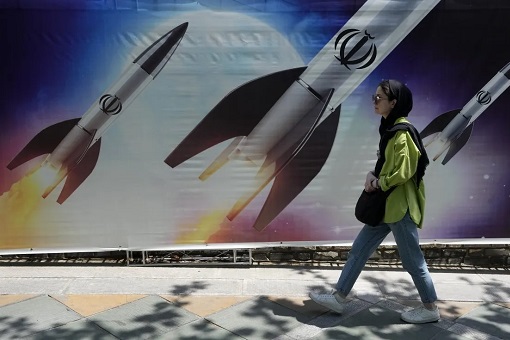
Iran will not stop rebuilding its missile stocks, even after the 12-day war. And Tehran has openly warned that Tel Aviv would be hit in the event of any U.S. attack. Netanyahu is afraid Israel will – again – go through the pain of an attack without a change of regime. He came to the conclusion that to stop the missiles being built, you have to have a regime change, but regime change can happen only with the U.S.
It’s not hard to see that Iran is at its weakest now – this is an opportunity that may not come again. The Iranian regime is vulnerable – its military defences diminished after the 12-day war, its regional proxy forces weakened, and after widespread protests against its rule at home. Israel has to convince Trump to believe this is the time – it’s now or never.
Politically, Netanyahu is also emboldened and encouraged by Israeli polls which repeatedly show a strong majority of Jewish residents support military action against Iran – including after the 12-day war last year. With no obvious cracks in the military and clerical alliance around Iran’s Supreme Leader Ayatollah Ali Khamenei, a military strike could help a splintered opposition movement in the country.
Even if a strike would lead to the chaos of a civil war that would not only be deeply destabilizing for Iranians, but for the region as a whole, it’s still worth a try. Israel’s prime minister, facing elections this year, has worked hard since the Hamas attacks to try and restore his broken image as Israel’s “Mr Security”. Regime change in Iran – or Khamanei’s assassination – would be a political prize.
It is a gamble, but it’s a calculated one. In truth, Netanyahu couldn’t care less what happens the day after Khamenei. He wants to show, together with Trump, that he destroyed the Iranian regime. It’s a risk he’s willing to take if he knows the Americans will go all the way. The biggest puzzle is who could convince Trump – Israel or Iran. Either way, the Mullahs don’t have good options.
Even if the Iranians are preparing to give in to Mr. Trump’s demands, there is no guarantee that the U.S. president will give the order to strike anyway just to flex his muscle and to claim a win. The President, who assured Iranians that “help is on its way,” but did not do enough as regime thugs shut down internet before butchering its own people, also has to show the Iranians that he keeps his promise, despite a late one.

More importantly, the U.S. is quietly establishing an overmatch on offense and defense – moving into place THAAD and Patriot air defenses to protect U.S. bases and allies in Israel and the Gulf from any Iranian retaliation. All of this carries a cost, and we doubt Mr. Trump is paying it for nothing. Trump is an expert in sending mixed signals, saying he is open to a deal but silently prepares to strike.
Before June’s 12-day war, Mr. Trump gave Ayatollah Ali Khamenei two months to dismantle his nuclear program. The Supreme Leader refused, so Jerusalem and Washington did it for him, burying Iran’s nuclear material deep underground. Concessions now on the enrichment of nuclear fuel – if the regime is even willing to make them – are far less meaningful. It would be a surprise if Trump blinks and walks away.
Other Articles That May Interest You …
- Corruption, Cronyism – How A Bank Collapse Sent Iran Into Chaos
- Revolution – How One Man Rallies Iranians To The Street
- “Operation Narnia” Revealed – The Bold Attack On Iran That Israel Feared Could Not Succeed
- Gone In 25 Minutes – How Trump Tricked Tehran Twice Before Obliterated Iran’s 3 Nuclear Sites With MOPs
- Iran’s “Axis Of Resistance” Missing In Action – Why Tehran Became Isolated & Alone In WAR Against Israel
- Iran On Fire – Khamenei Should Flee To Russia While He Can Before US-Israel Upcoming Surprise
- Israel’s “Operation Rising Lion” – Iran’s Costly Miscalculation Led To Losses Of Top Commanders & Scientists
- Paying The Price For Hamas Attacks – How Trump Misled Iran Before Israel Sends 200 Jets To Attack
- Ran Out Of Luck And Place To Hide – Here’s How Israel Trainee Squad Accidentally Killed Hamas Mastermind Sinwar
- Psychological Warfare – How Mossad Cracked Hezbollah Secret Network With Low-Tech Pager & Walkie-Talkie “Walking Bombs”
- 3 Big Kills In 24 Hours – Why Haniyeh Could Have Been Betrayed By Own Brothers

|
|
February 3rd, 2026 by financetwitter
|


|

|

|

|

|

|





















Comments
Add your comment now.
Leave a Reply