



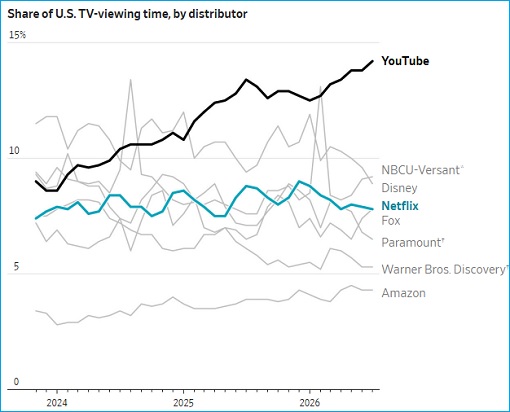
Netflix is struggling. While it still leads globally in the video streaming business with over 325 million subscribers compared to Amazon Prime Video (200 million+ subscribers), Disney+ (130 million+ subscribers), and Hulu (64+ million subscribers), its biggest competitor for home screen time and consumer attention is actually free content provider YouTube.
The streaming titan’s shares are down 42% in the last 12 months alone and have been nearly cut in half from their all-time high last summer. It abruptly replaced content chief Bela Bajaria last week just hours after a layoff of 1,000 employees (roughly 6% of the company) – its biggest round of layoffs in four years – that she helped engineer. But it was not the end of jobs cut.
By Monday (Oct 19), film chief Dan Lin lost his job, too. The ousters of two of the company’s top creative executives are signs that the streaming giant’s leaders feel the service needs to overhaul its content offerings. Co-CEOs Ted Sarandos and Greg Peters said in a memo that entertaining the world “requires us to be disciplined about where we prioritize our people and resources”.
Behind closed doors, Sarandos had actually complained internally for months that Americans were spending less time watching Netflix and that the service was short on new hit shows. He also has told colleagues that he wants the company, which has experimented with everything from video games to podcasts, to strengthen its core TV and movie offerings.
On Tuesday (October 20), Netflix reported third-quarter earnings that topped analyst estimates and revenue that was in line as Wall Street eyes the company’s engagement and advertising metrics. The company’s revenue was almost 12% higher year over year, boosted by growth in membership and an increase in subscription prices.
Net income for the quarter was US$3.66 billion, or 87 cents (versus 82 cents estimated) per share in terms of EPS (earning per share), compared with US$2.55 billion, or 59 cents a share in the same period last year. However, the company narrowed its 2026 full-year forecast, saying it now expects revenue to reach US$51.1 billion – below Wall Street’s expectations of US$51.2 billion for the year.
As a result, shares of Netflix fell about 6% in extended trading on Tuesday. Central to Netflix’s value offering has been its cheaper, ad-supported tier. Yet, the company on Tuesday lowered its full-year revenue guidance for its ad business. Netflix said it now expects 2026 ad revenue of around US$2.7 billion, down from the roughly US$3 billion the company had previously forecast.
Problems at the company that ushered in Hollywood’s streaming revolution have been building for a year as it has struggled to come up with hits on the level of “Stranger Things” or “Squid Game.” Netflix needs to – desperately – prove that it can produce hit movies and TV series again to stop a slide that has erased more than US$135 billion in market value in 2026.
The stock price is down 26% in 2026, putting Netflix among the 10 worst performers in the technology-heavy Nasdaq 100 Index and on track for its worst year since 2022, and it is coming off a 14% decline in September. In fact, its stock has sagged since its failed US$82.7 billion bid launched last year for Warner Bros. Discovery’s film and TV studios and HBO Max, which investors saw as a sign of weakness.
Although adding HBO Max and the Warner Bros. studio could have given Netflix a boost, investors worried that its leaders had run out of ideas for growth since Netflix hasn’t historically turned to major dealmaking. Besides that narrative, shareholders were concerned about Netflix taking on a massive debt load and going through a complex integration process.
Crucially, like many media companies, it is struggling to attract audiences spending more time watching YouTube and TikTok. User engagement has “stalled” owing to a lack of popular content despite heavy spending driven by a crowded, competitive entertainment landscape. Netflix’s struggles to keep viewers hooked have become increasingly apparent.
As of the end of September, Netflix hadn’t added net subscribers any month this year in the U.S., according to analytics firm Antenna, which tracks U.S. consumer purchases of subscriptions through sources such as credit-card bills. The good news is the rate at which U.S. subscribers cancel the Netflix service remains the lowest in the industry at just 2.1% in September.
Netflix grew global viewing hours by merely 2% year over year to 97 billion in the first half of 2026. Investors are worried that slowing engagement growth could hurt Netflix’s ability to retain customers and persuade them to pay more. Engagement is also “the golden compass for advertisers” since higher usage helps them reach broader audiences.
Worse, Netflix won the fewest Emmy Awards in a decade in 2026, and as admitted by its own co-chief executive officer Ted Sarandos – the company is “not growing” fast enough. “The content’s getting very expensive, and there are just still too many players,” – said Ken Mahoney of Mahoney Asset Management. “I think there are so many better tech stories out there than Netflix that have sticky customers.”
While Netflix is still leading its paid peers in viewership and profits, free streaming services like YouTube, Tubi, and The Roku Channel are gaining popularity, especially among younger audiences. YouTube’s viewership share on US TVs was 14.2% in July – nearly double Netflix’s 7.8% share, according to Nielsen. Roku’s free streamer and Tubi are also formidable competitors with shares of 2.9% and 2%, respectively.

Sure, the company has expanded its content offering to boost engagement. Some newer categories, such as live sports, have been more successful than others, such as video games. But only 3.5% of Netflix’s subscribers play games monthly, according to a recent internal memo. That business is tracking about 10% behind its 2026 reach and engagement goals.
Video podcasts and creator content have allowed Netflix to add hundreds of hours of programming at a fraction of the cost of scripted series. During the company’s last earnings call, Sarandos emphasized that building up these new formats takes time and that they are “evolutionary, not revolutionary.” In short, neither games nor podcasts have been a game changer so far.
Executives have debated behind closed doors whether to change the release cadence of certain shows to improve engagement. Netflix typically drops all the episodes of a season at once, while many competitors release new episodes weekly. Sarandos has resisted the change. Netflix data shows that members prefer an all-at-once binge versus a weekly cadence, according to the company.
In another change, it is starting to bet on major theatrical releases for some films after years of releasing most films directly online and giving a handful a few weeks on a limited number of screens. The company is releasing films including “Charlie vs. the Chocolate Factory” and “Narnia: The Magician’s Nephew” in theaters globally at least 45 days before they will be available to watch at home, the strategy typically used by traditional studios.
Other Articles That May Interest You …
- Inflation Too High, Too Long – Fed Hikes Interest Rate, Another Coming
- Financial Crisis – Why 5% Treasury Yield Keeps Investors Up At Night
- Global Bond Yields Hit New Highs As Investors Ready For Rate Hikes
- Market Turmoil – Oil Hit $100, Bond Selloff, Stocks Plunge, Grains Skyrocket
- Iran War Reveals How U.S. Sanction Was Easily Evaded Using Yuan
- Trump’s Executive Order To TikTok To Surrender 50% Stake – But Condemned As Daylight Robbery In China
- The Worst Is Yet To Come – How And Why Nvidia Lost $279 Billion In 1 Day, The Biggest Loss In Wall Street History
- Earn RM15 Just To Like YouTube Videos – Here’s How To Identify Red Flags Of The SCAM During Current Bad Economy
- Playing A Dangerous Game – Here’s Why Facebook Removes News Of PM Anwar Meeting With Hamas Terrorists
- Malu Apa Bossku – Crooked Najib Should Sue Netflix For Billions, Too Late To Ban “Man On The Run” Documentary

|
|
October 21st, 2026 by financetwitter
|


|

|

|

|

|

|
























Comments
Add your comment now.
Leave a Reply