



You don’t need a degree in international affairs or political science to understand the message Xi Jinping sent on Wednesday (September 8) as he showcased China’s military power in a parade marking the end of World War II – ranging from tanks to underwater drones, and from robot wolves to satellite killer. And president Donald Trump wasn’t happy about it.
Thought to be the largest military parade in China’s history, the Victory Day marked the 80th anniversary of Japan’s defeat in the Second World War. It was already bad in the first part when Xi, Russian President Vladimir Putin, and Indian Prime Minister Narendra Modi were seen hugging and laughing like old friends earlier at the SCO (Shanghai Cooperation Organization summit in Tianjin.
The second part – military parade – in Beijing became worse for the West when Modi, who left China after the SCO summit, was replaced by North Korea leader Kim Jong-un. It doesn’t matter that the parade was largely shunned by Western countries. Mr Xi was flanked by Mr Putin and Mr Kim alongside around two dozen leaders from mostly developing countries and those keen to challenge the US-led old world order.
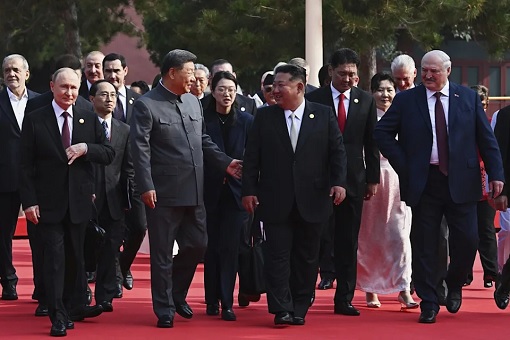
Like his earlier meeting with Modi, Putin was delighted to meet Kim, even thanked the North Korean dictator for his soldiers’ courageous fighting in the war in Ukraine during a bilateral meeting at China’s State Guesthouse. Kim also met with leaders like Malaysian Prime Minister Anwar Ibrahim, giving the heavily sanctioned Kim a rare chance to stand alongside other world leaders on the global stage.
The event was the first time that the leaders of China, Russia, North Korea, and Iran were all present in the same place. The Western media called it the “Axis of Aggressors” – perhaps the same reason why India avoided the parade. Nevertheless, the message from China’s lavish military parade was clear – Beijing has the weaponry, allies and ambition to shape a New World Order.
The video clip of President Xi – with Kim on his left and Putin on right – leading a group of 24 world leaders from mostly non-Western countries at Beijing’s massive military parade demonstrated not only a challenge to the U.S. and its allies, but also a show of unity and defiance of the West. The display was also designed to show off China’s military strength and geopolitical might.
Interestingly, Daniel Andrews, the former premier of Victoria, raised eyebrows in Australia for attending the parade, along with former New Zealand prime ministers John Key and Helen Clark. Even Indonesian President Prabowo Subianto rushed to Beijing despite facing a fierce protests at home over perks for lawmakers, indicating the importance of being part of the so-called “axis of upheaval”.
The massive show of China’s friends and advancing military might in front of 50,000 guests and spectators was deliberately designed to provoke Donald Trump. The U.S. president accused Xi of “conspiring against” the United States with Putin and Kim, yet insisted in a radio show that he was not concerned about the axis forming between Russia and China.
On social media Mr Trump wrote that Mr. Xi should “give my warmest regards to Vladimir Putin, and Kim Jong Un, as you conspire against the United States.” Later, he said on Wednesday (September 7) in the Oval Office that “they were hoping I was watching – and I was watching.” And that’s precisely what Beijing wanted Washington to say – an attention and an acknowledgement.
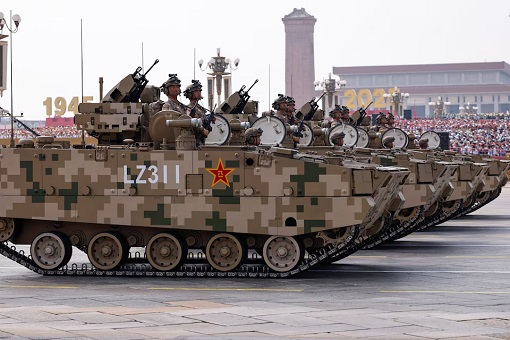
The world’s second-largest economy, which allocated about US$250 billion for their 2025 defence budget, showcased hypersonic missiles, a new generation of nuclear triad, long-range missiles, anti-drone systems, strategic bombers, and stealth drones – most of them for the first time. In his speech, President Xi Jinping gives the world a choice – choosing between “peace and war”.
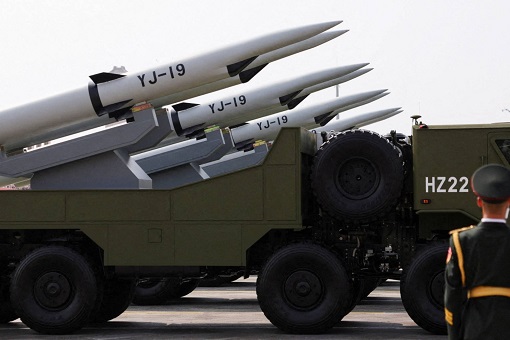
Marching in the parade were traditional People’s Liberation Army units from the police, navy and army, but also new ones like the cyberspace unit for the first time. But there are weapons which should concern the U.S. Navy, which patrols the western Pacific from its 7th Fleet headquarters in Japan. Joining existing YJ-17, YJ-19 and YJ-20 hypersonic missiles is the new YJ-15 missile.
The YJ missiles, short for “Ying Ji” or “eagle attack”, can be launched from ships or aircraft and are designed to inflict critical damage on large vessels. The anti-ship YJ-21, known as the “aircraft carrier killer”, is capable of supersonic speeds with a range over 600km. Clearly YJ-21, with 6 times the speed of sound, was a warning to the U.S. crown jewel – aircraft carriers.
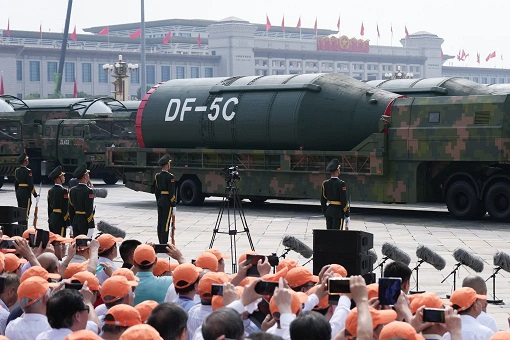
China showcased three types of nuclear-capable intercontinental ballistic missiles (ICBM) – Dong Feng-61 (DF-61), Dong Feng-31BJ, and the Dong Feng 5C (DF-5C) – for the first time during the victory day parade. The Dong Feng 5C (capable of carrying up to 12 warheads) has an estimated range of more than 20,000km – putting the entire globe under its strike range.
Crucially, the parade also revealed its first air-launched nuclear missile (ALBM), the JL-1, which along with 8,000-km-range JL-3 submarine-launched intercontinental missile, as well as DF-61 and DF-31BJ land-based intercontinental missiles, means China can now launch nuclear weapons from land, sea or air – an integrated strategic nuclear triad. This enhances the country’s nuclear deterrence and strategic nuclear counterattack capabilities.
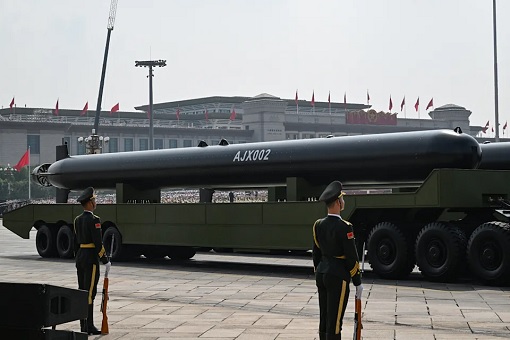
The parade featured two new, extra-large torpedo-shaped underwater drones – the AJX002 and the HSU100. The sea drone AJX002 is estimated to be around 60ft long, with torpedo-shaped hulls and pump-jet propulsion systems. While China still lags behind the U.S. in surface naval power, it has the world’s largest programme of “extra large uncrewed underwater vehicles” (XLUUVs) – with at least five types already in the water.
An impressive new kid on the block was the HQ-29 space defence system, capable of taking down foreign satellites. The high-velocity HQ-29 missile interceptors – “Satellite Killer” – can perform a dual role, intercepting ballistic missiles in their mid-course phase and space-based threats in low Earth orbit. It is an anti-ballistic missile (ABM) and anti-satellite weapon (ASAT) systems.
The Russia-Ukraine War and Israel-Iran conflict have shown the role of drones in war. To avoid using expensive missiles to neutralize lost-cost drones, Beijing has been developing laser weapons as a defence against drone attacks and other low-end threats. Besides high precision and low cost-per-shot LY-1 laser weapons, which can also disable electronics or blind pilots, China also displayed a missile gun and high-power microwave weapons.
The future war with the U.S. could see China deploying stealth attack drones such as the GJ-11, which is capable of flying alongside manned fighter jets and aiding them in their missions. Known as the “loyal wingman”, the Feihong-97 combat drone was actually first appeared at the 2019 Chinese National Day Parade, which means it had been flying for years already and has since been improved and refined.
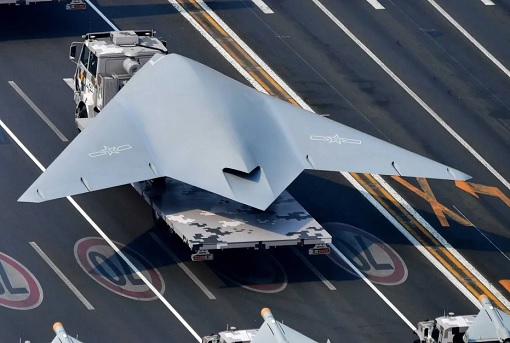
While anti-Chinese analysts belittle the latest military hardware as “untested gadgets”, they should be more worried about the weapons that China “have not shown”. The lavish event sends a signal that China is not afraid of the U.S. More importantly, it sends a frightening and destabilizing message to Taiwan, around which China has launched military drills in recent months, as well as Japan, South Korea and the Philippines.
Despite Trump’s best effort to downplay China’s military parade, Chinese news media and social media users have pointed out how “pathetic” Trump’s June military parade in Washington, D.C., was by comparison. Even the U.S. president has expressed how he was “very, very impressive” with the Chinese parade, while pretending he was “not concerned” but demanding China gives credit to the U.S. for its support in World War 2.
Donald Trump was largely humiliated because unlike Beijing’s sleek display of high-tech armaments and precision marching masses, Trump’s parade was a low-key homage to America’s military history, as World War Two tanks and revolutionary-era soldiers walked casually down Constitution Avenue near the White House that does not fit into Trump’s slogan of “Make America Great Again”.
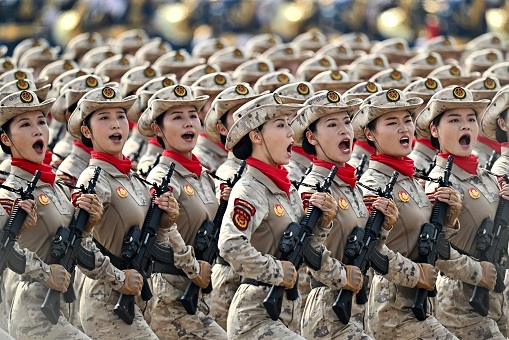
Starting with a gun salute – 80 times to mark 80 years since China’s victory over Japan in World War Two – the military parade was a display of power, precision and patriotism. “The great rejuvenation of the Chinese nation is unstoppable,” – Xi said in his speech as China shows the U.S. how a military parade should be properly done. China is catching up with the U.S. and challenging it for supremacy. What China lacked 80 years ago is what it was showing off now.
Make no mistake – China’s military prowess won’t be possible without an economic powerhouse. In 1995, the U.S. was still No. 1 in manufacturing, accounting for almost 24% of the planet’s manufacturing. Japan was second at 12.6% and Germany was third at 8.4%. In fourth place, China was responsible for merely 4.9% of global industrial output. Canada, at 2.2%, was in 10th place.
However, over the next three decades, the picture flipped. By 2023, China was in the top spot, contributing nearly 32% of global manufacturing. The U.S. had fallen to 15%, while Japan (6.6%), Germany (4.6%) and the rest of Europe had suffered even more. Even Russia’s industrial output has plunged to just 1.3% of the global total – 25 times less than China. The Soviet Union and its Eastern European satellites accounted for 20% of global industrial output in the 1980s.
In 2024, China produced 1 billion tonnes of steel. That was more than the rest of the world, and 12 times as much as the U.S. Last year, China was responsible for 54.6% of global shipbuilding. Japan and South Korea combined for another 40%, while the U.S. accounted for just 0.04%. Back in 1999, China produced only 1.8 million cars compared to the U.S.’ 31 million. But in 2024, China built 31.3 million cars while America produced only 10.6 million.
Mr. Trump does not have any strategy. He hopes his personal diplomacy can help strike deals with different dictators on different issues at different times. But America’s adversaries are united, while Mr. Trump hits U.S. allies with a tariff barrage. He keeps bragging about the great American military, whilst China keeps unleashing new military weapons that even the U.S. is struggling to keep up with.
Renaming Pentagon as the “Department of War” isn’t going to bring China or Russia to its knees. Xi’s meeting, first with Modi and Putin, then followed with Kim and Putin, was what annoys U.S. President Donald Trump the most, rather than the Chinese weaponry. Trump might wish he was in China to share the limelight when Xi, Putin and Kim climbed to the top of the Gate of Heavenly Peace that overlooks the historic square to watch the parade.
Other Articles That May Interest You …
- SCO Summit – U.S. Terribly Upset Over Car Rides, Hand-Holding & Jokes Sharing Between Xi, Putin And Modi
- Trump’s Bluffing Again – Give Me Magnets, Or Risk 200% Tariff On China
- Give Him Something To Brag About – Apple CEO Tim Cook Shows How To Scam Trump To Avoid Tariffs
- Forget 39% Swiss Tariffs – India In Bigger Trouble As Trump Slaps Extra 25% Tariff To 50%
- Malaysia, Thailand, Cambodia Celebrate 19% Tariffs – The Art Of Sucking Up Trump & Surrendering Concessions
- Trump Threatens 100% Tariffs On Russia – But Here’s Why Russian Markets Jump In Celebration Instead
- Pawns Europe & Ukraine Got Played – The Hidden Message Behind US-Russia Talks In Saudi Without Allies
- China Secretly Hiding Tonnes Of Gold – The Buying Spree In Preparation Of Trade War, Sanctions Or Even Invasion Of Taiwan
- Sanction My Foot! – Russia Makes A Mockery Of Western Oil Sanctions, While China & India Laugh All The Way To The Bank
- Europe Closed Front Door, But Opens Backdoor – How India Makes Easy Money Reselling Russian Cheap Oil To EU
- Black Market For Oil Is Booming – How Russian “Dark Fleet” Of Tankers Evade Western Price Cap

|
|
September 6th, 2025 by financetwitter
|


|

|

|

|

|

|














Comments
Add your comment now.
Leave a Reply