



Unemployment rate plunged to 2.9% in November 2025, reaching its lowest level in 11 years. Prime Minister Anwar Ibrahim quickly claimed the credit in January 2026, attributing the milestone to his Madani Government’s so-called economic reforms. Today, with Johor state election at high gear, Deputy Prime Minister Ahmad Zahid Hamidi is also taking credit for the country’s unemployment rate.
Malaysia’s unemployment rate has since edged up to 3.0% in April 2026 – representing 511,800 jobless individuals. However, none from Anwar’s Pakatan Harapan or Zahid’s Barisan Nasional dares to talk about the latest data as both – allies at federal level but rivals at the state of Johor – actively campaign against each other in the current southern state election.
Behind the sexy numbers, however, is a severe crisis buried under the low unemployment data which politicians are reluctant to talk about. That crisis is a skill-related underemployment crisis, where nearly 2 million workers (over 35% of the tertiary-educated workforce) are forced to take semi-skilled or low-skilled jobs that do not match their qualifications.
Irene Chong spends her work days folding clothes at a mall in Melaka despite holding a bachelor’s degree. The 24-year-old has found that her degree in communications from a private university in Kuala Lumpur is not opening the doors she had anticipated after graduating in 2022 from the four-year course. “I tried everywhere, even call centres, but I did not hear back from them,” she told The Straits Times.
With a student loan of RM100,000 (US$24,500) to repay, and feeling desperate for money and embarrassed about relying on her parents, she decided to take the retail job in 2023 while actively seeking better opportunities. “My parents thought university was the way to go for better jobs, and invested a lot in it,” – Chong said.
“But now I fold clothes, say ‘welcome’ to customers, smile and do double shifts. I don’t see a future (for me in general),” she confessed. Though Chong is considered part of the labour force, this measure is not the only one that matters. Malaysia’s unemployment rate stayed at an 11-year low of 2.9% for five months from November 2025, before inching up to 3% in April.

But economists said the headline figure masks a deeper problem – underemployment. Some 2.06 million people in Malaysia were in skill-related underemployment in 2024, a figure that is on an upward trend, affecting 36% of tertiary-educated employed people, according to the government’s 2026 Labour Force Statistics. This includes graduates and skilled workers who are employed, but in jobs that do not fully utilise their education, training or capabilities.
Graduate tracing data points to weaker early labour-market absorption in fields such as education, services, agriculture, social sciences, journalism and information, and arts and humanities, compared with technology and engineering-related fields. For workers like Chong, the gig economy has become both a lifeline and a trap, offering immediate income but no clear path back to the careers they had studied or trained for.
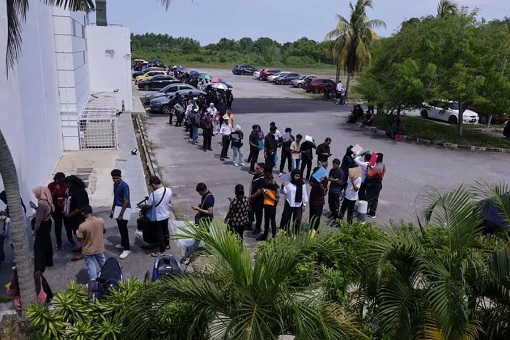
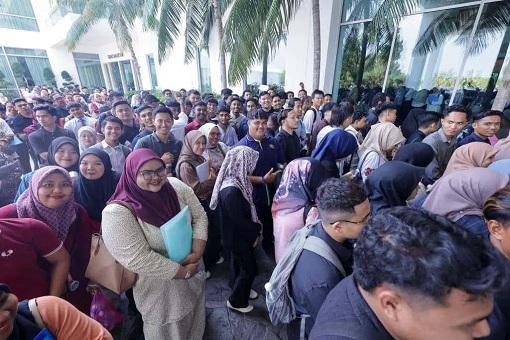
The scale of this mismatch was captured on June 14 – videos showing about 1,000 people queuing as far as 2-km for up to 500 vacancies at an open interview session conducted by Germany’s Infineon Technologies at the Holiday Inn hotel in Melaka went viral on social media. Aisyah Muhammad Hanif, 22, told ST that she was among those who went for the interview and is now waiting for a callback.
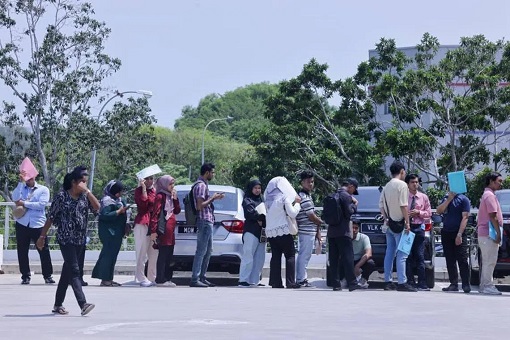
“I am a business degree graduate, but have been working at restaurants for the past few years because I cannot find other jobs,” Aisyah said. “I found out about this job (opening) from friends who are also trying their luck.” The company was hiring production operators and technicians, with a starting salary of RM3,500. This is higher than Malaysia’s median monthly salary, which was RM3,167 as at December 2025.
Independent economist Doris Liew, an expert on South-east Asian development and formerly affiliated with Malaysian think-tank the Institute for Democracy and Economic Affairs, said Malaysia continues to produce large numbers of graduates in business, humanities and the social sciences. But the country is facing talent shortages in technical fields such as engineering, software development and advanced manufacturing.
“This mismatch has become increasingly evident as the country seeks to move up the value chain in sectors such as semiconductors, digital services and high-value manufacturing,” Liew said, calling talent shortages a significant constraint on industrial upgrading. She added that the problem also affects mid-career workers, as reskilling and lifelong learning remain underdeveloped.

“Existing training mechanisms, including many programmes funded by the government, are often tied to employers and short-term training requirements, rather than serving as a comprehensive platform for career advancement and skills upgrading,” – Liew said.
{ Emulating Penang’s Model }
One model often cited is Penang, where the shortage of skilled labour has been a persistent issue for the state’s semiconductor sector since the 1980s. The state accounts for about 13% of global semiconductor assembly, testing and packaging, making it a key back-end node in the global chip supply chain. There, multinational companies saw the talent shortage as an industry-wide problem and decided to take matters into their own hands.
In 1989, they prepared a White Paper for the state government, leading to the launch of the Penang Skills Development Centre (PSDC). The move gave Penang a private sector-led but state-backed training centre designed around industry needs, rather than leaving skills development solely to educational institutions focused on academic achievement.
“Industry is evolving, technologies are evolving. We cannot just sit and do the same old training,” – PSDC chief executive officer Hari Narayanan told ST. In the 37 years since it was established, about 300,000 people have benefited from PSDC programmes, which have progressed from training production-line operators to offering courses in chip design and precision machining.
Other Malaysian states are also looking to emulate PSDC’s success, including Johor, where the success of the much-vaunted Johor-Singapore Special Economic Zone will depend in part on whether the state can build a healthy talent pipeline. Johor Corporation, the state’s investment holding company, has been collaborating with PSDC since 2018 to develop new industry-driven technical programmes, including for vocational and soft skills for its Johor Skills initiative.
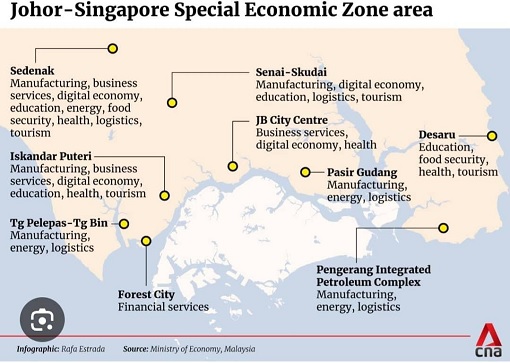
The JS-SEZ, formalised in January 2025, aims to develop Johor and Singapore into a major cross-border economic hub covering Johor Bahru, Iskandar Puteri, Pasir Gudang, Sedenak and Desaru, focusing on manufacturing, logistics, digital industries, energy and talent development. But even this economic zone has become Johor election’s warzone. Nobody cares about underemployment of job mismatch.

Economy Minister Akmal Nasrullah said the JS-SEZ master plan, which has been completed and approved by the Cabinet, will only be officially launched after the Johor state elections. Johor Menteri Besar Datuk Onn Hafiz – upset that it could be a deliberate delay tactic to reserve the “Shenzhen of Southeast Asia” for Anwar to claim credits later, has demanded the federal government to immediately announce the master plan.
{ Ensuring Better Wages and Mobility }
Beyond solving the problem of skills mismatch, economists say Malaysia must also ensure that productivity gains translate to better wages and upward mobility for workers. Economist Muhammed Abdul Khalid, a fellow at the Institute of Malaysian and International Studies, Universiti Kebangsaan Malaysia, said the issue is not one of low productivity, pointing out that labour productivity has risen by 5.3% from 2019 to 2024, according to Bank Negara Malaysia.
“Yet, the real wage per worker declined by 1.9% within the same period,” – he said, citing the central bank’s findings. Bank Negara Malaysia attributed the productivity gain to broad-based improvements across sectors, with construction posting the strongest jump in 2024 and manufacturing productivity returning to positive growth after the pandemic.

But inflation and rising cost of living erased nominal wage increases, leaving workers with negative purchasing power. Muhammed called for an overhaul of Malaysia’s industrial policy, moving away from tax breaks for low-end assembly factories and towards attracting companies focused on advanced technology and research.
Under its National Semiconductor Strategy, the government has pledged at least RM25 billion in fiscal support, while Budget 2025 introduced a RM1 billion strategic investment fund and expanded export tax incentives to include integrated circuit design. But the underemployment problem isn’t going away.
“It is a myth that graduates would magically get good jobs if they just studied different subjects or if universities offered more technical courses,” – Muhammed said. “We have a severe demand-side deficit. If the current vacancies are for retail or admin work, offering a more advanced engineering degree will not change the fact that the graduate will still end up underemployed.”
Other Articles That May Interest You …
- Johor, Negeri Sembilan, Melaka – Key To Winning General Election
- Election Gimmick – PM Anwar Chickens Out, Cuts Diesel Price
- No Good Options – Anwar To Lose Whether Election This Year Or 2027
- Johor Election Announced – PM Anwar’s PKR To Be Wiped Out
- RON95 & Fuel Subsidies – Anwar Should Call Iran For Safe & Free Passage
- Crying Crisis – But Approved 52 Million Liters Diesel To Philippines
- PM Anwar Shamelessly Demands Credit & Praise For Iran Diplomacy
- RON95 & Fuel Subsidies – Anwar Should Call Iran For Safe & Free Passage
- Energy Security – Why China Can Withstand $100 Oil Prices More Easily
- Corruption In PMO – Anwar’s Contradictions & Hypocrisy In Damage Control
- RM100 Cash Handout & Petrol Price Drop – How Anwar Cleverly Copies Najib’s Trick To Appease Growing Public Discontent

|
|
July 4th, 2026 by financetwitter
|


|

|

|

|

|

|

























Comments
Add your comment now.
Leave a Reply