



US President Donald Trump is giving Chinese President Xi Jinping a king’s welcome this week, as he pursues what the White House calls “strategic stability.” The question is whether there will be much substance beneath the surface pomp. The administration is fast losing the Iran War. China is helping Iran shoot at Americans in the Middle East with high-resolution satellite imagery of U.S. military facility.
China bought around 1 million metric tons of US soybeans just days ahead of Trump-Xi summit. In fact, after Mr. Trump and Mr. Xi met last October, China bought 12.4 million tons of soybeans from the United States in 2025. But that’s about it. Trump had tried – and failed – to bring China to its knees during his first term, and the tariffs war in the current second term has similarly failed spectacularly.
President Xi, meanwhile, has only one priority when he meets President Trump on the American soil – Taiwan. The Chinese leader has already “kautim” Taiwan main opposition party. In April, Cheng Li-wun, chairwoman of the Kuomintang, or KMT, traveled to mainland China for a red-carpet six-day tour, the first such visit in nearly a decade. Cheng also got an audience with Chinese leader Xi Jinping.
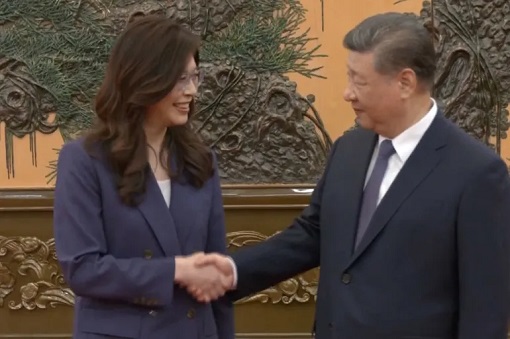
His hands were as “soft as clouds,” – Cheng said later after she shook hands with Xi in Beijing. What hasn’t been revealed publicly – months earlier, Chinese officials met with KMT negotiators to hammer out language Cheng would use during her trip. Cheng even shared advance copies of prepared remarks in which she made clear she opposed independence for Taiwan.
The visit set off alarm bells in Taiwan, whose government is suspicious of Beijing’s intentions. It also revealed a new chapter in China’s efforts to win control of the self-ruling island democracy, which it regards as part of its own territory – without ever firing a shot. Xi doesn’t want to bomb Taiwan the same way Trump attacked Iran. Beijing has a different strategy.
Even as China continues to apply military pressure on the island, it is intensifying efforts to drive a wedge through Taiwanese society, courting opponents to formal Taiwanese independence such as Cheng, and sowing doubts about America’s commitment to the island. The goal – to convince more Taiwanese that resistance to Chinese control is futile.
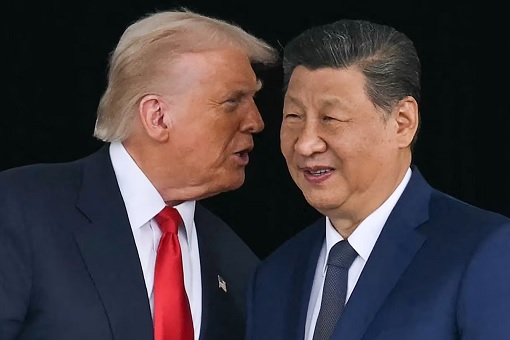
Xi sees an opening because of rising concerns in Taiwan that Trump might be willing to sacrifice support for the island in return for better relations with Beijing. Trump has at times echoed Chinese talking points on Taiwan’s government, and repeatedly accused Taiwan of having stolen the U.S. semiconductor industry, a charge Taipei rejects.
The U.S. president has also withheld approval on a US$14 billion arms sale to Taiwan, describing the package as a good bargaining chip in negotiations with China. A recent Brookings Institution poll found that only 24% of Taiwanese voters consider the U.S. a trustworthy ally, even though Taiwan has begun acknowledging long-concealed U.S. military training on the island.
Taiwan is trying to spend 5% of its economy on defense by 2030, but it will struggle to reach that NATO standard absent faster U.S. weapons deliveries. Taiwan’s internal politics is divided, and a U.S. delay would feed anxiety that America is unreliable and help those on the island who think Taiwan must accept a Hong Kong-style takeover.
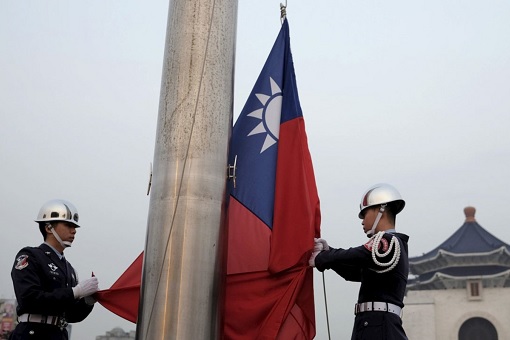
Beijing views Trump’s second term as a “rare window of opportunity” to sway Taiwanese opinion in the mainland’s favour, said Chiu Chui-cheng, minister of Taiwan’s Mainland Affairs Council, the government body that oversees cross-strait policy. “They think Trump’s unpredictability on U.S. commitments gives Xi more room to operate.”
Xi is expected to keep pressing Trump on Taiwan when the two meet in Washington this week. Xi’s aim, Chinese policy advisers say, is to coax Trump into expressing clearer opposition to Taiwanese independence, further narrowing the space for Taiwan to resist. China’s Foreign Ministry called Taiwan “the core of China’s core interests.”
At the same time, Beijing is trying to exert more influence on the ground in Taiwan. One way it hopes to do that is by working with Cheng, a 56-year-old former legislator and TV talk-show host who emerged unexpectedly last year as the head of the opposition in Taiwan and a possible future presidential candidate. She has made warmer relations with Beijing a priority.
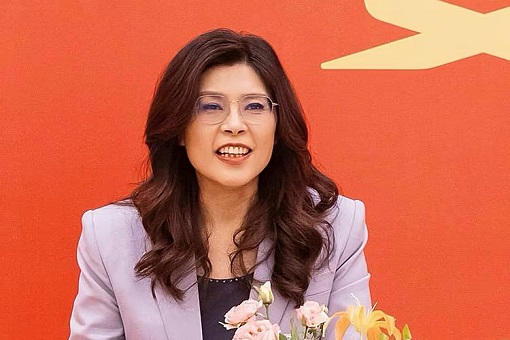
Tall and telegenic, with smartly tailored suits, she has a delivery so forceful that organizers of a press briefing late last year stopped to re-test three microphones before concluding she simply speaks at what local journalists described as “talk-show volume.” Cheng and her supporters say she has no plans to bend to Beijing and simply wants to promote better relations.
“Many friends in the international media have asked me whether I am pro-China or pro-U.S.,” – Cheng said during a party meeting in Taipei. “I ask in return: Why can’t I choose both? Why must I choose a side?” “We will never forget the friendship and generosity of the United States,” – she added. “But at the same time, mainland China is our family, and we could never bring ourselves to harm our own flesh and blood.”
In addition to courting the KMT, Beijing is flooding digital spaces with content mocking the ruling Democratic Progressive Party (DPP), and amplifying narratives that Washington will abandon the island, leaving China as the only partner Taiwan can trust. Taiwan’s National Security Bureau said in a report earlier this year that Beijing had launched an “all-out” cognitive warfare campaign via online platforms.
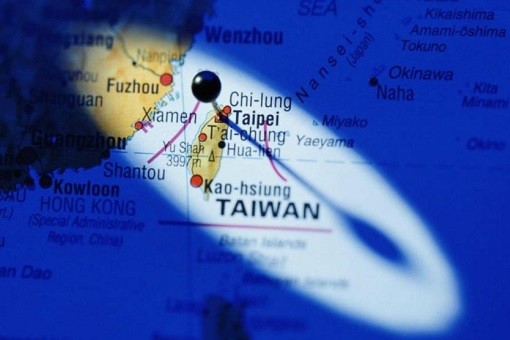
Taiwan has claimed that mainland-generated AI disinformation campaigns have been detected supporting Cheng’s election as chairwoman of the KMT party last year. The officials ultimately determined the campaign helped tilt the election in Cheng’s favor, calling it interference by Beijing in a Taiwanese political party.
Of course, Beijing has long denied involvement in disinformation campaigns. It says Taiwan is an inalienable part of Chinese territory, and it will do whatever it takes to bring the island under mainland control. Military pressure remains a major way for Xi to squeeze Taiwan. In early August, Beijing said it had imposed traffic control measures on ships passing through the strait’s southern entrance.
People familiar with Xi’s thinking say persuading more Taiwanese to reconcile with Beijing could enable him to show momentum, without the dangers of a war. Overall support for unification in Taiwan has fallen to under 8%, from 22% three decades ago, according to a long-running National Chengchi University poll. But about 21% of under-20s held a positive view of China in a poll last year.
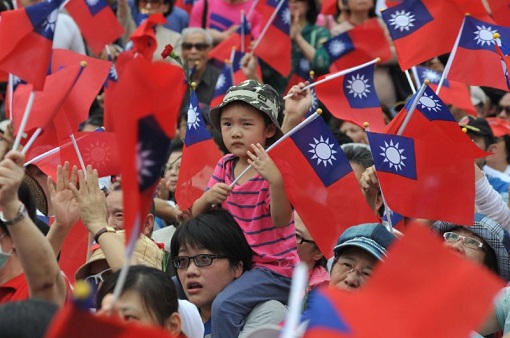
Many young Taiwanese haven’t lived through decades of tensions with the mainland, and some embrace Chinese popular culture. Beijing has worked with influencers on YouTube and TikTok, offering them sponsored trips and VIP treatment in exchange for content that echoes Communist Party talking points, according to an Australian Strategic Policy Institute analysis.
Taipei restricted access to one of the most popular Chinese social-media platforms, Xiaohongshu, in December, amid fears it could be a vehicle for soft-power influence. Taiwan is gearing up for elections in November for mayors and other local positions that could bring more politicians sympathetic to Beijing into positions of power.
While officially opposed to immediate unification, the KMT is generally seen as friendlier to Beijing than the DPP, attracting Taiwanese voters who favor calmer relations over confrontation. When the KMT last held Taiwan’s presidency, from 2008 to 2016, it fostered closer economic and political ties with the mainland, including the start of direct cross-strait flights.

Cheng, the KMT chairwoman, got her start as a student activist in pro-democracy protests against the KMT, advocating Taiwanese independence. But she left the DPP in the early 2000s and joined the KMT, the more Beijing-friendly party – though her embrace of closer ties with China would come years later. Her history of shifting positions makes her more useful to Beijing.
Other Articles That May Interest You …
- Shows Of Strength – Xi Warns Trump Against Taiwan Mishandling
- Leaked Documents – How Russia Is Preparing China To Invade Taiwan
- China Secretly Hiding Tonnes Of Gold – The Buying Spree In Preparation Of Trade War, Sanctions Or Even Invasion Of Taiwan
- U.S. Chip War Goes Haywire – Taiwanese Chipmaker TSMC’s Bad Business Decision Has Boomeranged
- A Strange Submarine Design – The West Worries Chinese Latest Stealth Attack Sub Could Strengthen Sea Blockade On Taiwan
- Democracy & Autocracy – Does U.S. Really Care About The Taiwanese People Or Practise True Democracy?
- The Biggest Winner – A Free “Case Study” For China To Learn The World’s Response If They Were To Invade Taiwan
- Warning To The U.S. And Taiwan – Here’s Why China Sent Record 56 Warplanes Into Taiwan, Raising Fears Of War
- Economic Destabilization – How China Prepares For American & Japanese Military Interference In Taiwan Conflict
- China Suddenly Banned Taiwanese Pineapples – And Taiwan Says The Political Retaliation Is Unfair & Unfriendly

|
|
September 22nd, 2026 by financetwitter
|


|

|

|

|

|

|














Comments
Add your comment now.
Leave a Reply