



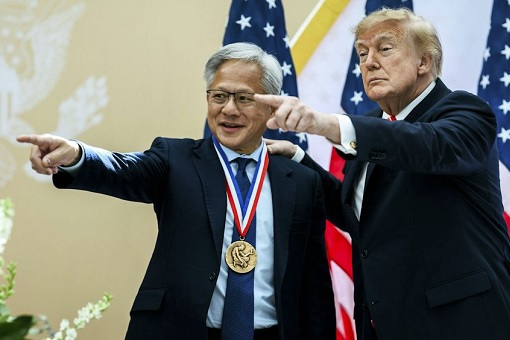
Jensen Huang’s crisis may be over, at least temporarily. The world watched how the “Godfather of AI” fell – and returned – to Nvidia. He is indeed “too big to fail” after being reinstated on November 23, 2026 – just 11 days after resigning amid personal scandal and national security scrutiny – following heavy lobbying from Silicon Valley top guns and of course, President Donald Trump.
But Huang’s extramarital scandal has also exposed a loophole that let Chinese companies legally tap as much as a quarter of their computing power by remotely accessing Nvidia chips in other countries, most notably Malaysia. The U.S. has now introduced new export rules targeting remote access to AI servers and chip shipments through third countries to close China workarounds.
Shipments, re-exports, or transfers of advanced AI chips to Malaysia, Singapore, Thailand, Indonesia, and Brazilnow require U.S. Commerce Department licenses due to elevated diversion risks. At the same time, Washington is dispatching a new squad of export-control cops to U.S. embassies to police chip smuggling after Huang’s affair with a suspected Chinese intelligence asset and chip smuggler.
Export rules usually govern future shipments. This new rule, however, is “backward compatible”, meaning it applies to old deals as well. Companies already leasing significant restricted Nvidia computing power to Chinese clients have 90 days, until February 2027, to secure a U.S. license or drop Chinese customers. If not, they face fines, criminal charges or a spot on a U.S. trade blacklist.
The move was clearly designed to choke off Chinese access to overseas hardware. Answers will emerge over the next three months in Malaysia, as U.S. officials begin vetting Nvidia chip owners. The U.S. has spent years trying to deny China of cutting-edge AI semiconductors, blocking exports of chipmaking machines and direct sales of Nvidia’s world-leading hardware.
However, thanks to Trump, a Biden-era export rule was shelved in May 2025, allowing Chinese firms to rent Nvidia computing power from overseas data centers. That remote access supplies an estimated 24% of China’s AI computing power. The biggest hub is Southeast Asia, especially Malaysia, which is friendly with Beijing, has a large Chinese-speaking population and is welcoming to data centers.

The latest rule to close the loophole that Chinese companies used to circumvent chip controls through remote access of AI chips includes an exemption for chips used for social media and other commercial purposes. Applicants must show that a data center is used exclusively for commercial work that doesn’t threaten national security.
Here’s the challenge – some Chinese companies renting Nvidia power in Malaysia, including e-commerce giant Alibaba and TikTok parent ByteDance, build advanced AI models alongside their commercial businesses. The U.S. goal is to prevent Chinese companies from using Nvidia’s top chips to develop advanced AI models that could pose a national-security risk.
The new rule is already biting, and the impact is giving Prime Minister Anwar Ibrahim headaches. A day after it went into effect, the Malaysian arm of Dubai-based data-center operator Damac forfeited a deposit by terminating a US$49 million land deal in Malaysia – just four days after its announcement. Damac provides Alibaba with infrastructure for Nvidia computing.

Companies have invested more than US$30 billion to build the data-center industry in Malaysia – something which PM Anwar likes to brag – and neighbouring countries. Much of that infrastructure was built for Chinese tech giants like Alibaba, ByteDance and Tencent, the company behind WeChat. With U.S. licenses expected to be tough to get, the companies will have to find non-Chinese customers.
But only the U.S. firms would be able to match the huge appetite that was provided by the Chinese clients. Desperate to fill the void, Southeast Asian operators may even have to cut prices to lure new customers. Some Southeast Asian AI operators saw this coming, writing contracts with Chinese buyers that included clauses that allowed them to cut off service based on changes in U.S. export controls.
Chinese companies also had other alternatives to access Nvidia chips – smuggling – which is providing about 22% of China’s AI computing power this year, nearly as much as remote access, estimated the Institute for Progress. U.S. officials have long complained there were too few regional export-control officers – essentially cops stationed at embassies to sniff out smuggling.
There were just eight export-control officers who operated worldwide last year, periodically visiting sites to verify that Nvidia chips were accounted for. Southeast Asia has had only one officer, based in Singapore. After Congress boosted funding, that number is set to reach 20 by the year’s end – and could grow to 65 by the end of 2027 if Congress approves the president’s budget request
The Commerce Department is adding officers in both Malaysia and Thailand. Officers often directly arrange visits with data centers and other sites, which have little choice but to cooperate to avoid blacklisting or other potential U.S. penalties. Local governments also generally cooperate to avoid losing American business.
In one of those spot checks, they actually helped one of Washington’s biggest smuggling prosecutions involving a US$2.5 billion AI chip smuggling scheme. In December 2025, an officer visited a Southeast Asian warehouse to verify a company’s Nvidia-powered servers. Instead, the officer was shown dummy servers fitted with stickers peeled from the real ones.

Apparently, the company located in Thailand – Super Micro Computer – had bought at least US$510 million worth of servers and sent them to China. Likewise, Singapore-based Megaspeed International is under scrutiny and U.S. trade restrictions in separate chip-diversion investigations after Jensen Huang’s bedroom scandal with Alice Huang, who formerly controlled Megaspeed.
The U.S. also blacklists three Malaysian firms namely Speedmatrix, MSFusion and PT Megaspeed. While MSFusion Sdn Bhd and Speedmatrix Sdn Bhd are registered in Malaysia, PT Megaspeed International carries Malaysian business addresses but is registered in Indonesia. Speedmatrix and PT Megaspeed International are subsidiaries of Megaspeed, which in turn is owned by Swiftdata Pte Ltd, another blacklisted entity.
Initially, Investment, Trade and Industry Minister Johari Ghani said that Speedmatrix – the Malaysian arm of Megaspeed, which has been under scrutiny over alleged diversion of AI chips to China – was not under investigation as there was no “credible evidence or a formal request from any foreign authority”. Later, the Ministry of Investment, Trade and Industry (MITI) denied that it has cleared Megaspeed or its local subsidiary of wrongdoing.

Malaysia does not require a license to import AI chips. But due to allegations of chip smuggling earlier this year, the government has since July 2025 imposed permit requirements for such chips from the U.S. to leave Malaysia. The country’s regulations also do not require data centres to divulge who their end users are, although industry stakeholders estimate that about half of the 1.4-gigawatt capacity serves the Chinese market.
Another local company caught in the crisis is conglomerate YTL, whose data centre arm is parked under YTL Power. YTL Power’s Johor data centre allegedly helped Alibaba remotely access advanced Nvidia chips, bypassing US export controls. Alibaba became a customer of a firm called Mega Speed to fund the purchase of Nvidia chips, which were then housed at YTL’s Johor facility and operated on Alibaba’s behalf by a Mega Speed subsidiary, Speed Matrix.
From a mere RM1.25 billion (0.4%) in 2021, data centre investments surging to RM95.8 billion, or 43.9% of total approved investments in the first half of 2026 alone, sparking a booming industry. But the shockwaves have stalled everything, with about half of all financing deals for upcoming data centre projects in Malaysia affected. The industry is at the mercy of Washington.
Like it or not, the new rules are a game changer. Big players would see additional compliance costs even if they survive the U.S. ban on chip exports. Smaller companies whose sole business is supplying only Chinese customers may find it more lucrative to disappear from the U.S. government radar and smuggle those chips into China.
Other Articles That May Interest You …
- Reasons Why Trump Pressured Nvidia Board To Reinstate Huang
- Spy & Extramarital Scandal – Nvidia Lost $430 Billion Over CEO Affair
- New Huawei AI System Now Challenges Nvidia After China Ban
- Nvidia CEO Bribes Trump To Sell “Obsolete” AI Chips – But China Rejects U.S. Chips With “Backdoor” Risk
- Give Him Something To Brag About – Apple CEO Tim Cook Shows How To Scam Trump To Avoid Tariffs
- China Secretly Hiding Tonnes Of Gold – The Buying Spree In Preparation Of Trade War, Sanctions Or Even Invasion Of Taiwan
- Sanction My Foot! – Russia Makes A Mockery Of Western Oil Sanctions, While China & India Laugh All The Way To The Bank
- Welcome To The Club – Here’s Why France Wants To Join BRICS, And Why Russia Objects The Idea
- Europe Closed Front Door, But Opens Backdoor – How India Makes Easy Money Reselling Russian Cheap Oil To EU
- France Joining De-Dollarization – Why China Gave Macron Lavish Banquet, But Treated Ursula Like Pariah
- Black Market For Oil Is Booming – How Russian “Dark Fleet” Of Tankers Evade Western Price Cap

|
|
November 27th, 2026 by financetwitter
|


|

|

|

|

|

|





















Comments
Add your comment now.
Leave a Reply