



Jensen Huang, CEO of chip designer Nvidia, has been working tirelessly for months behind the scenes in both Washington and Beijing for the sake of billions of dollars in future revenue from the ongoing U.S.-China trade war. After all, China is a huge market. Nvidia generated US$17 billion in revenue from China in the fiscal year ending January 26 – representing 13% of total sales.
The American technology company is set to make US$20 billion in revenue from China in its 2026 fiscal year. Like Apple, Nvidia cannot lose the juicy Chinese market. But unlike Apple CEO Tim Cook, who cleverly scammed President Trump with dubious investment figures of US$600 billion in order to avoid tariffs, Huang has a different trick to continue doing business with China.
Huang told President Donald Trump that restrictions on U.S. chip sales to China would backfire by pushing Chinese technology champions to achieve self-reliance. He advised the president to keep China hooked on American tech. He convinced Trump to keep selling to the Chinese to make money. As a sweetener, Huang said the company would invest as much as US$500 billion in the U.S.
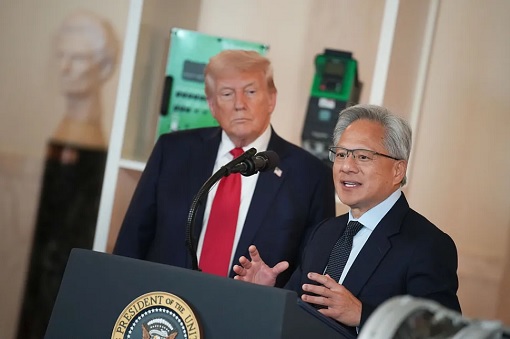
The billionaire’s business argument, along with the half-trillion-dollar investment offer from the world’s most valuable company, worked like a charm. The Taiwanese-American businessman, whose net worth hits close to US$160 billion, appeared to have struck a deal with dealmaker Trump using a brilliant reverse psychology, and a little bit of mind games.
It was only last month when the Trump administration decided to make a surprise U-turn to allow China to buy Nvidia’s H20 AI (Artificial Intelligence) chip. The news sent Nvidia’s stock up 4%, pushing its market capitalization further above the record US$4 trillion mark. The trade-off was that the Chinese-version H20 chip has been tweaked as a less powerful chip specially designed for China.
At a meeting with Huang in the White House last week, Trump made one more demand – Nvidia to give the U.S. government 20% of its chip sales to China in exchange for issuing the export licenses. “If I’m going to do that, I want you to pay us something,” – Trump said. Facing a choice of paying for long-term access to a market vital to his company or walking away, Jensen Huang countered with 15%.
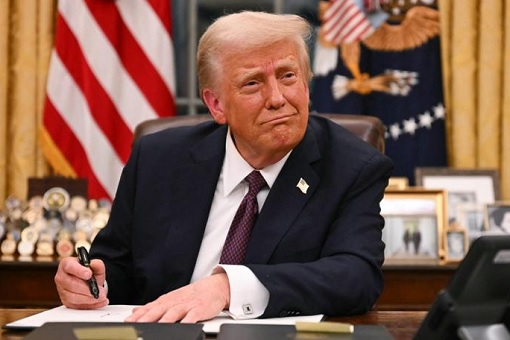
Call it bribes, deals, concessions or whatever you like. The unusual mixture of politics with business could face legal and security questions at a later stage. But more importantly, the U.S. is contradicting itself when previously, the US government had banned the export of the most advanced chips to China under the pretext of national security, only to reverse it in April.
To impress Trump at the meeting, Jensen Huang drew a diagram showing how tariffs would be counterproductive for his goal of increasing U.S. chip production. Shortly after, Trump announced he would exempt tech companies that invest in the U.S. from 100% tariffs on semiconductor imports. That was another spectacular U-turn after Trump said that he was looking at breaking up Nvidia due to its monopoly.
Thanks to Huang’s skillful lobbying, Donald Trump’s impression on him changed 180-degree overnight. Of course, it helped that Huang has also rained praise on Trump. “America’s unique advantage that no country could possibly have is President Trump,” – Huang said at a Washington AI summit in late July. An incredibly happy Trump praised Huang – “What a job you’ve done.”

But as Trump eyes Jensen Huang as new tech ally over Musk, some lawmakers from both Republican and Democrat have challenged Huang, arguing that if the Chinese get Nvidia chips, China’s AI companies could benefit – potentially aiding the Chinese military. Nvidia counters – “The H20 will not enhance anyone’s military capabilities but will help America win the support of developers worldwide”.
For years, Huang avoided the rough-and-dirty world of U.S. politics, preferring to schmooze with the videogamers who were the original customers for his chips. He resisted the lobbying game, delegating the task to his lieutenants. As Nvidia’s chips became one of the world’s most strategic commodities because of their role in AI, Washington remained a no-man’s-land for the Silicon Valley company.
Mr Huang didn’t visit the White House or engage lawmakers meaningfully until 2023, when he joined the chief executives of Intel and Qualcomm to lobby against new curbs on tech sales to China by the Biden administration. Nvidia condemned the Biden administration’s restrictions and warned the rules would benefit such Chinese competitors as Nvidia-rival Huawei.

When Trump won a second term, Huang faced the risk of even tighter U.S. controls on tech exports, largely due to anti-Chinese foreign policies. Nvidia hired former Trump national security adviser Robert O’Brien, co-founder of a consulting firm. O’Brien helped hammer a sense of urgency regarding breakthroughs from DeepSeek and other Chinese AI companies, as well as chip advances by Huawei.
In early April, when the White House was preparing to cut off H20 sales, Huang attended a US$1 million-a-head dinner with Trump at Mar-a-Lago. He told the president that selling the chip in China wasn’t a threat to national security. Huang also dangled an incentive – a promise to invest as much as half a trillion dollars worth of AI infrastructure and supercomputers in the U.S.
In early May, Huang spent about two hours with members of the House Foreign Affairs Committee to talk about the threat of Huawei and Chinese competitors and the need for Nvidia to have access to Chinese talent. Later that month, the Trump administration said it was getting rid of the Biden rule limiting chip sales to many friendly countries after pushback from Huang and other industry executives.

Crucially, Huang found a powerful ally at the White House – the so-called AI czar, David Sacks, who shared the fear of ceding the advanced chip market to Chinese rivals. The two men solicited the support of Commerce Secretary Howard Lutnick, who oversees export controls and is well-acquainted with tech companies from his former career as a Wall Street dealmaker.
They later went to see Trump for an unannounced meeting at the White House on July 10. Huang told the president that tight restrictions on Nvidia would just give Huawei a leg up in the AI race. Nvidia needed to access the Chinese market and its AI talent, Huang argued – “Does the president really want to let China get all the spoils and turn American champions like Nvidia into losers?”
President Trump – provoked and convinced – made his decision when Huang was in Beijing. China could have the H20 chips. Nvidia managed to play down concerns about chips being diverted to China’s military. On the contrary, Huang argued that Beijing would consider such a move risky because Washington could cut off access at any time. “They simply can’t rely on it,” – Huang said in a TV interview in July.
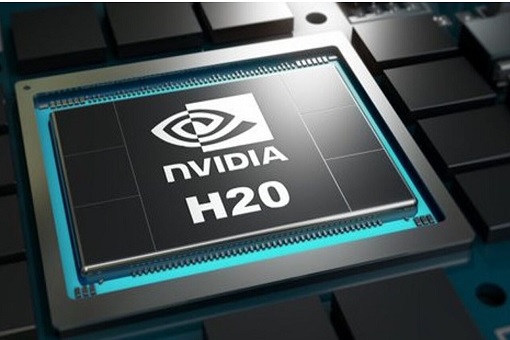
The H20 chip has played a critical role in filling sky-high demand for AI applications using open-source models such as Chinese-developed DeepSeek and Alibaba’s Qwen. While the H20 can’t be used for creating large AI models, such as the ones powering ChatGPT and other chatbots, engineers say the chip is still good at “inference” – the ability of AI programs to tap their training to answer user questions.
But a victory in Washington was only half the battle. Nvidia’s market share in China fell to 50% from 95% over the past four years thanks to U.S. restrictions. Huang visited China at least three times this year alone to reassure Chinese tech executives and government officials that Nvidia was committed to the market. He has met with top executives of Chinese cloud-computing leader Alibaba, smartphone and automaker Xiaomi and OpenAI challenger MiniMax.
People in China’s tech industry said they appreciated Huang’s efforts to modify his chips so they could be sold in China. Engineers there nicknamed him “Magic Tailor” for his skill in designing chips to thread the needle of U.S. regulations. But Trump makes things difficult when he brags that Nvidia sells only “old and obsolete” chips to China, allowing the U.S. to make tonnes of money.
However, it’s not easy to profit from China. Knowing the importance of the Chinese market to Nvidia, Beijing increased pressure on the company. China’s cybersecurity regulator summoned Nvidia and grilled it about security risks of the H20 chips, citing comments by U.S. lawmakers about the need for a bill to require tracking capabilities for advanced chips sold abroad.
On Tuesday (August 12), Beijing stunningly told local companies to avoid using Nvidia’s H20 processors, particularly for government-related purposes. On the same day, Nvidia rejected Chinese accusations that its AI chips include a hardware function or “backdoor” that could remotely deactivate the chips, also known as a “kill switch.” For obvious reasons, Nvidia will never admit even if its AI chips contain such vulnerabilities.
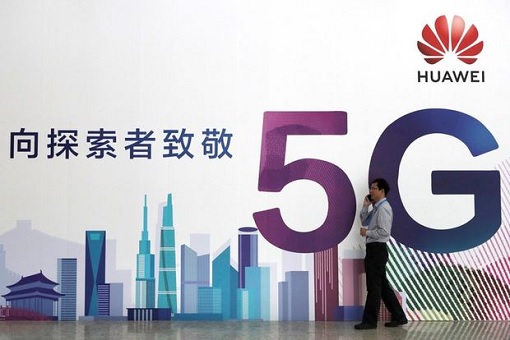
People’s Daily said Nvidia must produce “convincing security proofs” to eliminate Chinese users’ worries over security risks in its chips and regain market trust. The U.S. is tasting its own medicine. Trump previously had accused Huawei 5G equipment of having backdoor intended for use by law enforcement. Now, Beijing has turned the tables, using Trump’s playbook to accuse Nvidia of doing the same.
Exactly how could Nvidia prove that H2O chips do not have backdoor is both hilarious and challenging. In addition to Nvidia, Beijing’s latest move also affects artificial intelligence (AI) accelerators from Advanced Micro Devices (AMD). Both companies agreed to give the US government a 15% cut of the revenue from sales of lower-end AI chips to China.
To make things worse, some of Beijing’s letters to companies included a series of questions, such as why they buy Nvidia H20 chips over local alternatives, whether that is a necessary choice given domestic options, and whether they have found any security issues in the Nvidia hardware. China’s rejection, instead of rejoicing, shows the Middle Kingdom may not have desire for Nvidia AI chips as trumpeted by Trump.
There could be two possibilities. For starters, Chinese officials are worried that Nvidia chips could have location-tracking and remote shutdown capabilities. Second, Nvidia chips are clean, but China deliberately accuses the company of having security loopholes because Beijing wants Chinese companies to shift away from Western chips in favour of local offerings.
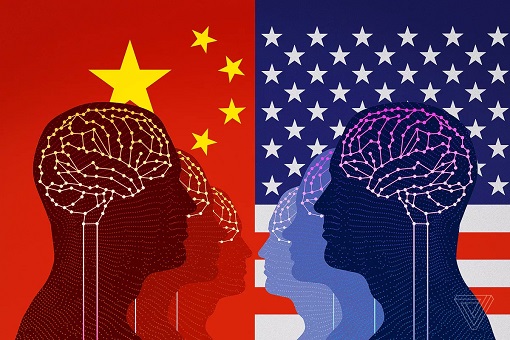
It was also an insult to China for Nvidia to dump its H20 chips – a less-advanced semiconductor compared to its flagship H100 and B100 chips – on Chinese soil. Beijing also knew the U.S. wanted to keep the Chinese AI ecosystem reliant on less-advanced U.S. technology for as long as possible in order to deprive Huawei of the revenue.
Other Articles That May Interest You …
- Give Him Something To Brag About – Apple CEO Tim Cook Shows How To Scam Trump To Avoid Tariffs
- Forget 39% Swiss Tariffs – India In Bigger Trouble As Trump Slaps Extra 25% Tariff To 50%
- Malaysia, Thailand, Cambodia Celebrate 19% Tariffs – The Art Of Sucking Up Trump & Surrendering Concessions
- Trump Threatens 100% Tariffs On Russia – But Here’s Why Russian Markets Jump In Celebration Instead
- Pawns Europe & Ukraine Got Played – The Hidden Message Behind US-Russia Talks In Saudi Without Allies
- China Secretly Hiding Tonnes Of Gold – The Buying Spree In Preparation Of Trade War, Sanctions Or Even Invasion Of Taiwan
- Sanction My Foot! – Russia Makes A Mockery Of Western Oil Sanctions, While China & India Laugh All The Way To The Bank
- Welcome To The Club – Here’s Why France Wants To Join BRICS, And Why Russia Objects The Idea
- Europe Closed Front Door, But Opens Backdoor – How India Makes Easy Money Reselling Russian Cheap Oil To EU
- France Joining De-Dollarization – Why China Gave Macron Lavish Banquet, But Treated Ursula Like Pariah
- Black Market For Oil Is Booming – How Russian “Dark Fleet” Of Tankers Evade Western Price Cap

|
|
August 13th, 2025 by financetwitter
|


|

|

|

|

|

|















Comments
Add your comment now.
Leave a Reply