



For as long as one can remember, Chinese President Xi Jinping has been calling for mutual respect, peaceful coexistence, win-win cooperation, and dialogue among major powers. He has said China should be treated with respect to reducing US-China competition. And he has said that countries should respect one another’s sovereignty and territorial integrity, a message especially for the U.S.
Xi has also vowed China will never “swallow the bitter fruit” of foreign meddling or invasion. On Wednesday (Nov 18), he showed Donald Trump the meaning of respect – personally greeted the U.S. president in a surprise appearance on the tarmac in Shenzhen, China, reciprocating a gesture by Trump during Xi’s state visit to Washington in September.
Flashback: In September 2026, Trump welcomed President Xi at Joint Base Andrews for the Chinese leader’s state visit to Washington, D.C. American presidents typically receive foreign leaders at the White House. Even then, Mr Xi did not break the protocol of hugging or embracing Mr Trump. This time, Xi Jinping broke nearly five decades of convention.
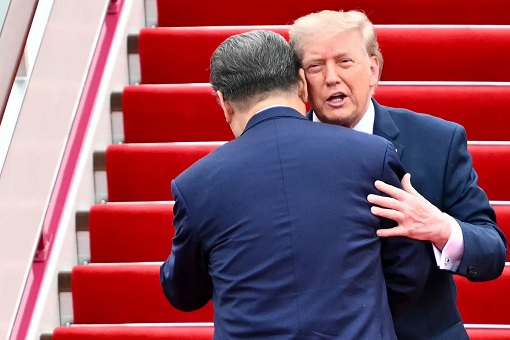
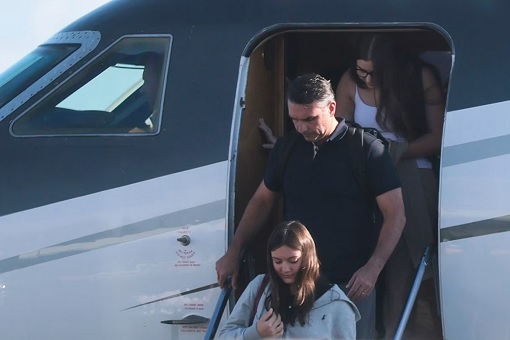
Arriving in China for the annual APEC conference just hours after spending time in the Philippines, Trump received the unusual diplomatic gesture when Xi met him at the bottom of Air Force One’s stairs. When Putin arrived in Shenzhen earlier, he was greeted only by Xi’s chief of staff Cai Qi. The Chinese president did not personally greet Trump when he visited Beijing in May.
Greeted with people waving colourful pom-poms and brandishing Chinese and American national flags, the two leaders shook hands, then had a brief hug and a short exchange before walking along the red carpet to their motorcades. “China is a country that values etiquette and has a tradition of reciprocity,” – Xi told Trump, according to Xinhua.
When a red dragon hugs a white eagle, it speaks volumes about the respect two leaders of world’s superpowers have for each other. Trump thanked Xi for coming to the airport in person and for China’s “special arrangements”, calling Xi a great leader and said he had enjoyed every one of their meetings. The last time Xi met a U.S. president at airport was in 2009, when he, then China’s vice president, received Barack Obama.
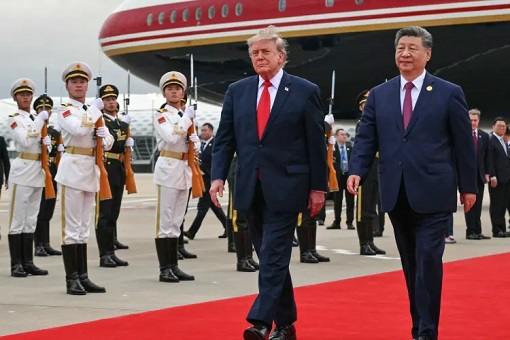
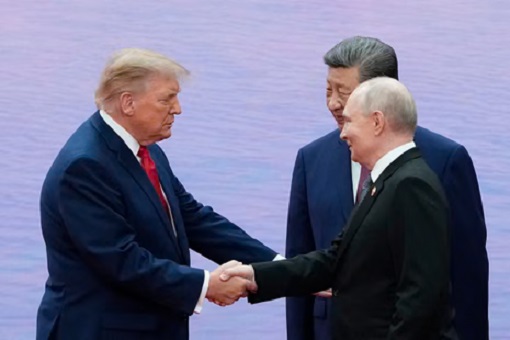
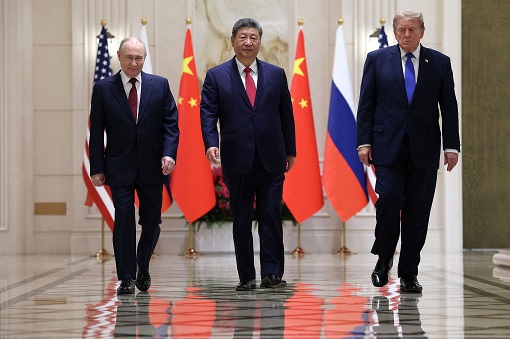
But the historic moment of mutual respect was just the appetizer. In an unprecedented show of unity among the stewards of the world’s three largest nuclear arsenals, Xi Jinping, Donald Trump and Russian President Vladimir Putin made headlines a day before their trilateral talks when the group of influential world leaders were pictured together in Shenzhen for the APEC summit.
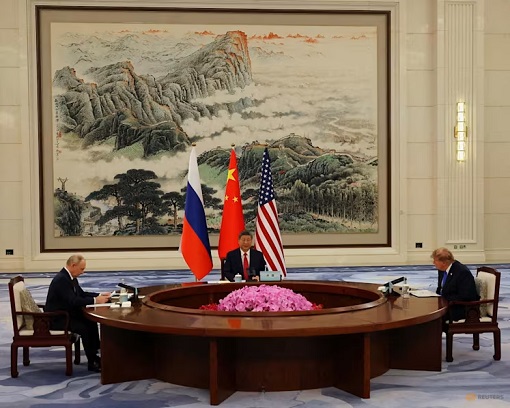
The first-ever gathering of the American, Chinese and Russian leaders was a further sign of the end of a unipolar world order dominated by the United States. “We are really making history,” – Trump said as they opened the 90-minute meeting, sitting around a large, round wooden table under a towering Chinese landscape painting. “No problems were ever solved under the old school, refusing to talk about them.”
The trilateral meeting has drawn comparisons with the 1945 Yalta Conference between the U.S., Britain and the Soviet Union that formalised spheres of influence, set the stage for the post-World War 2 order and became shorthand for great-power deals imposed on smaller countries. It has also unnerved leaders of smaller economies, particularly in Europe and Asia, who fear the world’s greatest military powers will disregard their interests.
However, the three nations remain divided by their competing ambitions and conflicting visions. Putin wants Washington to stay out of his way in Ukraine. Xi wants the U.S. to accept his claim that self-ruled Taiwan belongs to China. And Trump has made pushing Chinese and Russian influence out of the Western Hemisphere a central element of his so-called “Donroe Doctrine” to reassert U.S. dominance in the region.
While there was little indication that progress could be made on the major issues they brought to the table, they share something else – just sitting together is already a great achievement. Each of them would go home a winner. Going into the meeting, Trump embraced the historic gathering to promote an image of himself as a global peacemaker alongside two autocrats whom he has long admired.
With his party reeling from its midterm defeats, Trump left Washington eager to use his final two years in office to cement his legacy on the world stage. “We have a chance to accomplish a lot,” – he said as he departed for Asia, even though he has offered little indication of what he hoped to accomplish with Xi and Putin in Shenzhen, beyond opening talks on nuclear arms control.
The U.S.-backed New Strategic Arms Reduction Treaty, or New START, the last treaty limiting Washington and Moscow’s strategic nuclear arsenals, expired earlier this year. Trump has pushed for a broader agreement that would include China, whose rapid rise as a nuclear powerbrings new complications to any denuclearization effort. Beijing has repeatedly resisted joining the nuclear treaty.
For Vladimir Putin, the gathering marked a remarkable diplomatic comeback nearly five years after his invasion of Ukraine made him an international pariah. Russian media are describing the meeting between Xi, Putin and Trump in Shenzhen as “the main images of the day”, even a “historic handshake” – precisely the image the Kremlin was hoping for.
Unlike the US and China, Russia is not among the world’s three largest economies. Yet, at the APEC summit, Vladimir Putin clearly feels like a leader equal to Xi and Trump. Crucially, Moscow is sending a message to the world – attempts to isolate Russia have failed, despite its ongoing war in Ukraine. Even before the meeting among the leaders begins, Putin has already achieved his main objective.
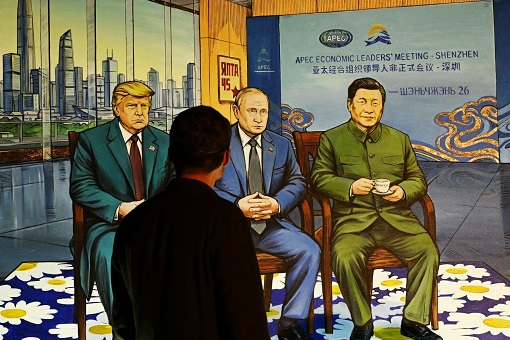
Putin’s very presence in this exclusive club, and the attention of the world’s media, allows Moscow to position itself as one of the world’s unshakable powers. “He’s my friend,” – Trump said after greeting the Russian leader for a two-way meeting earlier in the day. “We knew each other for a long time, and I think a lot of wonderful things can come out of this.”
More importantly, it was Putin who had first proposed a trilateral summit alongside the APEC meetings as a venue to discuss ending the Ukraine war. His place at the sit-down with the leaders of the world’s two largest economies underscored the limits of Western efforts to isolate him. Trump later said he and Putin had a lengthy discussion on Ukraine.
Xi Jinping, while playing host, has long said that it doesn’t belong in arms-control talks, saying its arsenal is dwarfed by those of Washington and Moscow. But Xi benefits just by being there. The meeting places the Chinese leader on an equal footing with the U.S. president, while standing alongside a close partner in Putin over whom he holds an overwhelming advantage.
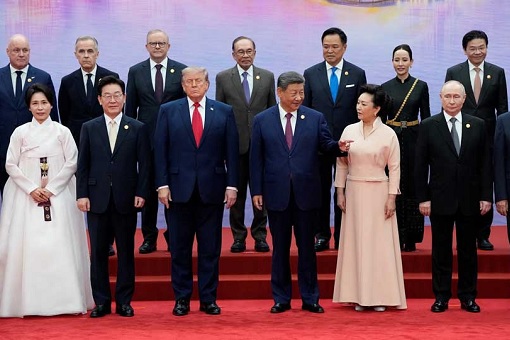
The Chinese leader gains from this trilateral meeting is the chance to look like the pivot player in international politics, convening this would-be “G3” on Chinese soil and sitting alongside his closest partner on the world stage, Putin, to negotiate with a remarkably friendly American president. “As long as you and I are in charge of things, we’ll never have a problem,” – Trump said as he met with Xi.
This is the kind of high-profile diplomatic event Trump just loves. The American president, standing alongside the leaders of China and Russia, to tackle issues of global importance. In fact, it’s not an exaggeration to say that Trump has seemed to be the most enthusiastic participant. Despite being given a rare personal welcome, he faced criticism from both Xi and Putin over U.S. economic sanctions and restrictions.
At the APEC CEO summit this morning, Xi called for “free and open trade”, while Putin touted Russia’s resilience under sanctions. Russia’s military, technology, and industrial sectors have been targeted over Moscow’s war in Ukraine. China, meanwhile, faces sanctions and restrictions linked to human rights, advanced technology and military development.
Not all leaders are treated equally. While leaders from Australia, Canada, South Korea and others were met by dancers and soldiers hoisting rifles, Japanese Prime Minister Sanae Takaichi was instead shown to a car after landing without any welcoming ceremony. Her visit to China comes amid a rift between Beijing and Tokyo that began a year ago after she said Japan could deploy its military if a Chinese move on Taiwan also threatened its territory.
Other Articles That May Interest You …
- Rare Window – How Xi Hopes To Swing Trump Against Taiwan
- Shows Of Strength – Xi Warns Trump Against Taiwan Mishandling
- Leaked Documents – How Russia Is Preparing China To Invade Taiwan
- China Secretly Hiding Tonnes Of Gold – The Buying Spree In Preparation Of Trade War, Sanctions Or Even Invasion Of Taiwan
- A Strange Submarine Design – The West Worries Chinese Latest Stealth Attack Sub Could Strengthen Sea Blockade On Taiwan
- Democracy & Autocracy – Does U.S. Really Care About The Taiwanese People Or Practise True Democracy?
- The Biggest Winner – A Free “Case Study” For China To Learn The World’s Response If They Were To Invade Taiwan
- Warning To The U.S. And Taiwan – Here’s Why China Sent Record 56 Warplanes Into Taiwan, Raising Fears Of War
- Economic Destabilization – How China Prepares For American & Japanese Military Interference In Taiwan Conflict
- China Suddenly Banned Taiwanese Pineapples – And Taiwan Says The Political Retaliation Is Unfair & Unfriendly

|
|
November 19th, 2026 by financetwitter
|


|

|

|

|

|

|











Comments
Add your comment now.
Leave a Reply