



The louder Malaysian Prime Minister Anwar Ibrahim screams about anti-corruption, the smellier the stench of corruption becomes under his administration. That was the joke on the street. While he tries very hard to convince the public that corruption is being eliminated, the perception is that corruption remains business as usual. Worse, Anwar’s own circle was involved in corruption.
From the PM’s political secretary, Shamsul Iskandar, to his former aide-turned-crony, Farhash Wafa Salvador Rizal Mubarak, and from Sabah Chief Minister Hajiji Noor to Deputy Prime Minister Ahmad Zahid Hamidi, Anwar’s fingerprints can be traced to protecting corrupt politicians in his Madani government. Even jailed ex-PM Najib Razak received special privileges.
The Ministry of Home Affairs under Saifuddin Nasution – a loyalist rewarded with backdoor minister – was no exception. In fact, the ministry in charge of national security, public order, immigration, law enforcement, and border control is arguably the most corrupt institution in the country. And the migrant worker system is just one of many cash cows that enrich many in the crooked system.
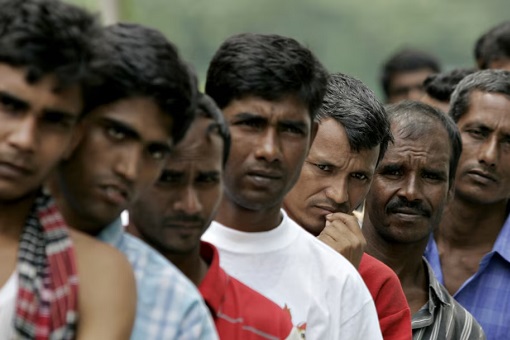
His name was Shofiqul Islam. He had borrowed to pay US$4,400 for a construction job that he had been promised in Malaysia – an astronomical sum for a Bangladeshi farmhand. He had gambled everything on leaving home to build a future for his two young children. The migrant worker – indebted, jobless and stranded in a foreign country – tried to keep it together as he picked up the phone to call his wife.
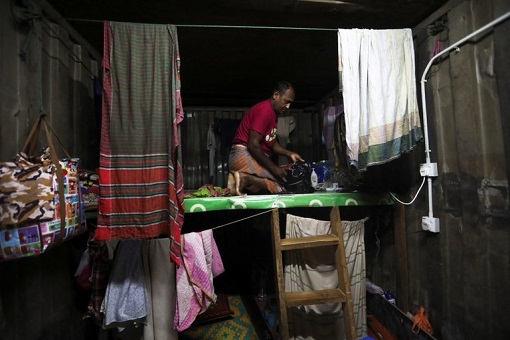
A representative for his employer had picked him up at the airport, and he was eventually dropped at a run-down building outside Kuala Lumpur. Three flights up, past a rusty metal gate, was a room with a stack of worn mattresses, a gas stove, two hole-in-the-floor toilets and a hose for a shower. Wait here, the representative said. Then he disappeared.
After 147 days, the job still hadn’t materialized. Shofiqul’s employer had gone silent. His visa had expired. And with each passing day, the interest on his debt escalates. In the sparse dormitory that morning in February 2024, Shofiqul agonized over his situation. But once his wife and six-year-old daughter emerged on the screen, he smiled, hiding his true feelings.
They spoke for an hour. He asked his daughter about the dragon fruit trees he’d planted near their home. Were they growing? Had white flowers sprung from them yet? And he consoled his wife: He’d heard the wait was almost over. “Don’t worry,” he said. “The job will come very soon.” But the job never came, and he would pay dearly for coming to Malaysia.
Shofiqul was one of more than 800,000 Bangladeshi workers who went to Malaysia over the past decade, often going into debt to pay recruitment fees far higher than people from other countries, sometimes on the promise of jobs that never existed.
Interviews with more than 100 people, including current and former government officials, labour analysts, recruitment agents and Bangladeshi migrants, describe a recruitment process shaped by entrenched corruption and designed to extract as much money as possible from desperate workers, often leading to debt bondage, forced labour and even human trafficking.
More than a dozen of those interviewed suggest that figures in Malaysia’s ruling elite, including at the highest levels of government, are aware of the issues but don’t – and won’t – attempt to fix them because the recruitment fees line the pockets of everyone involved. Most asked not to be identified discussing sensitive matters, with some citing fear of retribution.
A representative for the office of Malaysian Prime Minister Anwar Ibrahim referred Bloomberg to the Ministry of Home Affairs, which didn’t respond to repeated requests for comment. Bangladesh’s government didn’t respond to requests for comment. Everyone has something to hide in the comprehensive network of corruption in the Bangladesh-Malaysia migrant worker system.
True, migrants from around the world borrow to pay recruitment fees. They’re at risk wherever they go. But Malaysia’s recruitment from Bangladesh is one of the more extreme examples where private business people and government officials were working hand-in-glove to squeeze workers, Bloomberg’s reporting suggests. It also has a unique backstory that shows how money and power intertwine in Malaysia.
Shofiqul was born in 1990 in Mulgram, a village hugging the bend of a river in western Bangladesh. A matchmaker paired him with a girl named Hosne Ara Khatun. They married and later fell in love while farming garlic, rice, and jute. They had two children – a boy and a girl. Whatever they earned they spent on daily needs. “He wanted to earn more,” – Hosne Ara said. “He was desperate to go abroad.”
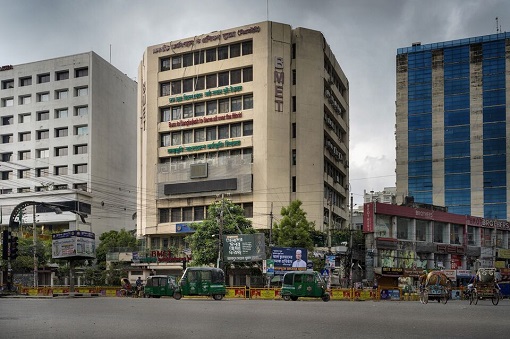
A village official introduced Shofiqul to a recruitment agent. The US$4,400 fee Shofiqul paid would be the equivalent of an American paying US$140,000 for a job. With a population of more than 170 million and not enough jobs, Bangladesh is a global supplier of workers. “Born in Bangladesh to serve all over the world,” – reads a sign outside a government building in Dhaka, the capital.
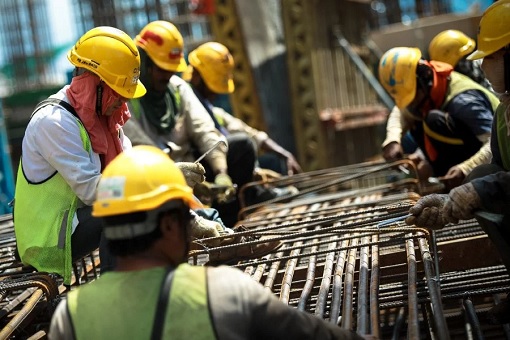
Malaysia is a top destination. Migrant workers hold one in five jobs there, revealed the U.S. State Department. They staff shops and factories. They toil on plantations. They help produce 25% of the world’s palm oil, 45% of its rubber gloves and more than US$100 billion in electronics and semiconductors annually.

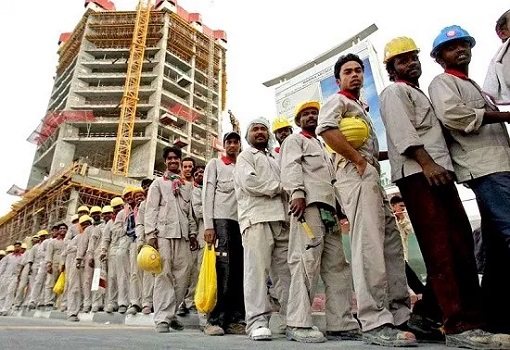
They build the skyscrapers shaping Kuala Lumpur’s skyline and the data centers powering Southeast Asia’s AI revolution. “Without them, the economy would collapse,” – said Charles Santiago, a former Member of Parliament in Malaysia who oversaw investigations into migrant-worker abuse as head of a parliamentary committee on human rights.
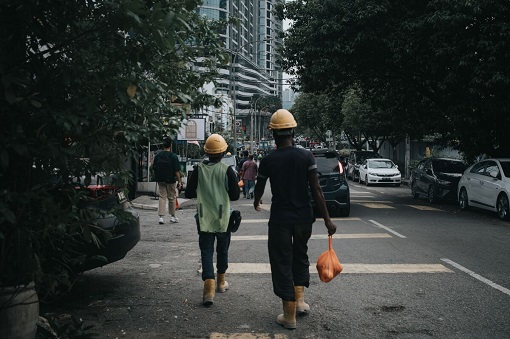
“But we treat them badly,” he said. They work at least six days a week, sometimes getting cheated on wages. They’re randomly searched by police. They live in crowded dormitories, abandoned buildings or even the garages of buildings they’re constructing. Few complain. They can’t risk losing their jobs because they need to repay their debts. Of all these migrants, none owes more than those from Bangladesh.
Malaysia has been recruiting Bangladeshis since at least the 1980s, and people at every step of the process have always demanded unofficial payments or kickbacks, according to more than 30 people familiar with the matter. But migrants had to pay much more, the people said, after one man, also originally from Bangladesh, came to play a key role.

{ Bangladesh Is Malaysia’s Leading Source of Migrant Workers }
His name is Aminul Islam Abdul Nor, but he goes by Amin. He’s a highly controversial member of Malaysia’s elite. Some people say he’s responsible for many of the troubles faced by incoming Bangladeshi migrant workers. In his first interview with Bloomberg News in July, Amin claimed he has devoted his career to helping migrant workers – and the issues they experience have nothing to do with him.
In the past 10 years, companies Amin founded have generated more than US$100 million (RM400 million) in profit, filings show. It’s unclear how wealthy he is. Amin didn’t respond to a request for comment on his wealth. But before he became so powerful, Amin made the journey from Bangladesh himself, eventually arriving in Malaysia in 1988 at age 21, and is now a Malaysian citizen.
He worked tirelessly, according to four people who say they knew him then. They called him a smooth operator – understated, soft-spoken and charming, with a knack for cultivating relationships. Behind the affable veneer was a shrewd businessman, they said. A few years later, he established a company providing worker housing and transportation. Later on, he started bringing in tens of thousands of workers himself.
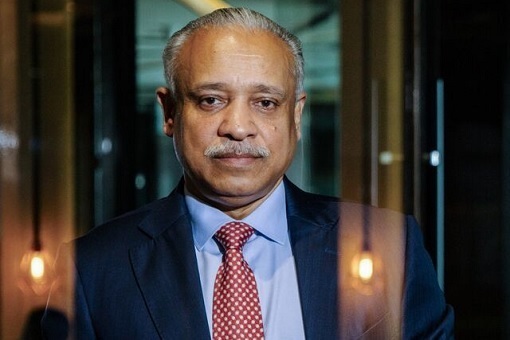
In 2008, Amin founded a company called Bestinet. It developed software to digitize Malaysia’s paper-based recruitment. He pitched it to the government, saying it would curtail corruption. That year, the Minister of Home Affairs was Syed Hamid Albar, who would be succeeded by Hishammuddin Hussein (2009-2013), Zahid Hamidi (2013-2018), Muhyiddin Yassin (2018-2020), Hamzah Zainuddin (2020-2022) and current Mr Saifuddin.
Some government officials had doubts, suspecting Amin of exploiting migrant workers. Nizam Jakel, a Malaysian businessman hired to lobby for Bestinet, said in testimony in a lawsuit years later that accused him and others of trying to take over Amin’s business. (Amin’s side won and Nizam’s side appealed. The suit was then settled on undisclosed terms. Nizam declined to comment for this story.)
The International Labour Organization (ILO) reviewed Amin’s system at his request in 2013. The United Nations body called it innovative and comprehensive but not “fool-proof in protecting migrants from excessive fees,” adding it “does not know of the credentials or competence of Bestinet,” according to comments reviewed by Bloomberg News.
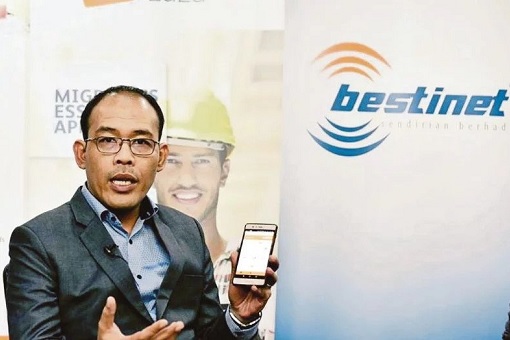
Two years later, Malaysia stunningly adopted the system – Foreign Worker Centralized Management System (FWCMS) – to process the entry of foreign workers into the country. Four people who know Amin say he understood the importance of powerful allies for doing business in Malaysia. He put several former senior government officials on his companies’ boards.
He even forged an alliance with an influential politician, Ahmad Zahid Hamidi, according to people who know the man. In 2015, when Malaysia adopted Bestinet’s system, Zahid was home affairs minister, overseeing immigration. That year, he announced Malaysia would bring in as many as 1.5 million Bangladeshi workers. It was a win for Bangladesh.
There was a catch – monopoly. All recruitment orders had to be routed to just 10 of Bangladesh’s more than 1,000 agencies, effectively ending open competition. Three former Bangladeshi officials said Malaysia insisted on the unprecedented arrangement. If Bangladesh didn’t comply, according to the officials, Malaysia under Zahid warned it would recruit elsewhere.
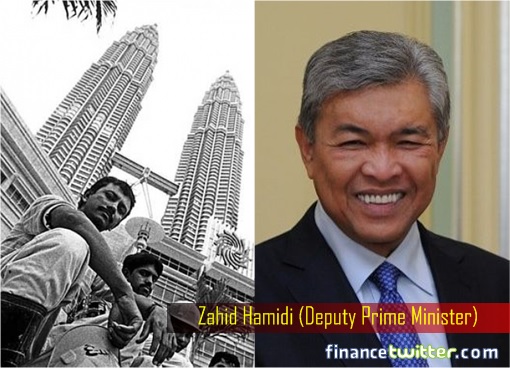
Amin and Zahid played key roles in this, according to six people who say they discussed the matter with Amin or were briefed on it. Amin chose the agencies and Zahid handled the politics, the people said. Zahid also instructed a Ministry of Home Affairs official to issue Bestinet a letter of acceptance for its software, the official later told a parliamentary committee.
Hanky-panky kicked in when the ministry issued the letter “before finalizing the terms and methods of procurement,” the committee found in 2025. Four people who attended meetings described their interactions as friendly. In the July interview, Amin said Malaysia selected the agencies and denied being friends with Zahid. In 2018, Zahid denied any involvement with Bestinet.
Limiting the agencies “had all the hallmarks of a syndication or cartel” to control recruitment costs, according to a 2018 lawsuit against the 10 firms and Bangladesh’s government by agencies that lost business. It didn’t name Amin or Bestinet as defendants but said Amin helped devise the plan. The firms weren’t picked on merit, the suit alleged. Six had never sent workers to Malaysia. The defendants and Amin denied the allegations. The suit was later withdrawn with no findings of wrongdoing.
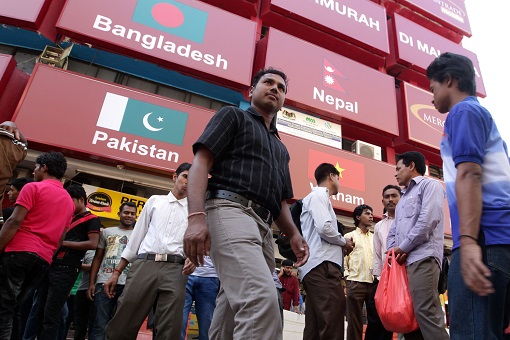
These 10 agencies began unlawfully charging workers an additional fee, known as a syndicate fee – about US$1,350 cash, according to allegations in letters from Bangladeshi agents to their government, witness statements collected by Bangladeshi criminal investigators, and interviews with 17 agents in both countries. If the fee wasn’t paid, they wouldn’t return workers’ passports, according to allegations in the interviews and documents.
Amin has an associate – Ruhul Amin, the owner of recruitment agency Catharsis International who collected the syndicate fees, which amounted to more than US$1 billion (RM4 billion) over a 10-year period, according to allegations in a letter signed by 453 Bangladeshi agents that haven’t been verified by Bloomberg. The profit was mouth-watering.
If agencies in the group of 10, which was later increased to 100, didn’t pass on the syndicate fees to him, Bestinet’s system wouldn’t give them any new orders, according to interviews with the 17 agents. In short, Zahid and Amin controlled and monopolized the entire lucrative supply chain of migrant workers in the country, enriching them in the process.
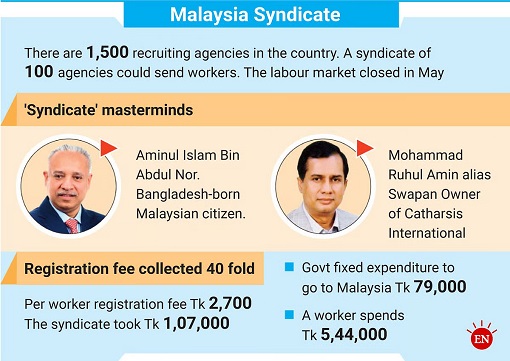
This fee and other charges pushed the per-person recruitment cost to as high as US$6,600, according to a 2024 memo prepared for Prime Minister Anwar by the Madani Research Centre, a Kuala Lumpur think tank. That’s more than twice what Bangladeshis paid before Bestinet became involved, according to the ILO, and more than double what Indonesians and Nepalis pay, according to agents who recruit there.
{ How Everyone Gets A Cut }
Amin pretended – even claimed – that he has never heard of syndicate fees. “I never met a single worker, so how do I collect money?” – he said. “People talk this way because they think they’re losing money because of us. We are the threat of the industry.” Of course, he lied as everyone gets a cut. It began with the recruitment agent that initially hooks the worker charges a recruitment fee of US$340.
The worker then passes through layers of regional agents before he eventually reaches a licensed recruitment agency in Dhaka. Each takes a fee, totaling US$1,300. The worker becomes US$250 poorer when he pays for a medical checkup and administrative fees. And before he departs, he pays a syndicate fee of US$1,350, not to mention US$340 for the airfare to Malaysia.

Then the worker would pay US$420 – a tax meant to be paid by his employer. Thereafter, he pays a fee of US$1,000 for the employer’s Malaysian agent – some of it allegedly goes to government officials in exchange for the approval to hire the worker, to executives at the employer, and to other middlemen. In total, a Bangladesh worker pays about US$5,000 for a job in Malaysia, often using borrowed money.
Three of the 10 agencies – Catharsis, Prantik Travels & Tourism Ltd. and Career Overseas Consultants Ltd. – denied collecting unlawful fees. The others didn’t respond to requests for comments. Catharsis was selected on merit and “never involved in any kind of unauthorized financial transaction,” the agency said, adding Ruhul “is a proponent of ethical recruitment.”
It’s unclear how many of the more than 800,000 Bangladeshis who came to Malaysia since 2016 paid syndicate fees, or where the money went. There’s no evidence it went to Amin. But Bangladesh’s police arrested dozens of the selected recruitment agents in 2024 in an investigation into alleged money laundering, extortion, and trafficking of migrant workers.
They asked Malaysia to stop using Bestinet’s software and called for Ruhul, who had left Bangladesh, and Amin to be extradited. The pair played key roles in a system that “fraudulently extorted money” from workers, Bangladesh’s branch of Interpol wrote to Malaysia, causing them “physical and mental torture.” But the Anwar government has no plan to do so.
While Amin denied the allegations, Minister of Home Affairs Saifuddin Nasution Ismail said in October that Malaysia’s police are in touch with their Bangladeshi counterparts. Amin hasn’t been extradited for obvious reasons. Clearly a delaying tactic, Saifuddin said the Malaysian government requested further clarification from Dhaka regarding the application.
The morning after Shofiqul called home he gasped for air, waking his roommates. They knelt around his mattress as he went into convulsions. Then he died.
A Bloomberg reporter visited the building a week later. His roommates, who had also been promised jobs, and other Bangladeshi workers living nearby gathered to recount what happened. They said the landlord called an ambulance that took away his body. Neither the workers nor Shofiqul’s widow knew the cause of death.
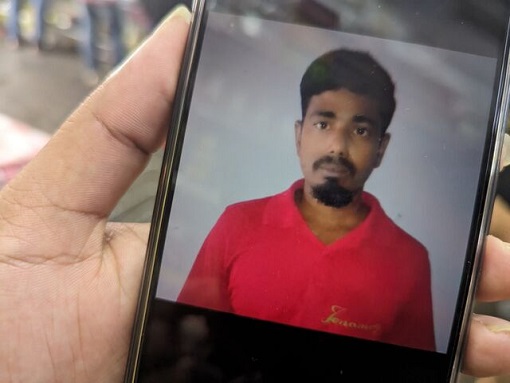
The men said Shofiqul had begun to despair about his situation. His visa had expired, so if he sought help from authorities he would have been deported. His options were to wait for his employer, Petrazehra Bhd., to provide the job, or disappear into Malaysia’s underworld of undocumented migrants. Petrazehra was approved to recruit 1,500 Bangladeshis.
But according to documents reviewed by Bloomberg, Petrazehra had recorded no revenue in the previous two years. Its owner, Muhaimin Mohd Fadhilah, didn’t respond to requests for comments. Bangladesh’s government has said at least 8,000 workers didn’t get promised jobs in recent years. A Malaysian official said the true figure is probably in the tens of thousands.
Shofiqul “clearly is a victim of human trafficking,” – said Latheefa Koya, a former Chief Commissioner of the Malaysian Anti-Corruption Commission (MACC). She described him as an extreme outcome of the institutional corruption in Malaysia’s recruitment of Bangladeshi workers. She and five other current or former senior members of Malaysia’s government outlined how it permeates every step of the process.

Government staff seek bribes from companies, which pass the costs on to agents in both countries, who pass them on to the workers. Because bringing in workers has become so lucrative, some companies deliberately over-recruit or promise fake jobs, they said, to illegally subcontract workers. The recruitment fees sustain the system. Everyone gets a cut, and the workers pay.
“This involves so many layers of people, even ministers,” – said Mahathir Mohamad, a former Malaysian prime minister who sought to reform the system. Recruitment costs affect workers even when the jobs exist. Malaysia prohibits them from switching companies, meaning they must stay in one job until they’re debt-free, creating a dangerous dependency.
Since 2019, U.S. authorities have sanctioned eight Malaysian companies for alleged forced labour, taking advantage of workers through debt bondage, threats or intimidation, while Malaysian suppliers of several global corporations have faced similar scrutiny. Documents and interviews with labour activists show the cases have a common feature – Bangladeshi workers with recruitment debts.
Malaysia’s cabinet discussed these matters after Anwar became prime minister in 2022, according to people with knowledge of the deliberations. He campaigned on eliminating graft and even called for an investigation into Bestinet. The MACC had started a probe. Cabinet officials knew Amin played a central role in Bangladeshi worker recruitment via his control over the agencies, which escalated costs.
Eliminating Bestinet as a government contractor would be a first step, some officials reasoned. In late 2023, the cabinet decided to cut ties after Bestinet’s contract expired the following year, according to people familiar with the matter. It looked like Amin’s run was ending. But the corruption is so entrenched that Amin has nothing to fear.
Amin tapped his network. He visited the MACC to speak with its chief, Azam Baki, who was himself tainted with corruption. Strangely, the commission’s investigation was dropped, the people said, asking not to be identified for fear of reprisals. The MACC declined to comment. Amin said he went there to give statements but denied ever meeting Azam.

Amin also asked top officials to lobby Anwar to extend Bestinet’s term, according to people with knowledge of the matter. Zahid, who is now deputy prime minister, privately pushed the prime minister, the people said. At the end of a cabinet meeting in early 2024, Anwar made a surprise announcement – Bestinet would get an extension. Amin said it was “based on merit” and he wasn’t involved.
On the morning of the interview last July, Amin arrived at Kuala Lumpur’s Mandarin Oriental Hotel flanked by two attorneys and Bestinet’s chief executive officer, Ismail Mohd Noor. He wore a linen blazer and a shirt with cuffs monogrammed “D.S.A.” for Dato’ Sri Amin – an honorary title. On one wrist was a smartwatch, on the other what appeared to be a Cecil Purnell, a timepiece that costs more than US$100,000.
Speaking for three hours, the two men said Bestinet’s system sped up worker processing, weeded out application fraud and eliminated in-person meetings that invite bribery. They said it ensured worker health checks can’t be gamed and companies can’t bring in uninsured workers. It eliminated illicit charges and made recruitment cheaper, safer and cleaner, they claimed.
Amin likened his system to a highway. He argued that he can’t control how people drive and isn’t responsible if officials approve bogus applications or agents overcharge workers. Authorities have scrutinized Bestinet and found no malpractice, he said. Unscrupulous agents in Bangladesh are the problem, Amin said. He stopped them from exploiting workers, he said, and now they’re slandering him.
“People keep on talking about Bestinet, keep on talking about me: ‘They take over this, take over that, monopoly, political connector, political influence’ – a lot of things,” – he said. He said he devoted his career, spanning 38 years and seven Malaysian governments, to helping migrant workers. “We are the ones who get the blame because we provide a solution.”
Amin was also critical of what happened to Shofiqul, whom he said he didn’t know. He questioned Shofiqul’s employer for bringing him in without a job, and Malaysia’s government for allowing that to happen. Meanwhile, after Shofiqul’s death, his still-jobless roommates quietly disappeared, probably into Malaysia’s black economy.

“They have to pay back what they borrowed,” – said Santiago, the former member of parliament. His argument is that the system itself is the villain, and within it, many people are at fault. The migrant workers “are victims of a big network that’s managed by elites and government operatives,” he said. He predicted Malaysia would suffer the consequences once global companies take notice.
“The path from Bangladesh to Malaysia is one of the most exploitative labour routes in Asia,” – said Andy Hall, a labour activist. “Bangladeshis work all over Malaysia’s economy. If you’re a global company buying from there, there’s no chance your supply chain is clean.”
Twelve days after that morning in early 2024, Shofiqul’s body was flown to Dhaka. Hosne Ara made the day-long journey from Mulgram to collect her husband’s remains. He was buried near his father’s home in the village. Hosne Ara said the agency refunded about half of his recruitment fee, and a few Bangladeshi workers in Malaysia sent some money. But she has to repay the rest, and she doesn’t know how.

Later, she and the children made a short journey over narrow roads that cut across the plains of the Padma River, back to the village where she was born. They moved in with her parents and brothers. She rarely goes back to Mulgram, saying she doesn’t feel safe there after dark. The dragon fruit trees that Shofiqul planted are still growing in the village, she said. Nobody tends to them anymore.
Neither Amin nor Zahid would be charged, let alone go to jail. Charging Amin would drag Zahid into a scandal, which in turn would tarnish Anwar’s image. The fact that Bestinet was personally rewarded by the prime minister with an extension when the company should be blacklisted speaks volumes about the Madani government’s empty rhetoric in fighting corruption.
Other Articles That May Interest You …
- Race C Bribes, Race M Receives – But It’s Race M Who Asks For Bribes First
- MACC Mole & Traitor – How Azam Baki Was Complicit In 1MDB Scandal
- Congrats Najib – Double Celebrations With New 15 Years’ Jail
- More Prison Time For Ex-PM Najib – Jasmine Loo Is Set To Sing Like A Canary As Witness In 1MDB Scandal
- 3rd Time U.S. Says “No Saudi Donation” – FBI Confirms Najib Stole RM3.2 Billion, Riza RM1 Billion & Jho Low RM6 Billion
- Sex, Bribes & Blackmail – Najib’s Appeal In Jeopardy After Leissner Exposed More Dirty Deals In 1MDB Scandal
- Corruption Scandal – How Anti-Corruption Chief Azam Baki’s Half-Baked Story Backfires & Implicates Him Even More
- 12 Years’ Jail & RM210 Million Fine For World’s Biggest Crook Najib – A Result Of Insulting The Judge’s Intelligence
- Day-72 Of SRC Trial: Najib’s Top-8 Lies That Were So Extraordinary They Might Backfire & Incriminate The Crook
- U.S. Securities Commission – No Saudi Donations, Najib Received RM2.6 Billion Kickbacks From 1MDB
- SRC Trial – Here’re 10 Points Any First Year Law Student Can Use To Nail Najib & Send The Crook To Jail

|
|
January 29th, 2026 by financetwitter
|


|

|

|

|

|

|























Comments
Add your comment now.
Leave a Reply