



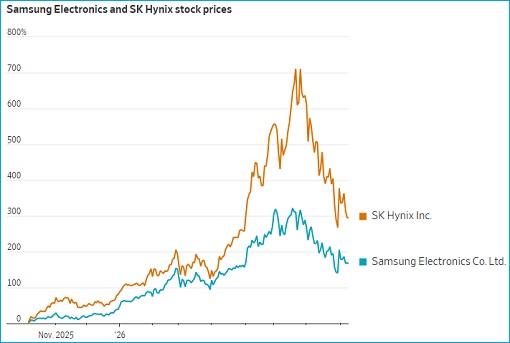
Everybody from teachers to retirees joined South Korea’s stock market frenzy, betting prices would rise forever. Samsung Elecronics share price was up by 320% in June 2026 – a staggering jump from October 2025. In the same period of nine months, SK Hynix jumped by 710%. KOSPI Composite Index skyrocketed from 3,455 (Oct 1, 2025) to 9,114 (June 22, 2026) points.
Lee Ka-young, a 25-year-old software developer, started investing in December, when her first paycheck from a new job left her convinced she would never earn enough to buy a home. She funded a trading account with around US$14,000 from her savings and crypto gains. Lee invested all of it into SK Hynix and later, into single-stock leveraged ETFs.
She started her own Instagram account to document her ride to riches. By May 2026, her account was up more than 58%, and her posts had drawn an average of 4 million views a month. South Korea became the world’s hottest stock market for most of the past year, powered by the AI (artificial intelligence) boom. Then it crashed. Lee lost all the money she made when stocks soared this year.
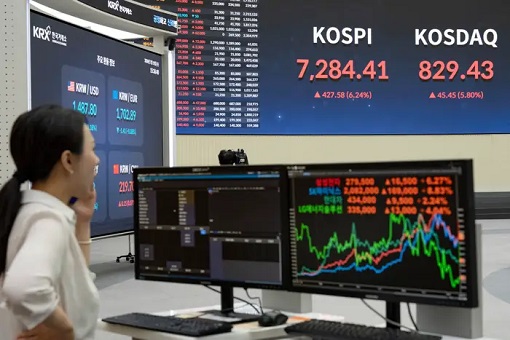
When the bull market started to turn, Lee held firm, looking for a rebound. “I got greedy,” – Lee admitted. “I kept thinking, what if it climbed even higher after I cashed out?” Her holdings are now worth 5% less than when she started in December. Her investments multiplied so fast – and vanished so quickly – it felt “like it was all a dream,” – Lee said. Like other ordinary investors, she was not alone.
Yoon Jae-Yi, a 30-year-old English teacher, lost US$19,000. She has since cut her living expenses – fewer taxi rides, less travel. Skipping meals, she tells herself, doubles as a diet. South Korea, which introduced Squid Game and K-Pop to the world, now hosts the planet’s craziest stock market, showcasing a stomach-churning volatility not seen in major markets in years.
Bank worker Yongjoon Kim lost 20 million Korean won (US$14,000) on the South Korean stock market last month. Kim’s money was meant to help buy a home, as he is getting married later this year. Instead, the value of his tech investments slumped by around 25% in July. “It’s going to sting and I’m going to have to work really hard to make up for this,” – Kim says. “But for others who have taken more risk, they’re going to feel the pain.”
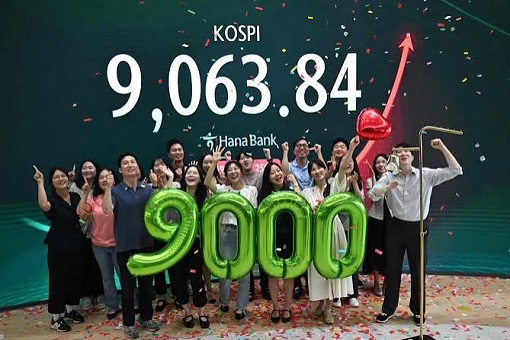
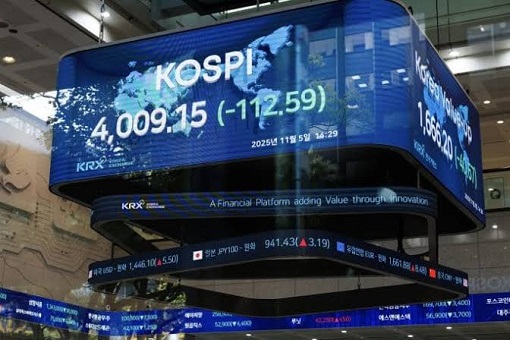
The benchmark Kospi index more than tripled in value, driven by faith in the AI boom. Two South Korean companies, memory-chip makers Samsung Electronics and SK Hynix, soared to trillion-dollar valuations and became the twin forces pushing record market gains. Then the KOSPI plunged around 40% over six weeks in June and July, burning hundreds of thousands of investors – a sober warning to those betting big on the AI industry.
The roller-coaster ride has continued though – the Kospi has since rebounded about 20% from its low. “The volatility is just too severe. This isn’t sound investing. It’s a gambling table, a casino,” – said 68-year-old Jung Eui-jung, who heads the Korea Stockholders’ Alliance, a group representing the country’s roughly 14 million individual investors.
The Kospi’s six-week collapse erased roughly US$2.5 trillion in market value. Individual investors – accounting for 60% to 70% of the Kospi’s daily trading volume – were hit the hardest. They are known as ants – weak individually but capable of collective power – and fed the market with a deep faith in Samsung and SK Hynix, the world’s two largest memory chip makers and fierce competitors driving the global AI infrastructure boom.
Making the market collapse worse was the introduction in May of South Korea’s first single-stock leveraged exchange-traded funds, or ETFs. Using financial tools such as debt and derivatives, these ETFs enabled an investors to double their bets on Samsung and SK Hynix. Meaning if one of the stocks went up 5% in a day, the leveraged ETF would rise by 10%. On the downside, if the stock fell 5%, the ETF would fall 10%.
The ants now blame South Korean President Lee Jae Myung’s administration for loosening regulations to allow such potentially lucrative, high-risk funds. His government has since put in place stricter rules around trading the ETFs with the aim of helping curb market volatility. But it was too little too late. The damage is done.
A group of individual investors sent mourning wreaths to the country’s National Assembly that carried messages promising revenge at the ballot box, as well as an urgent plea – “Ants being slaughtered – National Assembly, respond.” The presidential office said the South Korean government has been making an all-out effort to manage the market’s volatility, including through the new trading rules.
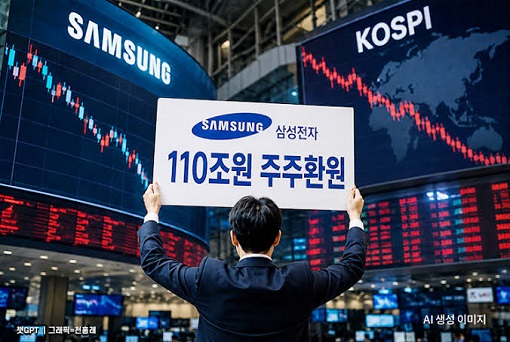
The market fallout was not limited in the country, but stretched to the U.S., where bets on South Korean chip stocks likely contributed to July losses of some 67% at Situational Awareness, an AI-focused hedge fund. The hedge fund liquidated most of its public equities portfolio to repay lenders. Situational Awareness had held a large position in the Korea-listed shares of SK Hynix, according to the Wall Street Journal.
Yoon Kyung-min, a 44-year-old sound engineer, said he still can’t believe the financial disaster of the past two months. After quitting his job, he had invested half of his severance pay into semiconductor stocks and saw US$7,200 evaporate in a week. “If my wife finds out, I will be in serious trouble,” – said Yoon, who thought the market “would rise forever.”
{ Presidential Push }
President Lee talked up his stockholdings on the campaign trail last year and pledged to nearly double the Kospi to a record 5,000 points by 2030 if elected to reward retail investors and boost overall public wealth. He said his market reform push could put an end to the long-standing phenomenon of South Korean stock undervaluation due to weaknesses in corporate governance and a lack of market transparency – known as the “Korea Discount.”
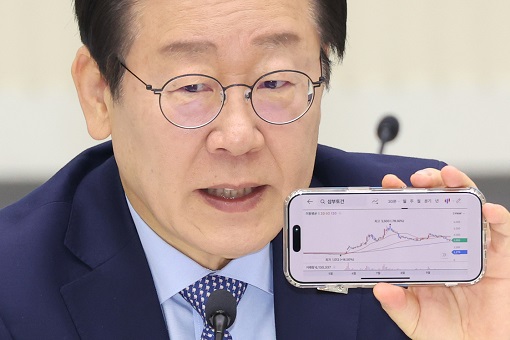
After becoming president in June 2025, Lee – a self-described ant – accelerated capital market reforms aimed at propping up share prices. The push coincided with rising global excitement about AI and the prospects for Samsung and SK Hynix. Memory-chip prices grew sharply in the past year, with demand far outstripping supply.
The Kospi was the world’s top-performing stock market in 2025 alone, with a 76% gain. The surge made South Korea the world’s 5th-largest market by market capitalization, moving from 13th place a year earlier and surpassing the U.K. and France. By mid-2026, Samsung and SK Hynix accounted for more than 50% of the exchange’s value. But very few saw the danger as the bull kept charging.
Instead, more ordinary Korean investors joined the frenzy, including stay-at-home mothers, students, and retirees cashing in their pensions. That’s the first red flag that the stock market was driven by greed, creating an overvalued asset bubble. Many newcomers became stock-rich almost overnight. Margin loan balances rose by US$7.9 billion to US$27.1 billion in six months, as more investors tried to boost returns.
The boom drew the attention of U.S. investors. At the start of the memory chip supercycle last year, neither Samsung nor SK Hynix traded on U.S. exchanges. That meant most Americans with domestic brokerage accounts had no way to buy the stocks directly. In May, Interactive Brokers became the first major U.S.-based brokerage to offer direct trading in Korean equities.
Around the same time, a little-known asset manager called Roundhill Investments launched an ETF, known by the ticker DRAM, that focused on memory manufacturers. It offered any American with a major brokerage account access to Samsung and SK Hynix, which together composed almost half the fund’s value. Within weeks, DRAM became the most successful ETF launch in U.S. history, in terms of attracting new investor money.
The record demand surprised the ETF industry, which is dominated by such financial behemoths as BlackRock and Vanguard Group. Rather than selling through a network of financial advisers, DRAM attracted individuals who heard about the ETF on social media and institutional traders, Roundhill Chief Executive Dave Mazza said in an interview.
{ The FOMO Effect }
South Korea rolled out its new leveraged ETFs in May, teeing up the precipitous fall. ETFs typically act as baskets for various assets, such as stocks in multiple firms. The newer ETFs, however, were designed to hold shares in just a single company and allowed investors to pile on additional leverage that magnified gains or losses.
The country had previously allowed leveraged ETFs that tracked multiple firms or the broader Kospi index. Rules intended to shield investors from compounded losses ban single-stock leveraged ETFs. Supporters of the rule change cited single-stock leveraged ETFs in other major markets, including the U.S., saying they would encourage more investors to trade such ETFs and keep their capital in South Korea.
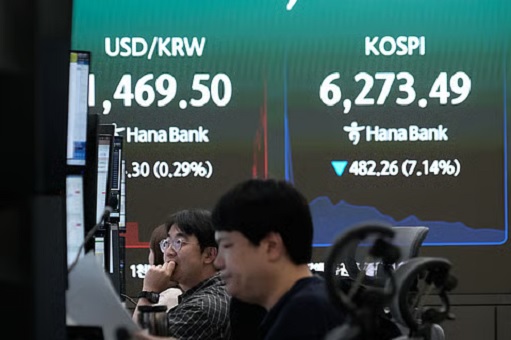
When the products launched on May 27, demand was so high that the website crashed for days from excessive traffic. By June, the Kospi crossed 9,000 points, more than three times its 2025 level. Then concerns over the strength of AI demand and encroaching Chinese competition punctured the semiconductor rally. Many individual investors, like Jake Cheong, a 30-year-old accountant in Seoul, got hung out to dry.
Cheong said he had never been big on stocks. He made small investments, mostly in conservative U.S. index funds. In the early stages of the chip rally, he cautioned friends and co-workers, convinced that unquestioned faith in skyrocketing South Korean shares would end in tears when the fall came. But even he could not resist the temptation.
In June, he decided the market surge was too good to pass up as a short-term investment. Cheong scooped up around US$21,000 worth of SK Hynix shares, using a significant chunk of his savings. Less than three weeks later, the stock had jumped by 40%. Unlike others who were under the delusion – and greed – that the super bull run would last forever, he cashed out. But his story didn’t end there.
SK Hynix planned to list on the Nasdaq via American Depositary Receipts, a move Cheong believed would help keep the firm’s South Korean-listed shares elevated for longer. He invested US$29,000 or so into a leveraged ETF tracking the firm. The added leverage meant that if SK Hynix’s stock fell, Cheong’s losses would be compounded. Then came the crash.
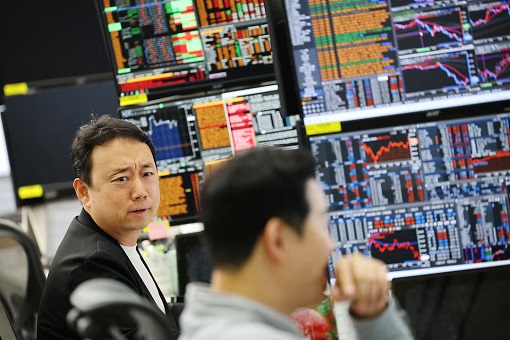
By the end of July an estimated 1.2 million South Korean personal investor accounts had faced margin calls, equivalent to about one in every 30 working-age adults in the country. His position has fallen 69% to roughly US$9,000. “My hard rule used to be that when too many people seem to be boasting about their stock gains, we’ve probably hit the peak,” Cheong said. “But FOMO (fear of missing out) got the better of me.”
{ All A Dream }
Some investors shrug off the volatility of what some call the “Rollerkospi.” Jonathan Pines, head of Asia at Federated Hermes, a U.S.-based asset manager, said the firm plays the long game with South Korean memory stocks. Given that elevated earnings in those stocks are expected to hold up for the next two years, he said, investors will eventually recoup most of their initial outlays.
South Korea’s president has suffered political losses in the past two months. Lee’s approval rating fell to 43.3% during that time, the lowest level since he took office in June last year. Members of the country’s main opposition party have called for inquiries into the ruling party’s handling of the market turmoil.

Presidential chief of staff for policy Kim Yong-beom, who once proclaimed that Korea “should be capable of doing what the U.S. stock market does,” faces a criminal complaint filed by an opposition party member alleging he improperly pressured regulators to approve single-stock leveraged products. He denies the allegations.
South Korean regulators recently rolled out a series of emergency measures to rein in volatility. Approval of new single-stock leveraged products has been put on hold, and a mandatory cash deposit required to trade them was tripled to roughly US$21,000. Authorities also expanded a mandatory online training course for individual investors that explains the risks and tracks mock investments through hours of trading exercises.
The Kospi 200 volatility index – a gauge of market risk and investor sentiment – fell to 56.76 this Monday from 86.18 on July 30, according to the Korea Exchange. Jung, the Korea Stockholders’ Alliance head, still wants regulators to delist the single-stock leveraged ETFs and devise rescue measures for individual investors who suffered deep losses.
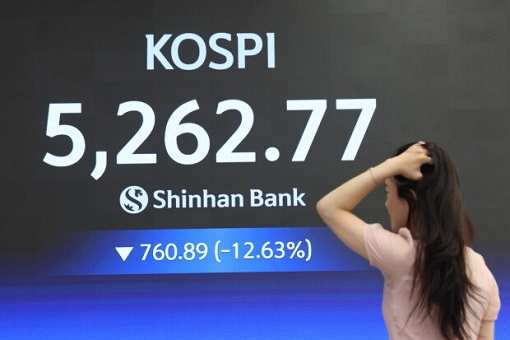
The Kospi faced “one of the sharpest corrections” in its history between June and August, comparable to the drops seen during Covid-19 and the 1997 Asian financial crisis. At a recent legislative debate in Seoul, Jung called for a moment of silence for South Korean individual investors. “To return to a normal investing environment, the government must not sit back,” he said. “Major surgery is needed.”
Other Articles That May Interest You …
- Why U.S. Launched Rare Joint Intervention With Japan To Prop Up Yen
- Japan Reveals Card Against Trump Tariff – U.S. Largest Creditor Threatens To Dump Its $1.1 Trillion U.S. Treasury
- Trump Has Already Lost His Trade War Against China – But He Can’t Find Ways To Climb Down And Save Face
- White House Privately Begging Xi To Call Trump First – But China Slapped 125% Tariff Instead
- Beijing Raises Tariffs To 125% – American Goods No Longer Marketable In China
- Trump Crashes Stock Markets, Dollar & Oil – Here’s Why China Retaliates With 34% Tariff, And Wiped Off $6.6 Trillion
- Recession 2025 – Why You Should Prepare For A Historic Crash As Massive Correction Builds
- $6.4 Trillion Wipeout – Financial Meltdown Has Begun As The U.S. Heading Toward A Recession
- De-Dollarization Kicks Into High Gear – Chinese Yuan Hit Record High, Overtook Japanese Yen As 4th Most Used Currency
- From Terminating Trade Deal To Cancelling $1.1 Trillion Debt Owed To China – Here’re Some Of Trump’s Crazy & Dirty Ideas
- Watch Out Trump!! – China May Weaponize “Rare Earth” To Retaliate Against U.S.’ Ban On Huawei

|
|
August 27th, 2026 by financetwitter
|


|

|

|

|

|

|

















Comments
Add your comment now.
Leave a Reply