



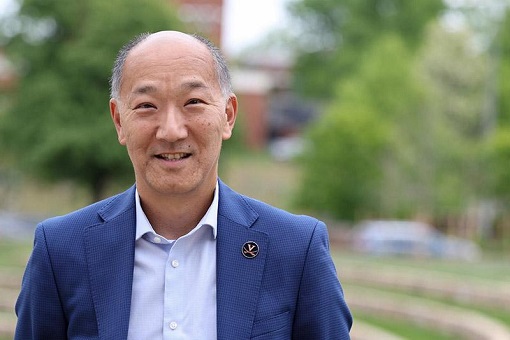
Ken Ono’s career as one of the world’s most prominent mathematicians has taken him to places that he never could have fathomed. Born on March 20, 1968, in Philadelphia, Pennsylvania, the 57-year-old American mathematician with fields of study in number theory is the son of mathematician Takashi Ono, who emigrated from Japan to the United States after World War II.
The renowned professor, who is the STEM (science, technology, engineering, mathematics) Advisor to the Provost and the Marvin Rosenblum Professor of Mathematics at the University of Virginia, regularly ventures far beyond campus, bringing his formulas everywhere from Hollywood to the Olympics. He’s the only number theorist who has ever been the star of a beer commercial.
But for his next act, this renaissance man of math is doing something improbable even by his standards. He’s leaving his tenured job to work for a 24-year-old, and he is taking an extended leave from academia with no plans to return. He’s jumping to a company founded by one of his former students, Carina Hong Letong, who has a dazzling résumé that would make AI feel insecure.
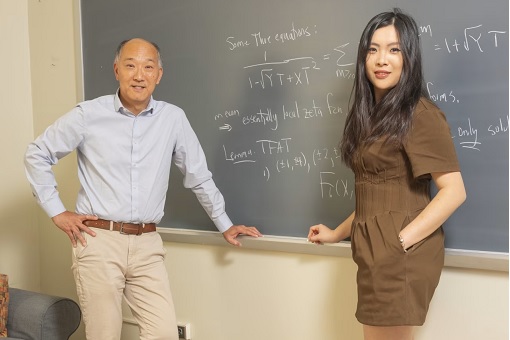
Not long ago, the idea of joining an AI startup in Silicon Valley would have sounded absurd to him. In fact, before it reoriented his career and uprooted his entire life, he considered himself a skeptic of Artificial Intelligence (AI). Until recently, he began talks by poking fun at the hype around the nascent technology. “My name is Ken Ono, and I am NI (Naturally Intelligent),” – he said.
Now he’s the unlikeliest employee of a startup that hopes to revolutionize math with AI. Initially, he planned to study medicine, but later switched to mathematics. He attributes his interest in mathematics to his father. A drop-out of Towson High School, he later enrolled at the University of Chicago without a high school diploma. There, he was a member of the Pepsi–Miyata Cycling Team.
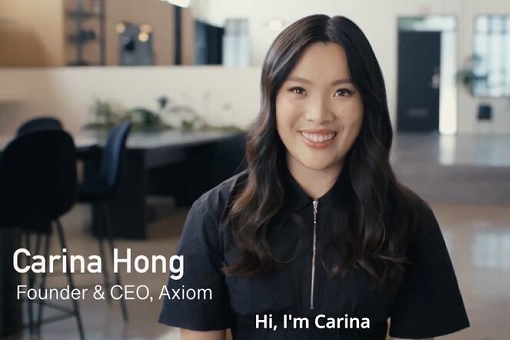
After graduating in three years from MIT, where she got her bachelor’s degree in physics and mathematics and wrote nine research papers and took 20 courses on advanced mathematics, as well as winning the Morgan Prize as the top undergraduate math researcher in America and earning a Rhodes scholarship, Carina Hong went to Stanford to pursue a joint law degree and math Ph.D.
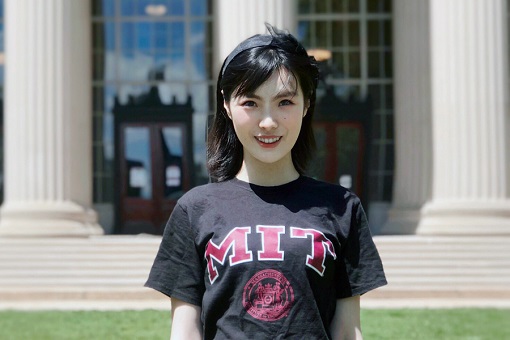
When she dropped out from Stanford to start Axiom Math, she raised US$64 million in less than a year, poached a handful of Meta’s AI researchers – and hired her mentor. Her key teammembers include Francois Charton, known for solving a century-old math problem; Aram Markosyan, an expert in AI safety and fairness; and Hugh Leather, an early pioneer in deep learning for code generation.
To her, it was a no-brainer. “Ken Ono is the idol of many math students,” – said Hong, Axiom’s founder and chief executive, who grew up in Guangzhou, China. The US$64 million seed funding round led by B Capital and participation from Greycroft, Madrona Venture Group, and Menlo Ventures values the San Francisco-based AI startup company at approximately US$300 million.
Hong’s company is named after the mathematical term for a basic truth that can be the starting point of an entire theory. Her goal is to build an “AI mathematician,” capable of reasoning through known problems, finding new ones, and validating its work through formal proofs. If it succeeds, Axiom might just crack problems that have perplexed mere humans for centuries.

The startup’s investors are betting that a mathematical superintelligence would have all kinds of commercial applications – software and hardware verification, logistics optimization, algorithmic trading and financial engineering. The world’s richest companies are burning through money and fueling concerns about this boom inflating a bubble, but mathematicians are increasingly bullish on AI’s potential to assist their work and usher in discoveries.
Researchers and investors alike find Axiom’s goal persuasive and inspiring. As Ono prepared to move across the country, he was reluctant to predict too far into the future. But the math professor who’s now working for a math startup did share one of his own axioms. “If I’m the first, so be it,” he said. “I will not be the last.”
As a child, pressure from his parents made him so miserable that he didn’t finish high school. Without a diploma, he still went to college, developed his passion for math and taught for decades at the University of Wisconsin and Emory before moving to UVA in 2019. He also led the nation’s top research program for elite undergraduates and mentored 10 winners of the Morgan Prize, including his new boss.
“He’s a larger-than-life figure in mathematics,” – said Ken Ribet, a former president of the American Mathematical Society. In math, Ono is known for his work on a range of topics across number theory, from Ramanujan’s congruences to the umbral moonshine conjecture. And if that last sentence made you break out in a sweat, you can now relax.
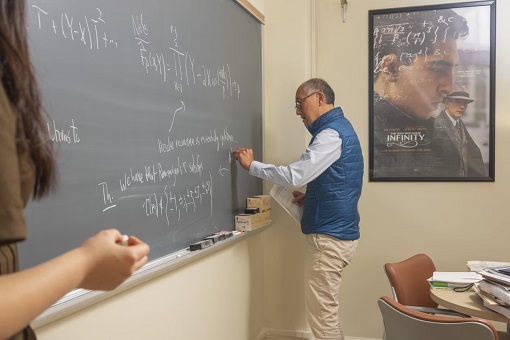
As it turns out, Ono is also known for his work applying math to other fields. He consulted for swimmers at UVA and Olympic gold medalists in the pool for Team USA. He advised the National Security Agency (NSA). He helped produce the 2015 movie “The Man Who Knew Infinity.” Then he went in front of the camera for a beer commercial and certified that 64 (the calories in Miller64) is a smaller number than 80 (rival light beers).
In recent years, Ono began tracking AI’s remarkable progress as it rapidly improved. He was intrigued, though not intimidated. AI was astonishing at cognitive tasks and solving problems it had already seen, but it struggled with the creative elements of his field, which require intuition and abstract thinking. That creativity is so fundamental to pure mathematics that Ono figured his job would be safe for decades.
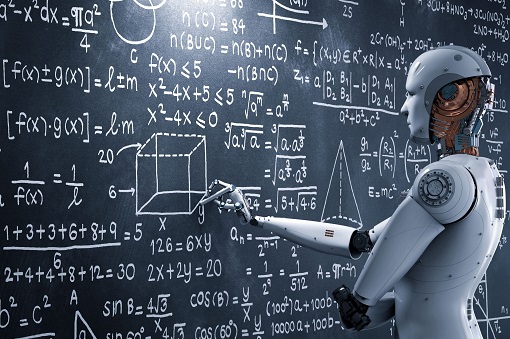
But last spring, he was one of 30 mathematicians invited to curate research-level problems as a test of the AI models. He left the symposium profoundly shaken by what he’d seen. “The lead I had on the models was shrinking,” – he said. “And in areas of mathematics that were not in my wheelhouse, I felt like the models were already blowing me away.”
For months afterward, Ono felt like he was grieving his identity. He didn’t know what to do next, knowing that AI models would only get smarter. “Then I had an epiphany. I realized what the models were offering was a different way of doing math” – he said. He already had colleagues, grad students and brilliant undergraduates as collaborators. Now he also has AI.
“I spend an hour or two every day spitballing with the models,” he says. “Late at night, if I can’t go to bed, I have my iPhone open, and I’m talking about math with the models at a crazy high level.” Meanwhile, AI wasn’t the only reason that his job as a professor suddenly felt tenuous.

With the Justice Department taking aim at higher education, he worried about threats to federal research funding. Earlier this year, UVA’s president resigned under pressure from the Trump administration. As the STEM adviser to the provost, Ono was spending more time dealing with politics, which meant less time to do math.
He decided to leave UVA for AI because he couldn’t resist the latest opportunity to put his mark on something other than a chalkboard. “I have the luxury of participating in transforming how the world actually works. As a pure mathematician, that has rarely been the case,” – Ono said. When he made the calculation that it was time for a change, he knew just the person to call.
Carina Hong had been a student in Ono’s research program in 2020, before she won the Morgan Prize and the Schafer Prize as math’s top undergraduate woman. Born and raised in China, she taught herself English when she was young to read the field’s advanced textbooks. She trained in math Olympiad programs, solving problems under time pressure and tight constraints, but she became obsessed with another kind of math.
“I was always very interested in mathematical discoveries. Olympiad Math is a constant dopamine hit, but research math is banging your head against the wall. It’s pain and suffering. I like that part,” – she said. For this reason, Axiom Math is positioning itself to redefine what artificial intelligence can achieve in scientific discovery and industry innovation.
“I wanted to understand biology more,” – she said in an interview with Slice of MIT. “There is a really big world besides math and physics in science, and having an understanding of math in one axis and biomedicine in another axis, can kind of span the science space. That at least was my mental model.” She was also considering a career in quantitative finance. But during her time at MIT, she realized something else lit her up.
“Math research is really fun,” – she described both math research and her first year of law school. She’s one of the few people who would know. A first-generation college student, Hong was a math whiz at MIT. Instead of going to a hedge fund as a quant trader, she went to Oxford as a Rhodes scholar. After studying neuroscience and writing two dissertations, she was off to Stanford for a law degree and math Ph.D.
On weekends, she liked to study at a coffee shop near campus. Drinking matcha lattes, she read wonky math papers and became friendly with Shubho Sengupta, an AI scientist at Meta Platforms who was another regular at the communal table. As they chatted, they realized they might be able to team up and bring their fields together.
During her morning runs, when she thought about leaving school and starting a company, Hong remembered advice that Lisa Su, the CEO of chip powerhouse AMD, offers students: run toward the hardest problems. “Research math is really hard,” – Hong said. “AI for math is harder.” She dropped out as soon as Axiom’s seed-funding round closed last summer.
Days later, Google DeepMind and OpenAI captivated nerds around the world when their models claimed gold medals at the International Mathematical Olympiad. So did Harmonic, a startup co-founded by Robinhood CEO Vlad Tenev, who says – “mathematical superintelligence is getting closer by the minute.”
Racing against that clock, Hong began chasing talent with Sengupta, her friend from the coffee shop and now Axiom’s chief technology officer. Among the research engineers they hired from Meta was François Charton, an AI math pioneer. Their recruiting blitz turned heads across Silicon Valley and got the attention of someone thousands of miles away: Ken Ono.
Before long, Ono was packing up with his wife and their schnoodle named Mochi. And this week, he started as the 15th employee of Axiom. When he began discussing his role, the startup’s initial offer was “chief math guy.” After some negotiation, they settled on an official title – “Founding Mathematician”. And his job is to push the company’s AI models to their limits.
He’ll be coming up with representative problems that can only be solved by understanding mathematical principles, all while drafting benchmarks that measure the system’s performance and guide the models. “Think of it like a map for a sailor. Before you set out to discover a new land, you need to know where you are and what’s already been explored,” – he says.
Ono says that exploration brought him to Axiom more than any reason, including the financial ones. “I’m not doing this for the money,” – he said. He was already one of UVA’s highest-paid employees and says he turned down more lucrative offers and larger stakes in other AI companies.
In the startup’s Palo Alto offices, the conference rooms are named for legendary mathematicians – Poincaré, Gauss, Hilbert, Lovelace, Turing. The company’s employees are the sort of people who noted that Axiom’s funding of US$64 million was 26 (2 to the power of 6) and joked that its next round could be 27. But the surprising thing about Ono’s colleagues is that many are his age.
“A lot of the top frontier researchers are at the stage of their lives where they have track records, they have bodies of work, they have financial security – and they’re looking for their legacy project,” – Hong said. And one of them is also looking for something else. “Even if we get to superintelligence, there will be mathematical questions that remain unsolved,” – Ono said. “I will still be looking for answers.”
Other Articles That May Interest You …
- More Competitive Vietnam – Making English Compulsory 2nd Language In Schools By 2035
- All Roads Lead Back To China – One Entrepreneur’s Supply-Chain Odyssey Shows Just How Difficult It Is To Quit China
- Highest Salary Of 20-Million Yuan – But China Still Facing AI Talent Shortage Of 4 Million By 2030
- US$1 Trillion Wipeout – How China’s DeepSeek AI Creates Havoc And Spooks U.S. Financial Markets
- Scrambling To Save TikTok – Why And How Trump Flip-Flops After Accusing TikTok Of National Security Threat
- Electric Car As Cheap As $11,000 – How China Beats The U.S. In Electric Vehicles & Leaves Global Brands In The Dust
- U.S. Tech War On China Backfires – How Sanctions Boosting China Chipmaking Industry To Become Self-Sufficient
- Apple’s Secret $275 Billion Investment In China – A Warning Why The U.S. Cannot Afford To Start A War With The Chinese
- Trump To Block Downloads Of TikTok & WeChat On Sunday – But Every Teenager Knows How To Use VPN To Bypass It
- Here’s The Real Reasons Trump Bans TikTok – And It Has Nothing To Do With National Security Threat
- From Trade War To Tech War – After 5G Technology, The US Aims To Cripple China’s Artificial Intelligence

|
|
December 5th, 2025 by financetwitter
|


|

|

|

|

|

|


















Comments
Add your comment now.
Leave a Reply