



Putin would face a “rough situation” if he did not co-operate in the peace process, while Zelensky had to “show some flexibility”. As for European leaders, they better move towards a deal as they wouldn’t necessarily get similar security guarantees on Ukraine from any future administration. That was roughly what Trump told all the parties involved in the Ukraine War.
After months of fruitless effort, U.S. President Donald Trump says – and hopes – an agreement between Russia and Ukraine to directly negotiate a “Peace Deal” to end the war is close at hand. Three days after Mr Trump gave Mr Putin a red carpet welcome in Alaska, he met with President Volodymyr Zelensky of Ukraine and European leaders at the White House on Monday (August 18).
Unlike his disastrous meeting in February at the White House with Trump and Vice President JD Vance, where he was attacked for being disrespectful and ungrateful in front of the world’s cameras, Zelensky was well prepared this round with his wardrobe. Instead of his military-style clothing, he came with an all-black jacket, shirt and slacks by Ukrainian fashion designer Viktor Anisimov.
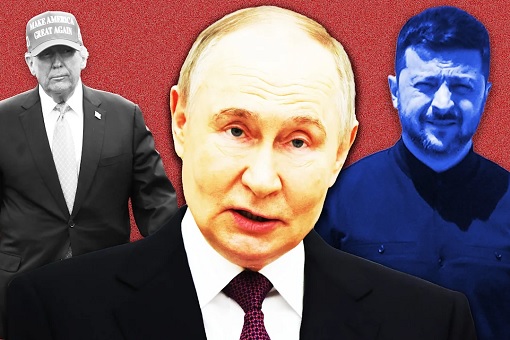
For his good behaviour this time – wearing more formal clothing and repeatedly expressing his gratitude to the POTUS – Trump greets Zelensky and puts an arm around him, returning praises. In contrast, Trump did not bother to greet any of the seven “warmongers” European leaders, who along with more than 100 journalists, swarmed the White House for an unusual meeting. That was the easy part.
Now comes the hard part.
It would be a massive challenge to get Russian President Vladimir Putin and Ukrainian President Volodymyr Zelensky in a room together. A meeting between both men for the first time since the war began in 2019 would be dramatic if one even comes together in the coming days. The format and the timing are still unclear, yet Trump wanted it to happen in a few weeks.
Even if the high-profile gathering materializes, which most likely won’t, it would only signal that the toughest phase of negotiations had just begun – and with no guarantee of success. It’s already known that a peace agreement, let alone a cease-fire agreement, will not deter Russia from invading Ukraine again. That’s due largely to the deep distrust built over decades between Russia and NATO.

The West likes to blame Putin’s past broken promises, including a pledge not to send troops into Ukraine just before the full-scale invasion, as well as how a commitment was broken in 2014 by Russia’s annexation of Crimea. But Moscow can also blame NATO for promises not to enlarge after the Cold War, only to break the promise and keep expanding eastward – threatening Russia.
So, while the European leaders can paint skepticism about whether Putin will honour his promises not to invade Ukraine because he had broken formal commitments before, Putin too can say NATO is untrustworthy because there’s no guarantee the North Atlantic Treaty Organization will not continue to expand after Russia agrees to end the Ukraine War.
On paper, the three parties – the U.S., Europe-Ukraine and Russia – have very different objectives. On the U.S. side, Trump’s goal is to win the Nobel Peace Prize by ending the war. Warmonger Europe, especially Britain, does not want the war to end and is using every available Ukrainian to fight the Russian. Ukraine wanted to join NATO, a red line to Russia, who is ready to use nuclear weapon if necessary.
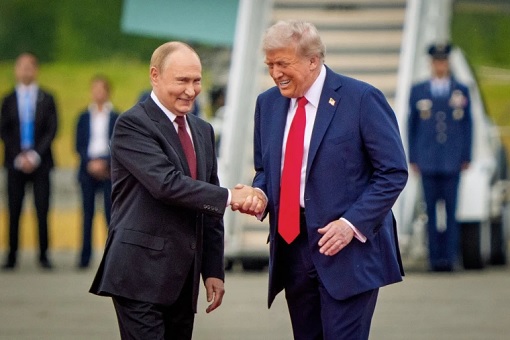
The most likely thing that could happen is for Putin to send a high-level official to talk with Ukraine, at least in the first round – till a common ground is found. Putin knew it would be a waste of time to meet Zelensky without Trump in the meeting. Furthermore, Zelensky cannot make a single decision without consulting leaders from France, Britain and Germany.
More importantly, negotiating directly with Zelensky will be a humiliation to Putin, who has spent 3½ years excoriating the Ukrainian leader as an illegitimate leader and puppet. Sitting down with Zelensky could damage Putin politically, not only because the Russian president has sold to his people why he invaded Ukraine, but also because Zelensky – painted as a lapdog of the West – isn’t in the same league as Putin.
Just because Trump is threatening Putin with more economic sanctions does not mean Moscow must listen to Washington. On Tuesday, Russian officials gave little indication they were working toward such a meeting. Foreign Minister Sergei Lavrov said plans for any contacts between officials should be laid out “with the utmost care” – suggesting more foot-dragging.

When even President Trump has called Zelensky a “dictator without elections”, Putin can easily question the Ukrainian president’s authority to sign any peace agreement. The Russian president has previously said a meeting between the two leaders should come at the end of a peace process – and more as a formality to sign the necessary documents.
“I’m ready to meet, but if it’s some kind of final stage, so we don’t sit there endlessly dividing things up, but bring this to an end. But we will need the signature of the legitimate authorities,” – Putin said in June. As far as he is concerned, Ukrainians are still able to fight because of Western support. Besides, Putin isn’t ready to end the war, not when Russians are winning.
Trump has acknowledged that ending the Ukraine-Russia war was harder than he expected, after boasting on the campaign trail that he could strike a deal in 24 hours. In a sign that Putin isn’t ready to meet yet, Russia launched deadly attacks at Ukraine the night before Zelensky’s Monday visit to the White House, as well as drone and missile strikes during the summit.

Moscow also said on Monday that any peacekeeping efforts involving NATO members, a proposal floated by Europeans and deemed by Zelensky as critical to Ukraine’s survival, are unacceptable. However, Trump has said he won’t send American troops to Ukraine. This means any peace negotiations were already dead before they could even begin.
Under a deal proposed by Putin during meeting with Trump in Alaska, Ukraine would surrender its eastern Donbas region, including parts of Donetsk that Ukrainian forces still control. Ukraine has repeatedly said its constitution prevents it from surrendering territory to Russia, and it is busy building deep fortifications stretching hundreds of miles across the Donbas, a region roughly the size of West Virginia
Clearly, Putin’s demands were calculated precisely and deliberately to produce a Ukrainian rejection – hence shifting the blame for a breakdown in talks to Kyiv and allowing Russia to continue with the war without a response from Washington. Putin’s game plan is to pour cold water on the idea of a meeting without actually refusing one outright – a strategy he has previously deployed in response to calls for a cease-fire.
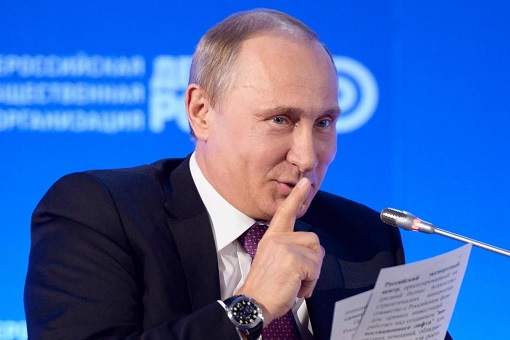
Trump’s current plan is that Putin and Zelensky meet one-on-one before he joins them for a trilateral summit, even though the Kremlin on Monday didn’t commit to that format. Still, a three-way gathering may or may not take place. But the biggest issue is what support the U.S. would give to secure any Russia-Ukraine deal long term.
Without U.S. troops’ “boots on the ground” to guarantee Ukraine’s security from Russia, and with Russia’s rejection of European troops in Ukraine, the Kremlin has issued only a vague statement that it was “considering the possibility” of holding high-level “direct talks” with Ukraine following Trump’s phone call with Putin. Even the question of the meeting venue could be a challenge.
Putin had suggested having the meeting in Moscow, while Hungary could be a backup plan. Earlier, French president Emmanuel Macron had proposed Geneva, with the Swiss foreign minister promising “immunity” to Putin despite an indictment by the international criminal court. Make no mistake – the more Trump and European leaders push for a meeting, the more Putin would refuse to meet with Zelensky.

The European leaders pressured Mr. Trump on providing a security guarantee similar to NATO’s Article 5, meaning that an attack on Ukraine would be considered an attack on all NATO countries. But the U.S. president has already ruled out Ukraine joining NATO, and said the U.S. may provide air support as part of security guarantees.
Other Articles That May Interest You …
- Better Luck Next Time In Moscow – How Putin Plays Trump For A “PR Victory” At Alaska Summit
- Forget 39% Swiss Tariffs – India In Bigger Trouble As Trump Slaps Extra 25% Tariff To 50%
- Trump Threatens 100% Tariffs On Russia – But Here’s Why Russian Markets Jump In Celebration Instead
- Zelensky Last Stand – How Strategist Putin Trapped 10,000 Ukrainian Troops In Kursk, And Slaughtering Them Now
- A Meeting Turned Into Shouting Match – How Trump-Vance Whacked Zelensky Before Kicked Him Out Of The White House
- Ukraine Has Lost The War – Zelensky Forced To Surrender Minerals Deal To Trump, But EU Hasn’t Figure That Out
- Pawns Europe & Ukraine Got Played – The Hidden Message Behind US-Russia Talks In Saudi Without Allies
- The Real Reason Behind Ukraine Invasion – NATO Chief Stoltenberg Admits Russia Invaded Ukraine Due To NATO Expansion
- Ukraine War – China’s Military Support For Russia Would Be Really Bad News For U.S. & Allies
- From Wheat To Oil & Gas – How Russia Invasion Of Ukraine Affects Europe’s Food Supply, And Even Your Loaf Of Bread

|
|
August 20th, 2025 by financetwitter
|


|

|

|

|

|

|
















Comments
Add your comment now.
Leave a Reply