



Wearing a suit to the White House was just the appetizer. Zelensky, after consultation with European leaders, had also brought a gift President Trump could not refuse – a promise to buy US$100 billion worth of American weapons financed by Europe. It was a calculated move to appease – and to obtain – U.S. security guarantees from the Commander-in-Chief.
After Trump appeared to align himself with Putin following a summit in Alaska that saw the U.S. rolled out the red carpet for the Russian president, the E.U. and Ukraine had to cook up something. It was a clever trick of creating a leverage out of nothing – Europe to spend US$100 billion it does not have, to buy weapons from America that it does not have, and to arm soldiers that Ukraine now lacks.
Make no mistake – the West or NATO has already lost the proxy war in Ukraine, but can’t lose face by admitting it. For 30 years, Russia has been warning that it would respond to NATO militarizing its borders via eastward expansion. There was no threat to Ukraine before 2014. Only a tiny minority of Ukrainians wanted to join NATO, and Russia laid no claim to any of Ukraine’s territory.
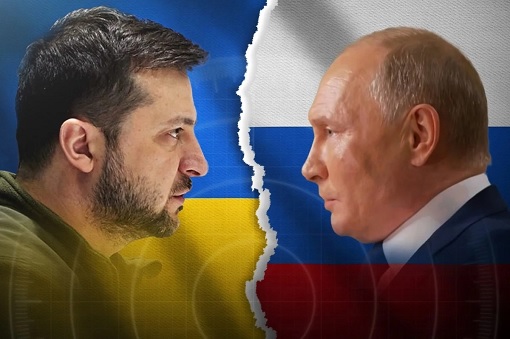
Everything changed when the arrogant Western governments supported a coup to pull Ukraine into NATO’s orbit, even though CIA Directors, Ambassadors and even some Western leaders had warned that such provocation would trigger a war. Vladimir Putin decisively and boldly did what the West was betting he won’t do – annexed Crimea in 2014 and invaded Ukraine in 2022.
Donald Trump did not lie when he accused Joe Biden (and Zelensky) for the war, blaming the clueless Biden for provoking Russia’s full-scale invasion by supporting Ukraine’s NATO membership aspirations. Only by pointing fingers at his predecessor can Trump, whose interest is more business than war, claim credits for ending the war promised during his election campaign.
More importantly, Trump is pulling away from the war because he knew Ukraine can’t defeat the Russian. Europeans, especially warmonger Britain, also knew the war has now been lost, but is doubling down to distract from E.U.’s many crises – cost-of-living crisis, housing crisis, migration crisis, sluggish economic crisis, and above all, political crisis.
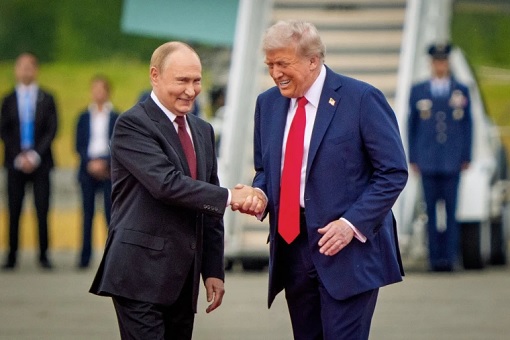
The EU political leadership hopes that the war in Ukraine can help the people of Europe forget their grievances. That’s why we have repeatedly heard that the biggest threat to European security is Russia and that the solution is none other than to defeat Russia in Ukraine. We have also been repeatedly told that the path to peace is escalation, hence the flowing of European weapons into Ukraine.
Yet, after the 27-member bloc collectively pledged over US$164.8 billion in support to Ukraine since the start of the war, including US$59.6 billion in military assistance, not to mention US$130 billion spending by the United States, the West still fails to push Russia out of Ukraine. To save face, the West claims it was the Russian forces that have failed to break Ukraine.
Hilariously, now Europe and Ukraine are demanding security guarantees despite initial claims that Russia was losing. They created the “Coalition of the Willing”, whatever that means. Warmonger UK and France came up with the concept of a multinational force. Some 30 countries reportedly have signed up to the coalition, even though it’s unclear what they would each be prepared to contribute.
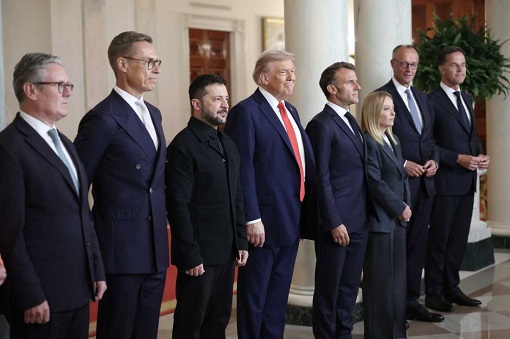
But the purpose is crystal clear – to deter the Russians from fresh attacks on Ukraine in years to come after a Peace Agreement with Moscow. Countries like Germany and Italy are reluctant to commit ground troops, while Australia and Canada may be more willing. France said the coalition would provide “reassurance forces at sea, in the air, and on land that the allies are ready to provide to Ukraine.”
However, there’s one huge problem. A fully-fledged assurance force fanning out across a 1,000- kilometer (600-mile) front line would require more than 100,000 troops in order to make Russia think twice about invading Ukraine again. But the number itself is a challenge to the European armies which have shrunk since the end of the Cold War.
While Trump agrees to the idea of the U.S. offering Ukraine security guarantees, the U.S. president has rejected the prospect of U.S. troops being deployed to Ukrainian soil. He suggested on social media that guarantees “would be provided by the various European countries, with co-ordination with the United States of America” in the form of air support for Kyiv as part of security guarantees.

Still, there’s another problem – Moscow repeated its insistence there could be no troops from any NATO country on Ukrainian soil. Putin could smell a scam of assembling NATO-like troops or anything that appears like Article 5 of the North Atlantic Treaty Organization that says an armed attack against one or more NATO allies shall be considered an attack against them all.
On the contrary, Moscow has insisted that any peace settlement includes limits on the numbers and capabilities of Ukraine’s military. Therefore, sending NATO troops disguised as peacekeeping forces or in whatever form that will boost the Ukrainian military capabilities is a non-starter. Taking a page from European’s playbook, Moscow has said it must be part of any Ukraine’s security guarantees.
On Wednesday (August 20), Russian Foreign Minister Sergey Lavrov said that talks about security guarantees for Ukraine without Russia’s participation was “a path to nowhere,” appearing to torpedo Monday’s talks between European leaders and Zelensky at the White House. Lavrov dismissed European diplomacy as “aggressive escalation” and a “clumsy effort to sway Trump”.
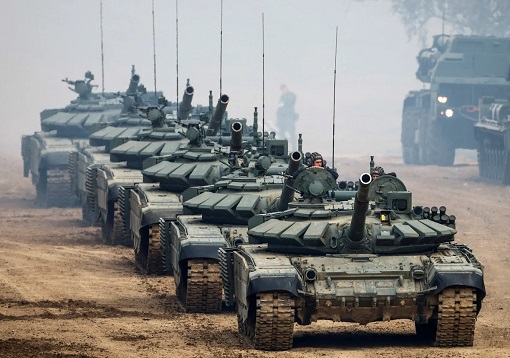
Even if Europe decides to bulldoze the plan, there’s a risk that Russia might be tempted to test the resolve of any assurance force by plotting some excuse for a new “special military operation”. It could play into Putin’s hand as a new invasion could split the transatlantic alliance, with the U.S. unwilling to follow through on security guarantees, leaving Europeans to fend themselves.
Here’s the best part – Lavrov also said that China, Russia’s ally in the war, should be among Ukraine’s security guarantors. The argument was that if the European forces are allowed to be deployed to Ukraine, then Chinese forces should also be allowed. Exactly why would Europe guarantee Ukraine’s security, but not China? Obviously, it was a clever delay tactic to create more problems to a peace settlement.
If Kyiv cannot accept China as a security guarantor, then Moscow too cannot accept Europe as a security guarantor. Even after throwing the spanner, Lavrov continues to avoid and direct reference to a possible Putin-Zelensky summit – another plan to delay any peace talks. Trump’s plan was to first meet Putin, then Zelensky, followed by a bilateral meeting between Putin and Zelensky.
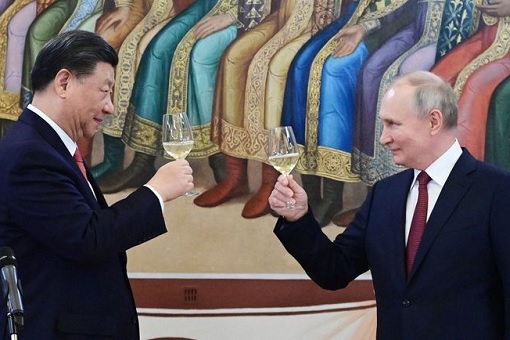
Putin still has many delay tactics in the tool box, including the question of Zelensky’s legitimacy. “You can negotiate with anyone, but because of his illegitimacy, he [Zelenskyy] has no right to sign anything,” – Putin told Russian officials earlier this year. Putin never refers to Zelensky by name and instead speaks of the “Kyiv regime”.
While Zelensky and his European partners can scream till foaming at the mouth about the need of a strong security guarantees, Putin too can play the same game – demanding a strong guarantee that the “root cause” of the conflict – NATO’s eastward expansion – is fixed first because it put Russia’s survival at risk. This alone could take months, if not years, of talks and negotiations.
The White House has both floated the idea of a trilateral summit involving Trump, Putin and Zelenskyy, or a bilateral meeting between the Russian and Ukraine leaders. But Lavrov repeated Moscow’s insistence that any meeting with Putin and Zelenskyy present should be the culmination of negotiations, preceded “step by step, gradually, starting from the expert level.”
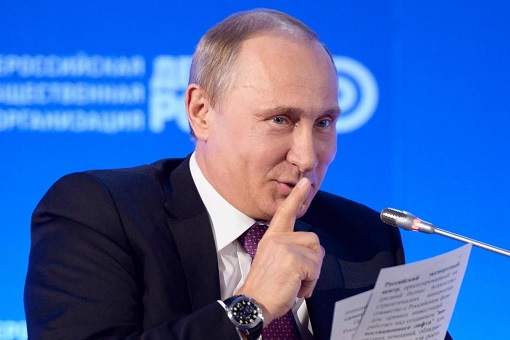
At the same time, in order not to offend and embarrass the egoistic Donald Trump, Moscow has avoided closing the door entirely, hinting that the Putin-Zelenskyy (both have only met in person once – in 2019) meeting could take place, while giving no sign that it is actually on the horizon. The strategy is to give Trump some false hopes of a coming deal, when in reality, Putin is beating around the bush.
Other Articles That May Interest You …
- Trump Pushing Putin & Zelensky To Talk – But Ending Ukraine War Is Easier Said Than Done
- Better Luck Next Time In Moscow – How Putin Plays Trump For A “PR Victory” At Alaska Summit
- Trump Threatens 100% Tariffs On Russia – But Here’s Why Russian Markets Jump In Celebration Instead
- Zelensky Last Stand – How Strategist Putin Trapped 10,000 Ukrainian Troops In Kursk, And Slaughtering Them Now
- A Meeting Turned Into Shouting Match – How Trump-Vance Whacked Zelensky Before Kicked Him Out Of The White House
- Ukraine Has Lost The War – Zelensky Forced To Surrender Minerals Deal To Trump, But EU Hasn’t Figure That Out
- Pawns Europe & Ukraine Got Played – The Hidden Message Behind US-Russia Talks In Saudi Without Allies
- The Real Reason Behind Ukraine Invasion – NATO Chief Stoltenberg Admits Russia Invaded Ukraine Due To NATO Expansion
- Ukraine War – China’s Military Support For Russia Would Be Really Bad News For U.S. & Allies
- From Wheat To Oil & Gas – How Russia Invasion Of Ukraine Affects Europe’s Food Supply, And Even Your Loaf Of Bread

|
|
August 22nd, 2025 by financetwitter
|


|

|

|

|

|

|















Comments
Add your comment now.
Leave a Reply