



China’s attempt to show humanoid robots during last year’s Chinese New Year Spring Festival Gala was laughed at by the West. Around that time, public demonstrations of the humanoids often drew scepticism, such as a robot marathon in April that made headlines for stumbles, crashes and breakdowns. It was the same scenario when Elon Musk laughed at China in 2011 after being asked if BYD was a rival.
But Chinese robots do not need 10 years like BYD to surpass Tesla. As Musk scrambles to transition Tesla’s focus from electric vehicles business to humanoid robot, shutting down production of the flagship Model S and Model X in the process, this year’s Spring Festival Gala saw an entirely different Chinese humanoids, with videos from the event circulating widely online.
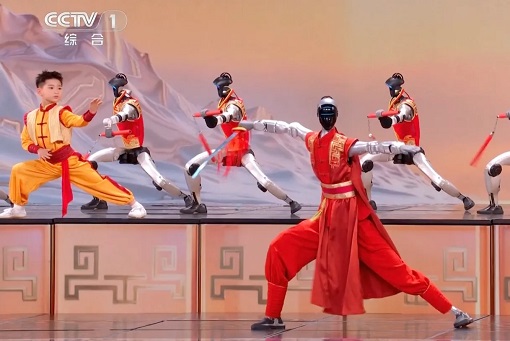
The West was shocked and stunned as a troupe of humanoid Chinese robots breakdanced, jumped and performed backflips at the 2026 Chinese New Year Spring Festival Gala, which was watched by almost 400 million people on TVs last week. The broadcast generated 23 billion views across social media. In just one year, China shows how far it has progressed in technological advancements.
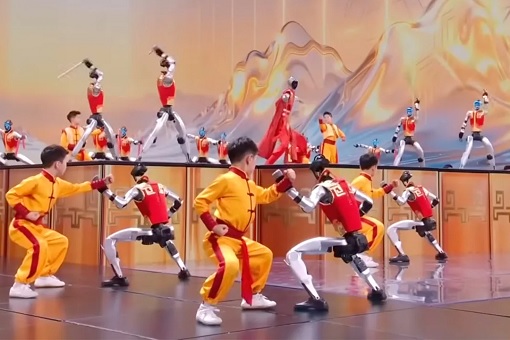
In the display, a dozen human-looking robots from technology company Unitree can be seen moving in perfect unison. Like Bruce Lee, the robots could throw punches and kicks in a martial arts display. In another segment, the company’s 180cm H2 humanoid bot performed Kung Fu while dressed as the “Monkey King” from Chinese folklore. The performances drew comparisons with a display in 2025.
Last year, the same company – Unitree Robotics – had featured less advanced versions of the robots twirling handkerchiefs in a wobbly folk dance. Emily Lathrop, an associate engineer at Rand, says last week’s display was an “impressive demonstration of how far China’s humanoid robotics have advanced in the past year”. Now, not many dare to laugh or ridicule the Chinese robots.
The West can call it propaganda or whatever they like, but the spectacular display cemented something which many already feared – that China is pushing ahead as the leader over the West in advanced robotics. And there is nothing anyone can do to stop it, including the U.S. Viewers have expressed everything from admiration for the technological advancements to concern about what they mean for the labour force and the U.S.-China tech race.
For decades, humanoid robots have been the science fiction or gimmicks. But in China, advanced robots that appear uncannily human are fast becoming reality. China accounted for around 90% of all humanoid robots sold last year, according to data from Omdia. Hangzhou-based Unitree, which is valued at about US$7 billion, sold 5,500 robots, while rival Agibot sold more than 5,000.
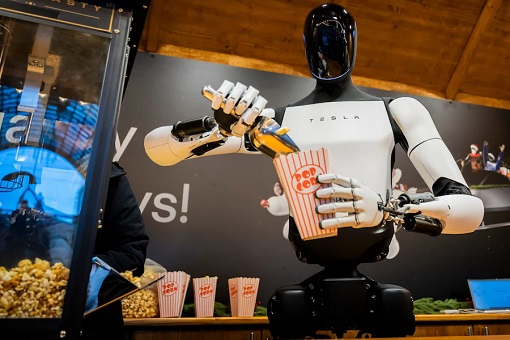
While progress in the West has been notably slower due to complacent, trade war, arrogance and whatnot, analysts at TrendForce have predicted global shipments will top 50,000 this year. Tesla – which is developing the Optimus bipedal bot, designed to perform “unsafe, repetitive or boring tasks” – has so far fallen well short of Elon Musk’s stated targets for the tech.
Compared to Unitree’s humanoids, not a single Optimus has been sold by Tesla, even though the company has built around 150 of its robots – which are still in the testing and internal deployment phase. Tesla is currently using a small number of Optimus robots for simple tasks within its own factories, contrary to Musk’s previous claim that it would have “several thousand” working by the end of 2025.
Analysts at Barclays this week estimated that “physical AI” – referring to robotics and automated machines – could be a US$1 trillion industry by 2035. They suggested that the market for humanoid robots alone could be worth around US$200 billion, up from about US$3 billion today. However, it appears China would be the biggest winner in the game.
China has already taken an early lead in the manufacturing and deployment of humanoid robots, according to data from Barclays. Analysts at the company estimate that of the roughly 15,000 humanoid robot installations in 2025, China accounted for more than 85%, compared with just 13% in the U.S. Even fans of Musk have to admit that China is out in front.
“China is way ahead on the robotics front,” – says Dan Ives, an analyst at Wedbush Securities. “Tesla is poised to be a clear leader on Optimus, but there is no denying that China is playing at a different level than the US.” Unlike the West, China appears to be solving problems of mass production and securing a supply chain of robotic parts faster than the U.S.
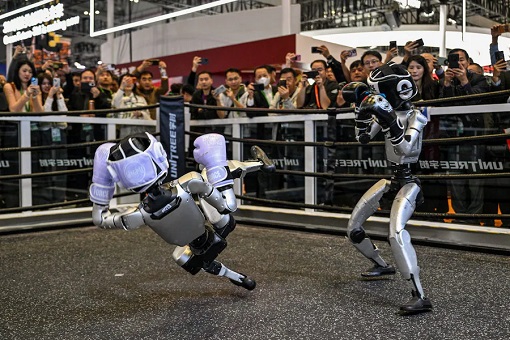
For now, humanoid robots are mostly used for demonstration purposes and research, unlike robotic arms that are used on industrial and automotive assembly lines. But the West should be worried of what China is hiding or didn’t show while the Middle Kingdom unleashed robots performing kung fu stunts at the 2026 Chinese New Year Spring Festival Gala.
Even if China has not secretly started experimenting humanoid soldiers for a potential war with the Western power, Beijing’s lead in robots has opened up a new front in the US-China trade war and tech war. “If we look at the hardware and mass production capabilities, China is building up the supply chain advantages,” – says Ethan Qi, a Beijing-based analyst at Counterpoint Research.
China’s manufacturing prowess, combined with government support, has also enabled Chinese robotics producers to manufacture their products at much lower prices than competitors. Unitree, for example, advertises its cheapest R1 robot for US$4,900 and US$13,500 for its G1 humanoid robot. Meanwhile, Tesla’s Optimus would cost almost US$20,000 – if annual output reaches 1 million units.
If BYD and Tesla competition is any indicator, the U.S. would most likely lose again in the humanoid business. Unitree expects between 10,000 and 20,000 shipments in 2026. The enhanced dexterity shown by the start-up’s kung fu humanoids like aerial flips and weapon handling signals strong potential for economic impact in physically demanding tasks that involve delicate tool handling and precise movements.
As usual, a congressional committee warned last year of the “growing national security threat posed by Chinese robotics”. The committee warned that bots deployed in the U.S. could be a “Trojan horse” and used for espionage. This month, the U.S. briefly added Unitree to a Pentagon blacklist of companies with alleged military ties, before withdrawing the updated list. Unitree has denied selling products to China’s military.
Still, not everyone is obsessed with the U.S.’ anti-Chinese argument that China’s robots posed “threats of data exfiltration and remote sabotage or manipulation of critical systems”. Supporters of the robotic technology say advances in humanoid robots should be seen as a major opportunity to boost productivity in all countries.
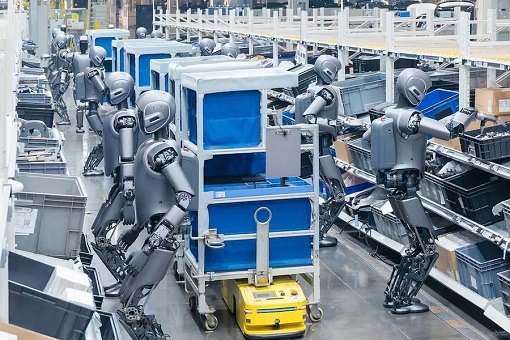
These robots, they argue, could eventually be used for a whole host of tedious or dangerous jobs currently undertaken by humans – replacing factory workers or warehouse labourers. Other companies are developing household robots, using human trainers to repeatedly fold towels or stack dishes so that AI software can copy their movements.
With an ageing population and rising labour costs, robots could provide China with an industrial edge. Between 2022 and 2024, the cost of its robots dropped by 40%, according to a report from the consultancy Bain. And just like how China dominates the electric vehicles industry by flooding it with state support, Beijing is backing its robotics champions with tens of billions of dollars in funding.
Beijing has openly declared its support to boost its robotics industry is a key part of its next five-year industrial plan. Last year, the National Development and Reform Commission confirmed plans for a US$130 billion venture fund with a focus on AI and robotics. The country has already started converting some of its car plants to fully autonomous “dark factories”.
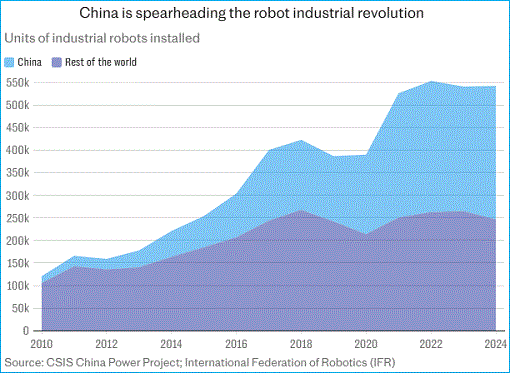
With 295,000 industrial robots in 2024, China already has more installations than every other country in the world put together. Humanoid robots could soon be deployed into China’s industrial production lines – providing a flexible AI workforce – while other robots are already being deployed for security purposes, something which the U.S. wasn’t impressed.
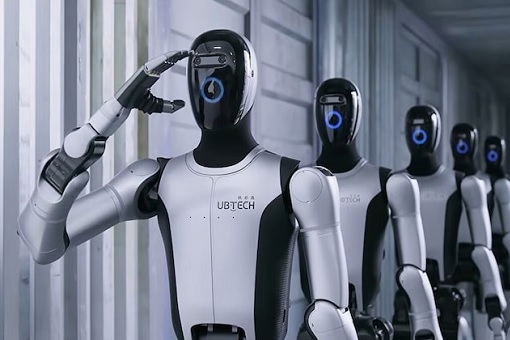
UBTech, a Chinese robotics firm which has shipped hundreds of Walker S2 humanoids to active factories in what it calls the world’s first mass delivery of humanlike robots, has been awarded a US$37 million contract late last year to take on autonomous border patrols, including “conducting inspections”, with its humanoid robots on the border with Vietnam.
In January this year, the world’s largest plane maker Airbus confirmed it had signed a deal with China’s UBTech to trial its robots in its aircraft factories. The partnership comes after a deal last year that UBTech inked with U.S. semi conductor maker Texas Instruments. Production capacity for its industrial humanoid robots is expected to exceed 10,000 units in 2026.
Critics upset – and jealous – with China’s latest robotic dance motions may say stage performance does not equate to industrial robustness, and argue what the robots did was the result of being trained for a routine “hundreds or thousands of times”. The burning question is can the Western robots do the same? “People outside China underestimate China, but China is an ass-kicker next level,” – Musk said last month.
Other Articles That May Interest You …
- U.S. Factory Can’t Compete With Chinese On American Soil
- Project Vault – Trump Copying China’s Critical Minerals Strategy
- Strategy Shift – Trump’s Decoupling Europe Rather Than China
- Adding Fuel To Fire – Why Russia Cheers Trump’s Greenland Grab
- US Soybean Farmers Panicking – China Not Buying, Trump Has To Bailout
- SCO Summit – U.S. Terribly Upset Over Car Rides, Hand-Holding & Jokes Sharing Between Xi, Putin And Modi
- China Too Strong For U.S. – Why Europe In Trouble As Trump Shifts Target To Bully EU With 50% Tariff Threats
- Trump Has Already Lost His Trade War Against China – But He Can’t Find Ways To Climb Down And Save Face
- Pawns Europe & Ukraine Got Played – The Hidden Message Behind US-Russia Talks In Saudi Without Allies
- China Secretly Hiding Tonnes Of Gold – The Buying Spree In Preparation Of Trade War, Sanctions Or Even Invasion Of Taiwan
- Biden Blinked – Huawei CFO Sabrina Meng Returns Home, US-DOJ Dropped Extradition Request

|
|
February 24th, 2026 by financetwitter
|


|

|

|

|

|

|




















Comments
Add your comment now.
Leave a Reply