



Just after midnight on May 7, the screen in the Pakistan Air Force’s operations room lit up in red with the positions of dozens of active enemy planes across the border in India. Air Chief Marshal Zaheer Sidhu, who would visit Washington in the aftermath of one of the worst hostilities between Pakistan and India, had been sleeping on a mattress just off that room for days in anticipation of an Indian assault.
New Delhi had blamed Islamabad for backing – even sponsoring – militants who carried out an attack on April 22 in Indian-administered Kashmir that killed 26 civilians. In spite of Islamabad’s denial of any involvement, India had vowed revenge and launched “Operation Sindoor” in retaliation for the terrorist attack, which came in the early hours of May 7 with air strikes on Pakistan.
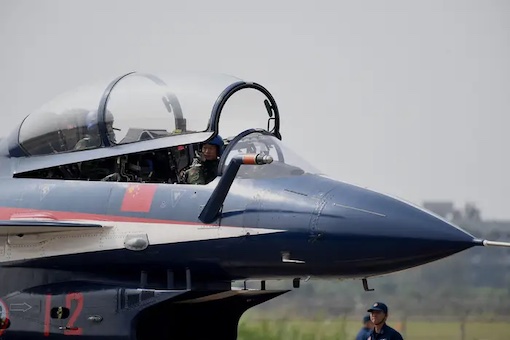
Pakistani Air Force Chief Sidhu ordered Pakistan’s prized Chinese-made J-10C jets to scramble. A senior Pakistani Air Force (PAF) official, who was present in the operations room, said Sidhu instructed his staff to target Rafales, a French-made fighter that is the jewel of India’s fleet and had never been downed in battle. “He wanted Rafales,” – said the official.
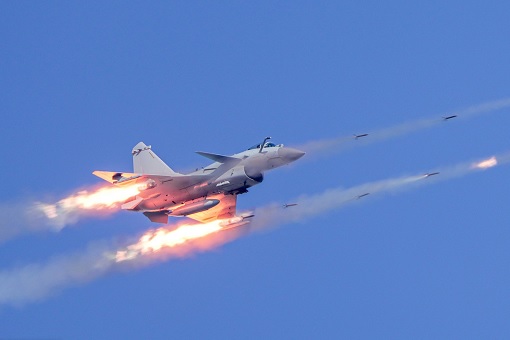
The hour-long fight, which took place in darkness, involved some 110 aircraft, experts estimate, making it the world’s largest air battle in decades. The J-10s shot down at least one Rafale, Reuters reported in May, citing US officials. Its downing surprised many in the military community and raised questions about the effectiveness of Western military hardware against untested Chinese alternatives.
Pakistani Foreign Minister Ishaq Dar told parliament later that day – “Our jet fighters … shot down three Indian Rafales, three Rafales [that] are French. Ours were J-10Cs”. He was referring to the Chengdu J-10 Vigorous Dragon (known as Firebird by NATO), a Chinese multipurpose fighter jet that was untested in an active combat zone until the latest India-Pakistan conflict.
Shares of Dassault, which makes the Rafale, tumbled after news flashed that the fighter had been shot down. Thanks to the conflict, Indonesia, which has outstanding Rafale orders as part of its modernization plan on its ageing fleet of fighters, has said it is now considering purchasing the 4.5-generation J-10s – a major boost to China’s efforts to sell the aircraft overseas.
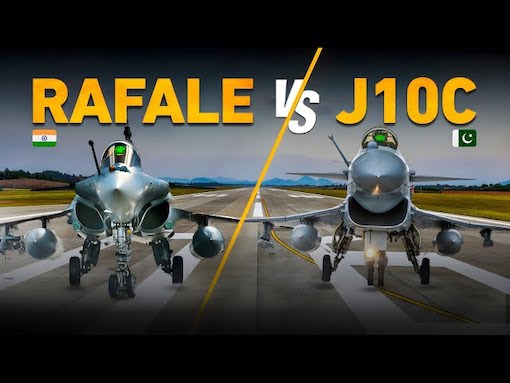
But Reuters interviews with two Indian officials and three of their Pakistani counterparts found that the performance of the Rafale wasn’t the key problem – central to its downing was an Indian intelligence failure concerning the range of the China-made PL-15 missile fired by the J-10 fighter. China and Pakistan are the only countries to operate both J-10s, known as Vigorous Dragons, and PL-15s.
The faulty intelligence gave the Rafale pilots a false sense of confidence they were out of Pakistani firing distance, which they believed was only around 150 km, the Indian officials said, referring to the widely cited range of PL-15’s export variant. “We ambushed them,” – the PAF official said, adding that Islamabad conducted an electronic warfare assault on Delhi’s systems in an attempt to confuse Indian pilots.
“The Indians were not expecting to be shot at,” – said Justin Bronk, air warfare expert at London’s Royal United Services Institute (RUSI) think-tank. “And the PL-15 is clearly very capable at long range.” So, when news spread that bitter enemy Pakistan shot down six Indian aircraft during the four-day conflict, India rubbished the figures, but acknowledged that it had lost “some” of its fighter jets.
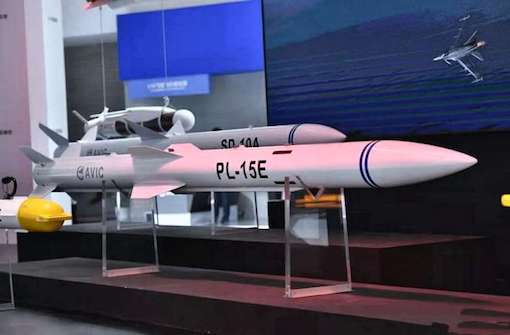
The PL-15 that hit the Rafale was fired from around 200km (124.27 miles) away, according to Pakistani officials, and even farther according to Indian officials. That would make it among the longest-range air-to-air strikes recorded. India’s defense and foreign ministries did not return requests for comment about the intelligence mistakes.
For obvious reasons, Delhi still hasn’t acknowledged a Rafale being shot down, but France’s air chief told reporters in June that he had seen evidence of the loss of that fighter and two other aircraft flown by India, including a Russian-made Sukhoi. A top Dassault executive also told French lawmakers in the same month that India had lost a Rafale in operations, though he didn’t have specific details.
Last month (July 2025), Kerala Congress MP K. Francis George stunned Parliament by disclosing that India lost three Rafales, one Sukhoi Su-30MKI, and one MiG-29 – all reportedly downed within Indian territory. He has also accused Prime Minister Narendra Modi’s administration of covering up the loss of five Indian Air Force (IAF) fighter jets – a deliberate attempt to mislead the Indian public and international partners.
{ Situational Awareness }

Reuters spoke to eight Pakistani and two Indian officials to piece together an account of the aerial battle, which marked the start of four days of fighting between the two nuclear-armed neighbours that caused alarm in Washington. The officials all spoke on condition of anonymity to discuss national security matters.
Not only did Islamabad have the element of surprise with its missiles’ range, the Pakistani and Indian officials said, but it managed to more efficiently connect its military hardware to surveillance on the ground and in the air, providing it with a clearer picture of the battlefield. Such networks, known as “kill chains,” have become a crucial element of modern warfare.
Four Pakistani officials said they created a “kill chain,” or a multi-domain operation, by linking air, land and space sensors. The network included a Pakistani-developed system, Data Link 17, which connected Chinese military hardware with other equipment, including a Swedish-made surveillance plane, two Pakistani officials said.
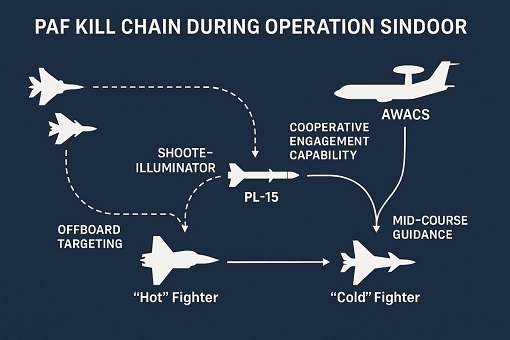
Here’s the secret sauce – the system allowed the J-10s flying closer to India to obtain radar feeds from the surveillance plane cruising further away, meaning the Chinese-made fighters could turn their radars off and fly undetected, according to experts. Pakistan’s military did not respond to requests for comment on this point.
Delhi is trying to set up a similar network, the Indian officials said, adding that their process was more complicated because the country sourced aircraft from a wide range of exporters. The kill chain process involves a series of steps, from initial detection of a threat to the application of force or other means to neutralize it. Just imagine using Google Map which shows you various routes available to reach your destination.
The chain may have started with a Pakistani ground radar – “maybe a surface-to-air missile system, or some other type of radar system” – which “illuminated the Indian target.” Then, a Pakistani J-10C fighter “launched its missiles, probably at range, and finally, an airborne early warning and control aircraft used a midcourse datalink to update and guide the missile to the Indian fighter.”
Retired UK Air Marshal Greg Bagwell, now a fellow at RUSI, said the episode didn’t conclusively prove the superiority of either Chinese or Western air assets but it showed the importance of having the right information and using it. “The winner in this was the side that had the best situational awareness,” – said Bagwell.
{ Change In Tactics }
After India in the early hours of May 7 struck targets in Pakistan that it called “terrorist infrastructure,” Sidhu ordered his squadrons to switch from defense to attack. Five PAF officials said India had deployed some 70 planes, which was more than they had expected and provided Islamabad’s PL-15s with a target-rich environment. India has not said how many planes were used.
The May 7 battle marked the first big air contest of the modern era in which weaponry is used to strike targets beyond visual range, said Bagwell, noting both India and Pakistan’s planes remained well within their airspaces across the duration of the fight. Five Pakistani officials said an electronic assault on Indian sensors and communications systems reduced the situational awareness of the Rafale’s pilots.

The two Indian officials said the Rafales were not blinded during the skirmishes and that Indian satellites were not jammed. But they acknowledged that Pakistan appeared to have disrupted the Sukhoi, whose systems Delhi is now upgrading. Other Indian security officials have deflected questions away from the Rafale, a centerpiece of India’s military modernization, to the orders given to the air force.
India’s defense attaché in Jakarta told a university seminar that Delhi had lost some aircraft “only because of the constraint given by the political leadership to not attack (Pakistan’s) military establishments and their air defenses.” India’s chief of defense staff Gen. Anil Chauhan previously told Reuters that Delhi quickly “rectified tactics” after the initial losses.
After the May 7 air combat, India – humiliated – began targeting Pakistani military infrastructure and asserting its strength in the skies. Its Indian-made BrahMos supersonic cruise missile repeatedly sliced through Pakistan’s air defenses, according to officials on both sides. From the beginning, India’s air force is bigger than Pakistan, therefore, for India to lose even one piece of Rafale is unacceptable.
On May 10, India said it struck at least nine air bases and radar sites in Pakistan. It also hit a surveillance plane parked in a hangar in southern Pakistan, according to Indian and Pakistani officials. A ceasefire was agreed later that day, after U.S. officials held talks with both sides.
{ Live Inputs }
In the aftermath of the deadly conflict, India’s deputy army chief Lt. Gen. Rahul Singh accused Pakistan of receiving “live inputs” or real-time intelligencefrom China during the battles, suggesting radar and satellite feeds that gave away key Indian positions. He did not provide evidence and Islamabad denies the allegation. Day later, however, India’s Chief of Defence Staff Gen Anil Chauhan played down Chinese’s support for Pakistan.
When asked at a July briefing about Beijing’s military partnership with Pakistan, Chinese Foreign Ministry spokesperson Mao Ning told reporters the work was “part of the normal cooperation between the two countries and does not target any third party.” Beijing’s air chief Lt. Gen. Wang Gang visited Pakistan in July to discuss how Islamabad had used Chinese equipment to put together the “kill chain” for the Rafale, two PAF officials said.

China did not respond when asked about that interaction. The Pakistani military said in a statement in July that Wang had expressed “keen interest in learning from PAF’s battle-proven experience in Multi Domain Operations.” Beijing would rather play dumb and pretend to be weak than to offend Pakistan or India, treating the northern border as a “live lab” to test its weapons supplied to Pakistan.
Other Articles That May Interest You …
- Ukraine War – China’s Military Support For Russia Would Be Really Bad News For U.S. & Allies
- Proof British Navy Blew Up Nord Stream – PM Truss Sent Text Message “It’s Done” To Secretary Of State Blinken After Attacks
- Europe’s Fake Solidarity Cracking – Panic & Social Unrest Began As Putin Says “No Gas” Until Sanctions Lifted
- Moscow & Beijing Laughing All The Way To The Bank – How China Makes Easy Money Reselling Russian Gas To Europe
- The Worst Is Not Over Yet – Why Inflation & Recession Are Still Alive And The Global Economy Is Still In Bad Shape
- US Could Only Watch As China Harass Taiwan – South Korea President’s Refusal To Meet Pelosi Shows Split Within U.S. Allies
- A Shift In Propaganda To Damage Control In Washington – Why President Biden & Western Media Making U-Turn Now
- Economic & Financial Meltdown Is Here – All Signs Lead To Recession, Stagflation, Jobless And A Repeat Of Dot-Com Bust
- Russia Cuts Off Gas To Poland & Bulgaria – European Gas Jumps 24% As Putin Starts Punishing “Unfriendly Countries”
- From Wheat To Oil & Gas – How Russia Invasion Of Ukraine Affects Europe’s Food Supply, And Even Your Loaf Of Bread
- Warning To The U.S. – China Fires Nuclear-Capable “Aircraft-Carrier Killer” Ballistic Missiles In South China Sea

|
|
August 2nd, 2025 by financetwitter
|


|

|

|

|

|

|























Comments
Add your comment now.
Leave a Reply