



Residents were already struggling to flee within a 20-minute evacuation time. But the flames surged 32 storeys in just 5 minutes at Hong Kong’s Wang Fuk Court, a massive housing complex in Hong Kong’s Tai Po district, at 14:51 local time on Wednesday (November 26). As night falls on Thursday, more than 24 hours later, the death toll from the blaze climbed to at least 65 people.
By Friday morning, the death toll skyrocketed to 94, before jumped to 128 in the afternoon. With 79 people injured, 16 bodies inside the buildings and hundreds still missing, this is Hong Kong’s worst fire since 1948, when a warehouse blaze killed 176 people. Among the dead is firefighter Ho Wai-ho, 37, who was with the service at Sha Tin Fire Station for nine years. The blaze easily surpassed the toll of the August 1962 fire in the Sham Shui Po district which killed 44.
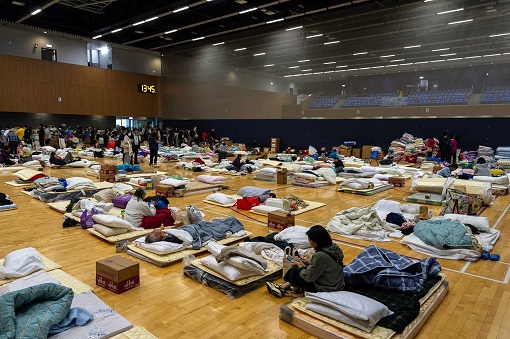
Within 40 minutes of the fire first being reported, it was declared a level four, but by 18:22, about three and a half hours later, the level was raised again to level five – the highest in severity. A whopping 2,311 firefighters, 391 fire engines, 188 ambulances and some 400 police officers were deployed. The disaster saw about 900 people taking shelter in nine emergency centres, with an army of 250 doctors and 250 other medical professionals mobilized to assists the affected residents.
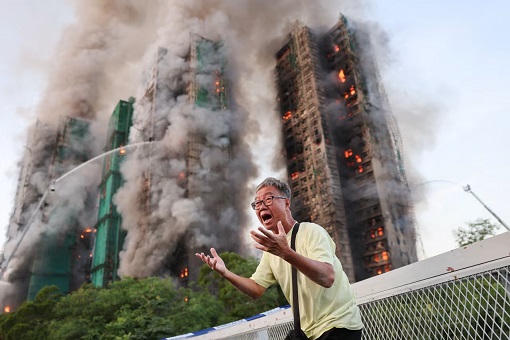
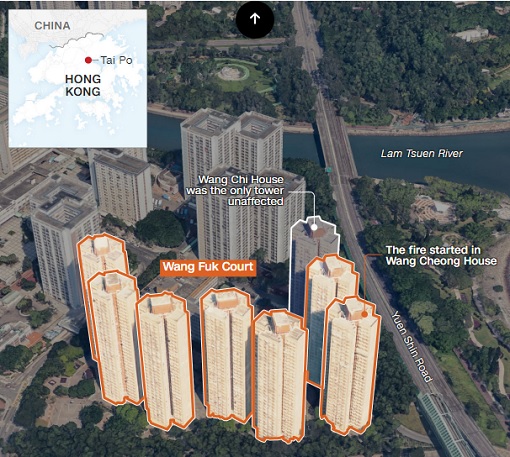
At least 55 survivors have been rescued by firefighters. Wang Fuk Court consists of eight tower blocks. Built in 1983, the tower blocks were undergoing renovations when the fire broke out – and started in “Block F”, The complex comprises 1,984 apartments for some 4,600 residents. Nearly 40% of the 4,600 people who lived there are at least 65 years old, making evacuation even more challengeing.
Some residents say the fire alarms in the building did not go off. Kiko Ma, who owns an apartment at Wang Fuk Court, says the alarms had been turned off amid renovation works, as construction workers regularly used fire escapes to get in and out of the building. She said that residents often saw construction workers smoking and found cigarette butts along their window ledges.
John Lee, the city’s leader, said on Thursday the fires were “basically under control.” But live video footage shows pockets of fires still burning through apartment windows, whilst black smoke was still billowing from the charred remains of several high-rise buildings on Thursday night. Lee said each household affected by the blaze will receive 10,000 Hong Kong dollars (about US$1,200) in relief funds from the government.
Hong Kong is also establishing an assistance fund for the housing estate, worth 300 million Hong Kong dollars (US$38.5 million). But financial help has just begun. A wave of donations followed comments from President Xi Jinping, who urged all-out efforts to reduce casualties and rallied relevant authorities and parties to provide “necessary support.”
Chinese private firms quickly pledged tens of millions of dollars to support rescue and relief efforts. Alibaba Group and its affiliate Ant Group together committed 30 million Hong Kong dollars to support fire relief efforts. Alibaba founder Jack Ma, one of the most recognizable Chinese entrepreneurs, also pledged US$30 million through his charity foundation to provide emergency aid to those affected.
Sportswear maker Anta, which owns brands such as Jack Wolfskin and Fila, said it would donate HK$30 million in cash and equipment. Tencent Holdings, Xiaomi Corp, BYD, Lenovo, Geely and ByteDance each pledged HK$10 million to aid the rescue efforts and support victims of the blaze. Still, the burning question is what caused the fire and how did it spread so quickly.
While the cause of the fire is unknown, a preliminary investigation found that the rapid speed at which it spread was unusual. Police say a mesh material and plastic sheets were found on the outside of the buildings – both of which are not believed to be fireproof. Styrofoam was also found on the building’s windows – and that, together with the other construction materials is likely to have caused the flames to spread so fiercely.
As a result of the “grossly negligent”, Hong Kong’s police have arrested three men who worked for a construction company, aged between 52 and 68, on suspicion of manslaughter in relation to the fire. Two of them are directors of a construction firm while the other is an engineering consultant. A police spokesperson said investigators were looking into the alleged actions, or failure to act.
The Independent Commission Against Corruption (ICAC), Hong Kong’s statutory anti-graft body, announced on Thursday that it had set up a dedicated task force “given the significant public interest in this matter.” Officials are investigating “potential corruption” linked to the major renovations at Wang Fuk Court. Authorities will also investigate whether building materials complied with fire safety standards.
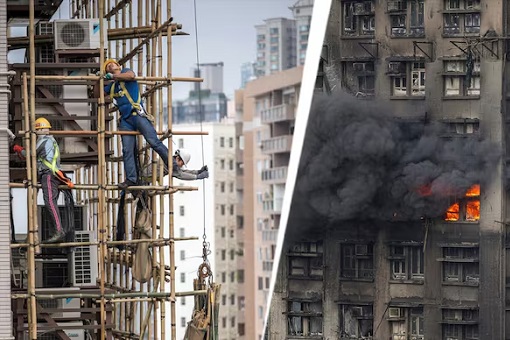
The deadly blaze has also sparked a debate over Hong Kong’s centuries-old use of bamboo scaffolding – an ancient construction technique that dates back to the Han dynasty and is still widely used in the city. Although bamboo is celebrated for its flexibility and low cost, construction experts are once again questioning the use of this flammable material in building projects.
These scaffolds are erected on buildings hundreds of feet high and wrapped in fabric safety nets forming colorful cocoons of green, blue and purple. Bamboo is not only used in the construction of new buildings, but also in the renovation of thousands of historic tenements (“tong lau”) every year – making it an essential construction material in Hong Kong.
Officials said the blaze may have started on a section of bamboo scaffolding encasing the complex, which then spread to other buildings through the wooden poles and protective netting – prompting public scrutiny of the city’s housing standards. John Lee, Chief Executive of Hong Kong, said the government will inspect all bamboo scaffolding in the city, and official bodies will meet to discuss a move to metal scaffolding.
While Hong Kong’s current dry season could easily ignite a disaster, it didn’t help that the blocks at Wang Fuk Court were “relatively old” – built in the 1980s – so “the glass windows are not fire resilient“. Unlike modern buildings which have double pane glass windows, the old one used just a single pane, allowing the flames to easily penetrate through the façade.
It’s not rocket science that the fire is not only preventable, but also “man-made”. And it’s not hard to understand whyanger is already swelling among Hongkongers about the causes of the fire. It was already bad that the social anxiety in Hong Kong has been about affordable housing, where sky-high property prices mean that many people live in tightly packed high-rise apartments that can become death traps when disaster strikes.
It becomes worse when nobody is taking responsibility, with even the government led by John Lee is busy playing the blaming game – pointing finger at bamboo. The angry people think that blaming bamboo – which the government has already pledged to phase out from public construction works – deflects responsibility from the actual cause of the fire.
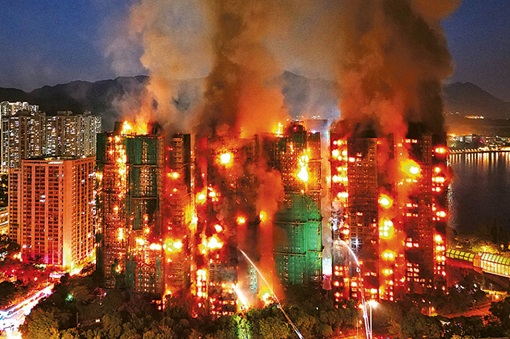
In reality, residents had complained for months about shoddy behaviour from the construction company. Last year, in response to complaints, an email from the incompetent and clueless Hong Kong Labour Department gave a lame excuse that because the renovation works didn’t involve open flames, “the risk of fire from the scaffolding is relatively low”.
In fact, people living at Wang Fuk Court had raised concerns over maintenance activity in September 2024, including about the potential flammability of the protective green mesh contractors had used to cover the bamboo scaffolding raised around the buildings. But the authorities told residents the material’s “flame-retardant performance” met standards, only for the Hong Kong police to declare how that they do not.
It doesn’t matter whether the cause of fire could be from a cigarette butt or a spark from welding works. With dry season, a small fire which may have started on a section of bamboo scaffolding encasing the complex could easily spread like wildfire to other buildings through the wooden poles and protective netting. Highly inflammable foam material, protective mesh sheets and plastic that may not have met fire standards would just add fuel to the fire.
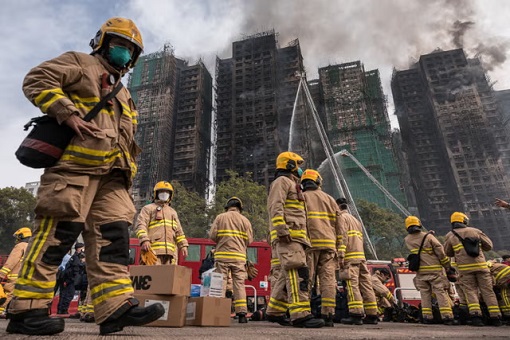
As temperature of the fire reached 500-Celcius (932-Fehrenheit) at its peak, the tightly packed high-rise apartments would easily catch fire from the heat alone (just like how a roast chicken or duck is being made) and became death traps without sufficient air circulation. That’s why helicopter and drone were not used to help extinguish the fire.
Traditionally, Hong Kong has held open inquiries into major tragedies, often headed by an independent judge. Now, the people aren’t sure anymore due to the perception that Hong Kong’s judiciary is no longer independent, especially on matters which are critical of the government. Since Beijing’s sweeping crackdown on the pro-democracy movement in Hong Kong, trust in the authorities is low.
Prestige, which secured a HK$330 million (US$42.4 million) renovation contract for the complex in January 2024 would be in trouble. But the fact that the renovation works continued despite the Labour Department having issued six improvement notices to the contractor over its work at the complex and even initiated three prosecutions speaks volumes that corruption was involved.
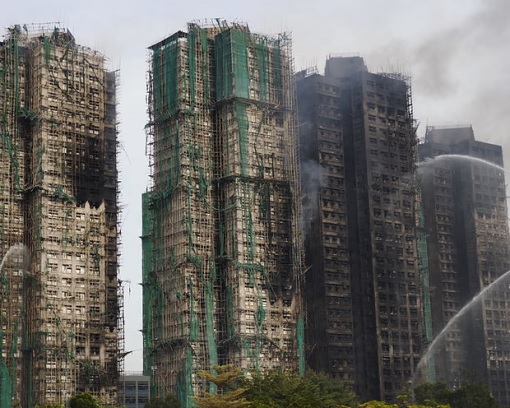
Interestingly, management of Wang Fuk Court told the homeowners’ committee in October 2025 that among the items needing repair or maintenance in the complex were fire water inlets, hose components such as fire nozzles, fire alarm bells, fire extinguishers and fire hose reels, as well as lighting fixtures with batteries.
Other Articles That May Interest You …
- Covid-19 Third Wave – The 3 Deadly Mistakes From Hong Kong That Every Country Should Avoid
- Kowtow To China? – Cook Explains Why Apple Removed A Popular App Used By Hong Kong Protesters
- Hong Kong’s 2-Million Sea Of Black – Here’s How Protesters Hide Their ID From Surveillance
- A New Record Of Online Love Scam – This Hong Kong Businesswoman Lost HK$180 Million
- Revealed!! – Britain’s Evil Plan In Denying Hong Kong People Nationality Before 1997 Handover
- Land Of Gold – 1,300 Buyers Trying Their Luck On 4 Mini Flats In Hong Kong
- Losing Faith In China & Hong Kong – Superman Li Ka-shing To Sell “The Center”
- Biggest Loser – Hong Kong Businessman Scammed HK$58 Million
- China vs Hong Kong Rivalry – These 22 “Naughty” Graphics Tell All
- Can You Solve This Hong Kong Exam Question For 6-Year-Old, In 20-Seconds?
- Here’s How Hong Kong Chief, CY Leung, Uses Gangster & Police To Break Protesters

|
|
November 28th, 2025 by financetwitter
|


|

|

|

|

|

|
























Copilot gives very different figures from yours:
In the deadly Tai Po fire at Wang Fuk Court, the Hong Kong Fire Services Department deployed 767 fire and ambulance personnel, 128 fire engines, and 57 ambulances.
Breakdown of the Emergency Response
Personnel:
• A total of 767 staff from the Fire Services Department were mobilized.
• This included both firefighters and ambulance crews working together in rescue and medical support roles.
Fire Engines:
• 128 fire engines were dispatched to the scene.
• These vehicles carried hose lines, equipment, and teams to fight the blaze across multiple blocks.
Ambulances:
• 57 ambulances were deployed to transport the injured and provide on-site medical care.
• Ambulance staff worked in coordination with firefighters to evacuate residents and treat victims.
Additional Equipment:
• Eight hose lines and seven aerial ladder trucks were used to combat flames spreading across scaffolding and multiple buildings.
• 22 search teams were formed to locate and rescue trapped residents.