



For months, many investors had viewed the 4.5% yield on the benchmark 10-year note as an attractive point to step in and buy bonds. But as yields surged through that level, market participants adjusted their view and opinion. Analysts and economists then believed that the 10-year yield was heading to 4.75%. Now even that level has been breached, investors have started preparing for thre worst.
Yields were edging up again on Friday (Sept 11) after briefly dipping following the August inflation report – which bolstered expectations for a rate increase at Wednesday’s Fed policy announcement. U.S. money markets priced an 87% probability that the Federal Reserve will hike rates by 25 basis points on Wednesday – pushing the dollar’s value against a basket of currencies called the DXY dollar index.
The 10-year bond yield was 4.95% around midday Friday, just 5 basis points from the important 5% threshold that represented a danger zone for stocks. It briefly spiked to 4.99% earlier in the day. In early morning Monday (Sept 14), the yield spiked to 4.996. Exactly what makes 5% such a feared threshold among investors?
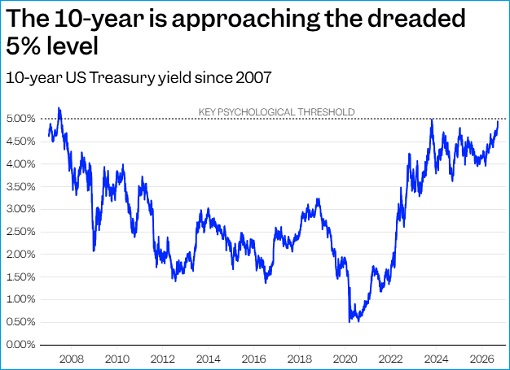
There’s nothing inherently catastrophic about the number itself, but 5% yield has become the level to watch largely because the 10-year yield has rarely broken through that threshold in recent history. Beyond a short-lived bond market freakout in 2023, the last time the 10-year yield rose past 5% was in 2007, in the months leading up to the start of the Great Financial Crisis.
“Traders look at round numbers, and above 5% means that the next stop could be 5.5% and 6%,” – Jose Torres, a senior economist at Interactive Brokers, said. “And in this post-Great Financial Crisis economy, it’s not a yield that’s tolerable for financial markets.” The 20-year and 30-year yields have already breached the 5% mark, but the 10-year, which most directly influences borrowing costs like mortgages and corporate loans, tends to have more “gravitas” in the eyes of investors.
{ How The U.S. Bond Market Works }
A U.S. treasury bond is essentially the U.S. government packaging up its debt and selling it to investors with a promise to pay interest. Investors can buy bonds that mature at different rates – a two-year note will mean an investor gets their money back quicker than a 30-year bond, but typically with lower interest. Think of it like the interest rate the bank pays you when you keep your money in their fixed deposit.
When it comes to measuring the bond market, investors pay attention to the yield rate for each type of bond. The yield is the rate of return that investors who purchase that type of bond can expect to receive once the bond matures, and it fluctuates based on the price of the bond itself. A higher yield rate means more investors are trying to sell off their bonds and are willing to offer more to get it off their hands.
Activity in the bond market provides an insight into how investors are feeling about the US economy, even more so than the stock market, which can get outsized boosts from industries that are doing particularly well, like AI and tech, even when other sectors of the economy are faring less well. Higher yields in the bond market point to concern about not only rising inflation, but also lack of confidence about the U.S. economy.
{ 5% Means Higher Borrowing Costs }
Markets also consider higher borrowing costs a negative in and of themselves. The 10-year yield hitting 5% immediately draws attention to higher mortgage rates and higher funding costs for businesses. Essentially, Americans who have been grappling with the higher cost of living over the last few years now face another issue – elevated costs are here to stay.
The average 30-year average fixed mortgage rate was 6.76% in the last week, according to Freddie Mac data. The rate has increased 60 basis points this year, marching higher alongside the 76 basis-point rise in the 10-year bond yield. The effective yield on the ICE Bank of America US High Yield Index, a reflection of corporate borrowing costs, also rose to 7.42% in the last week, up 89 basis points since the start of this year.
{ The ‘Danger Zone’ for Stocks }
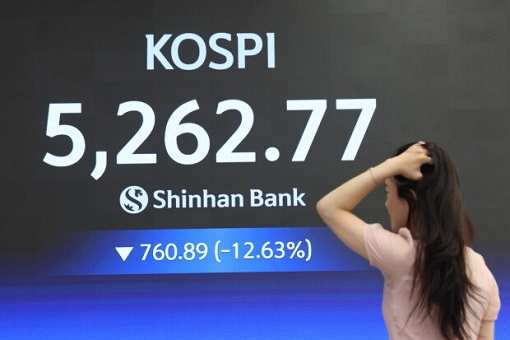
Higher yields have also historically stoked fears about the impact of higher rates on risk assets, like stocks. In a note to clients earlier this year, HSBC said it believed yields were solidly in the “danger zone” when it came to the impact on equities. If the treasury yield breaks above 5%, it would not only cause stresses, but also potentially cause the risk asset space to fall over.
The 10-year U.S. Treasury yield acts as a primary benchmark for borrowing costs and financial asset values, meaning that rising yields typically pressure stock prices down by increasing corporate borrowing costs and reducing the present value of future earnings. The speed at which yields increased mattered more to the impact on stocks than the actual yield itself.
Therefore, the speed at which the 10-year rose from the 4.5% mark is worrying. Financial analysts use the 10-year Treasury yield as a baseline “risk-free rate” in models that calculate what future corporate earnings are worth today. When this yield climbs, the discount rate goes up, which shrinks the calculated present value of a company’s future profits.
U.S. government bonds – known as treasuries – are supposed to be the most stable type of investment vehicle because they are backed by the U.S. government, making them virtually risk-free. So, when the 10-year yield offers a higher guaranteed return, investors may pull money out of riskier stocks and move it into fixed-income bonds.
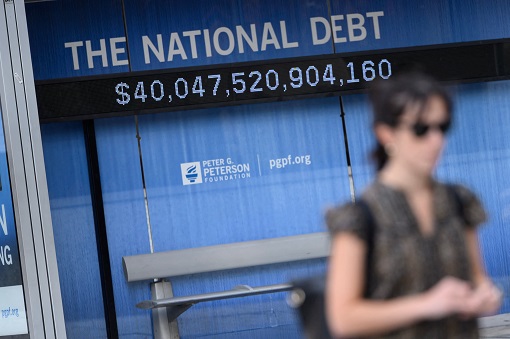
But investor concerns over issues including rising inflation, the continuing war with Iran, and the US’s record national debt have shaken the market and slowed demand for US treasury bonds. Loans for homes, cars and credit cards, along with money businesses borrow to keep things running, could get more expensive if the sell-off in the bond market continues.

{ 5% Means Treasurys Could Crowd Out Corporate Debt }
Yields hitting 5% also fuels concerns that Treasurys will start competing with corporate bonds, which could have negative implications on the AI boom, which is being financed in large part with debt. Higher borrowing costs could skew the economics for AI companies plowing money into the technology at a time when investors are already concerned about the return on soaring capex.
Torres said the pressure on government bonds was intense, given ongoing fiscal and inflation concerns. The only things that could meaningfully lower yields at this point are a long-term resolution with the Iran war, or the Fed beginning substantial quantitative easing, such as by adding around US$50 billion worth of Treasurys to its balance sheet, he speculated.
Some analysts saw the potential for yields to climb to 6% in the near future, which would mark the 10-year highest yield since 2000. The danger period of going from 5% to 6%, if that were to happen in the next couple of months, it would be quite difficult for the market. Such rate could mean the beginning of another “Global Financial Crisis” like the 2007-2008.

Other Articles That May Interest You …
- Global Bond Yields Hit New Highs As Investors Ready For Rate Hikes
- Market Turmoil – Oil Hit $100, Bond Selloff, Stocks Plunge, Grains Skyrocket
- Iran War Reveals How U.S. Sanction Was Easily Evaded Using Yuan
- Paying The Price For Hamas Attacks – How Trump Misled Iran Before Israel Sends 200 Jets To Attack
- Ran Out Of Luck And Place To Hide – Here’s How Israel Trainee Squad Accidentally Killed Hamas Mastermind Sinwar
- Live By The Sword, Die By The Sword – Anwar Madly Angry After BFF Hamas Terrorist Leader Haniyeh Assassinated
- Playing A Dangerous Game – Here’s Why Facebook Removes News Of PM Anwar Meeting With Hamas Terrorists
- Hamas Is Game Over – How The Terror Group Miscalculated, Betrayed, Abandoned And Made More Mistakes
- Careful What You Wish For – U.S. May Slap Economic Sanction On Malaysia For Supporting & Training Hamas Terrorists
- Human Shields – How Hamas Cleverly Wins Propaganda War, But Was Stunned By “Fire Power” Unleashed By Israel
- An Eye For An Eye!!! – No One Can Stop Israel From Reducing Gaza To Rubble And Erase Hamas Terrorists

|
|
September 14th, 2026 by financetwitter
|


|

|

|

|

|

|



















Comments
Add your comment now.
Leave a Reply